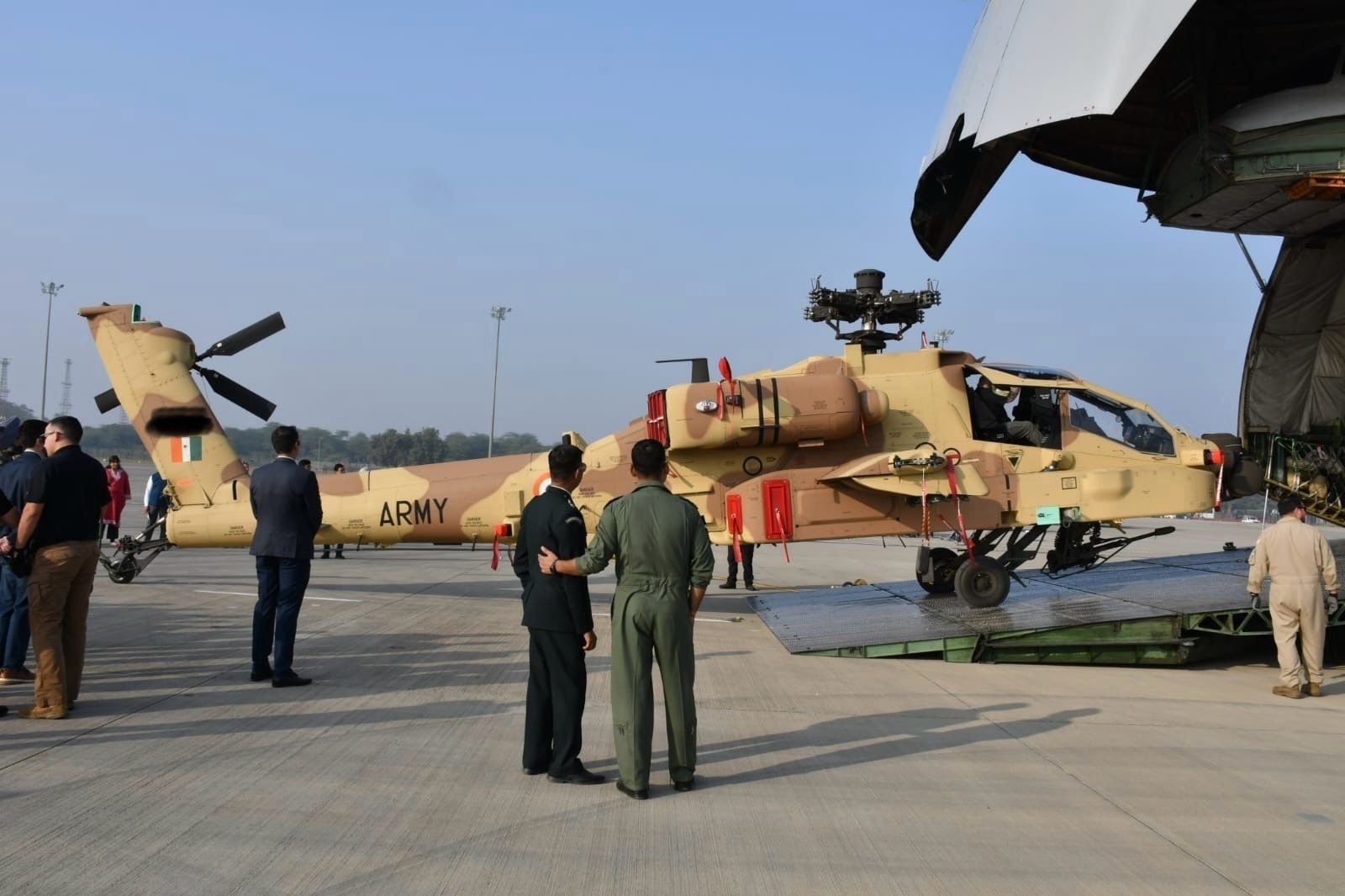

The Indian Army has inducted its second batch of AH-64E Apache attack helicopters, marking another major milestone in India’s aviation modernisation programme and significantly enhancing its precision-strike, close air support, and offensive airpower capabilities. The latest delivery, comprising three helicopters, arrived on 17 December 2025 at Hindan Airbase, where they will undergo inspection, integration, and flight validation before entering operational service.
This delivery is part of the Indian Army’s order for six AH-64E Apache helicopters, acquired to bolster land-force firepower and combat aviation capability. The first batch arrived earlier this year, while the remaining aircraft are scheduled for delivery in 2026.
The Indian Air Force (IAF) currently operates 22 AH-64E Apaches, which entered service under an earlier procurement programme. With both services flying the type, India is emerging as one of the largest Apache operators outside the United States, an important factor in strengthening joint operations, air–land integration, and future theatre command structures.
Regional Security Dynamics: Pakistan and China Fronts
The induction comes at a time of ongoing regional tensions, particularly along India’s borders with China and Pakistan.
The Indian Army has been involved in multiple standoffs and clashes with China along the Line of Actual Control (LAC), especially in eastern Ladakh, where high-altitude aerial reconnaissance and rapid offensive capability remain critical. Likewise, tensions with Pakistan along the Line of Control (LoC) and international border persist, with regular cross-border exchanges and evolving military posturing.
Within this context, the AH-64E fleet offers the Army a decisive edge in high-threat environments, from mountain warfare to armoured confrontation and close air support roles.
Supporting Joint Operations and Future Theatre Commands
The new Apache platforms are also expected to play a central role in India’s ongoing transition toward joint operational structures and integrated theatre commands. Operating alongside IAF Apache squadrons, the Army’s AH-64Es will support joint targeting, reconnaissance, air–land battle coordination, and rapid strike missions under unified command frameworks.
Their ability to share real-time battlefield data, integrate with ground-based command networks, and conduct synchronised operations will significantly enhance interoperability across land and air domains, a key requirement for India’s future theatre command architecture.
AH-64E Apache: Capabilities and Combat Value
The AH-64E Apache is regarded as one of the world’s most advanced multi-role attack helicopters, purpose-built for anti-armour warfare, precision strike, deep attack, and armed reconnaissance.
Key features include:
-
AN/APG-78 Longbow fire control radar, enabling near-instantaneous detection, classification, and engagement of targets
-
Hellfire missiles, rockets, and air-to-air capability for layered offensive options
-
Advanced avionics, sensor fusion, and target acquisition systems for high-fidelity situational awareness
-
Composite rotor design improving performance, lift, and endurance
-
Network-centric data link architecture, allowing direct mission coordination and real-time information exchange across platforms
These capabilities are particularly suited to the Indian Army’s high-altitude operational requirements, armoured thrust missions, and mobile strike concepts.
Strategic and Modernisation Outlook
The Apache induction complements India’s broader aviation modernisation strategy, which includes expanding unmanned capabilities, enhancing surveillance assets, and increasing indigenous aircraft production. The AH-64E is expected to serve alongside platforms such as the Prachand Light Combat Helicopter (LCH), offering multiple mission profiles and greater tactical flexibility.
Analysts note that the Apache fleet will also strengthen India’s ability to conduct swift offensive manoeuvres, deter adversaries across two active fronts, and improve rapid-reaction capability in volatile border environments.