In geopolitics, the power is rarely announced before it is exercised. It is first organised through a strategy and signalled through a posture and then legitimised through an action. Alfred Thayer Mahan understood this dynamic well when he argued that control of the seas is not merely about battleships but about geographical position, maritime commerce, overseas bases and the political will or vision to dominate the naval domain. India is increasingly aligning itself with Mahanian’s understanding of the Indian Ocean Region (IOR). India’s Double Fish Hook Strategy can be analysed through the Mahanian strategic lens. It is not simply a counter strategy to so-called China’s String of Pearls strategy, as often framed, but a conscious and strategic move with a bigger vision of maritime dominance in the Indian Ocean Region through a sea control posture based on Mahanian logic of “Whoever controls the Indian Ocean will dominate Asia, the destiny of the world will be decided on its waters”.
The IOR has a distinct maritime geography because it is a closed ocean surrounded by three continents Africa, Asia and Australia and it is accessible only through critical maritime chokepoints such as the Strait of Hormuz, Bab el-Mandeb and the Strait of Malacca, unlike other oceans. It carries the majority of the world’s energy flows and trade routes and around 80 percent of the world’s maritime oil trade passes through the IOR. These choke points are of immense strategic importance as they handle huge volumes of trade.
Double Fish Hook Strategy and Sea Control
The Double Fish Hook Strategy is not an official doctrinal term. It represents the conceptual interpretation of India’s strategic behavioural pattern in the Indian Ocean Region, aimed at achieving sea dominance and countering China’s strategy to influence the region. The “hooks” represent arcs of influence that explain India’s expanding maritime footprint on both flanks of the Indian Ocean. There are two hooks, one on the eastern IOR and the other on the western IOR. Both hooks display the structural or strategic moves by the political elite and the strategic intellect of India to dominate the IOR, which creates a double fish hook-like pattern on the map of the IOR. A central misinterpretation about this strategy is that it exists solely to counter China’s String of Pearls. But under the rationalization of countering the “String of Pearls,” India is accelerating its pursuit of dominance in the IOR.
India’s Relations with Small Island Developing States (SIDS) play a crucial role in operationalizing the sea control posture as well as containing China’s commercial and security influence over the IOR. Islands are not ignored in maritime strategy, they are the pivots of sea control. Control over islands translates into control over sea lanes, chokepoints, surveillance and logistical depth. India’s engagement with island states in the Indian Ocean is therefore not symbolic but strategic.
The Eastern Hook of ‘Double Fish Hook Strategy’ covers all the maritime chokepoints that connect the Indian Ocean with the Pacific Ocean, which are the Strait of Malacca, the Straits of Lombok and Sunda. It starts from the Andaman and Nicobar Islands, then goes to Sabang port in Indonesia, then to the Cocos (Keeling) Islands of Australia and ends in the Diego Garcia Islands, which are controlled by the US. India has strategically covered both chokepoints. It has a proper Andaman and Nicobar Command, which is a tri-service command, having upgraded airfields, logistics systems and a well-equipped Intelligence, Surveillance and Reconnaissance System (ISR). The geographical location of the Andaman and Nicobar Islands gives significant strategic leverage to India, as they lie at the mouth of the maritime chokepoint, the Strait of Malacca, and the influence of China in Myanmar can be easily counterbalanced through these islands.
India signed a mutual agreement with Australia on mutual logistic support, MLSA, in June 2020. In this regard, India has access to the facilities of Australia’s Cocos Islands, located in the centre of the narrow Sunda and Lombok straits, the alternative trade route of the Strait of Malacca. This eastern hook ends at Diego Garcia Island, which is controlled by the US. India and the US also have agreements related to combined logistics and surveillance in the IOR, including LEMOA, COMCASA and BECA.
The Western Hook of this strategy has two contested choke points, the Strait of Hormuz and the Bab el-Mandeb. It originates from Chahbahar Port in Iran, on which India has been heavily investing to counterbalance China’s influence in Gwadar Port, Pakistan. The next strategic station lies on the edge of the Strait of Hormuz, on one side and on the other side is the Bab el Mandeb, near the Duqm Port of Oman. It is the most crucial choke point at the crossroads of the global oil trade route. By getting naval access to Duqm Port, the power projection in the IOR is enhanced. The Assumption Island of Seychelles lies on the opening of the Mozambique Channel from where the sea communication lines extend to the Cape of Good Hope, which is also a choke point, especially when a crisis escalates in the Red Sea or Suez Canal region.
India inaugurated a 3,000-meter runway on Agalega Island, Mauritius, in 2024, which is essentially a military base capable of handling Navy P-8I Poseidon anti-submarine warfare aircraft (ASW). This means India will have the logistical and ISR facilities. Reunion Island is still governed by France, located next to Mauritius. India and France have a comprehensive Joint Strategic Vision for Cooperation in the Indian Ocean Region (IOR). The western hook ends on Chagos Island, for which India has been supporting Mauritius for a long time against the UK, and now it is the territory of Mauritius. Recently, in October 2025, India secured an agreement from the government of Mauritius to strengthen maritime security and enhance defence cooperation in the Chagos Archipelago. The western hook can be a strategic move to contain China’s growing partnership with African States, as well as to promote Indian geo-economic interests on the African continent.
Naval Modernization and Sea Control
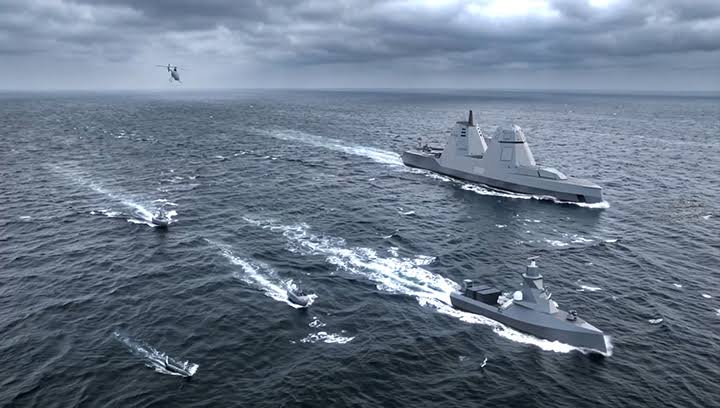
The shift in the Indian posture is reflected in investments in naval modernization, such as aircraft carriers, submarines and maritime surveillance systems. In contemporary naval strategy, the Aircraft carrier is the central figure of a sea-control posture. It is the core strategic asset through which a state can ensure sea dominance. It often serves as an instrument of military might and global ambitions. India has INS Vikramditya and INS Vikrant, currently operational. INS Vikrant (IAC-I), designed and built in India, was commissioned in 2022, and INS Vishal (IAS-II), an indigenous Aircraft carrier, is expected to join the fleet by 2030. India has 13 destroyers, equipped with cutting-edge technology as well as supersonic BrahMos Cruise Missiles and Barak Missiles. India has INS-Arihant ballistic missile nuclear submarine, commissioned in 2016, India’s first operational SSBN. The INS Arighat is expected to be commissioned by the end of 2024. India’s SSBN force has evolved from INS Arihant to more capable Arighat, Aridhaman and future S4/S5-class submarines with enhanced stealth and strike range. This kind of modernization in the Indian Navy shows the other side of the mirror, which reflects India’s vision of becoming a regional hegemon in the maritime domain.
India’s Double Fish Hook Strategy along with Naval Modernizations reflects a deliberate Mahanian pursuit of sea control along with the counter strategy to China’s String of Pearls. By accelerating its influence in islands, chokepoints, naval modernisation and logistics agreements like: Logistic Exchange Memorandum of Agreement (LEMOA), Communication Compatibility and Security Agreement (COMCASA), Basic Exchange and Cooperation Agreement (BECA) Reciprocal Exchange of Logistics Support (RELOS) agreement with Russia, Mutual Logistics Support Agreement (MLSA) with Australia and a Joint Strategic Vision for Cooperation in the IOR with France, India is institutionalizing maritime dominance across the IOR. This depicts that the evolving posture of India is to be a sea hegemon of Indian Ocean Region IOR.

Javaria Shaikh
Javaria Shaikh is a PhD scholar in International Relations at the School of Integrated Social Sciences, University of Lahore. She also serves as a Research Associate at the Maritime Centre of Excellence, Lahore, Pakistan. She has published extensively in both national and international outlets. Her research interests include defence and strategic studies, nuclear deterrence, and arms control.

Suffian Zafar
Suffian Zafar is a Mphil Scholar of International Relations at the University of Punjab, Lahore. He is currently working as a Junior Research Fellow at the Maritime Centre of Excellence MCE. His Gmail address: suffianzafarmce@gmail.com.