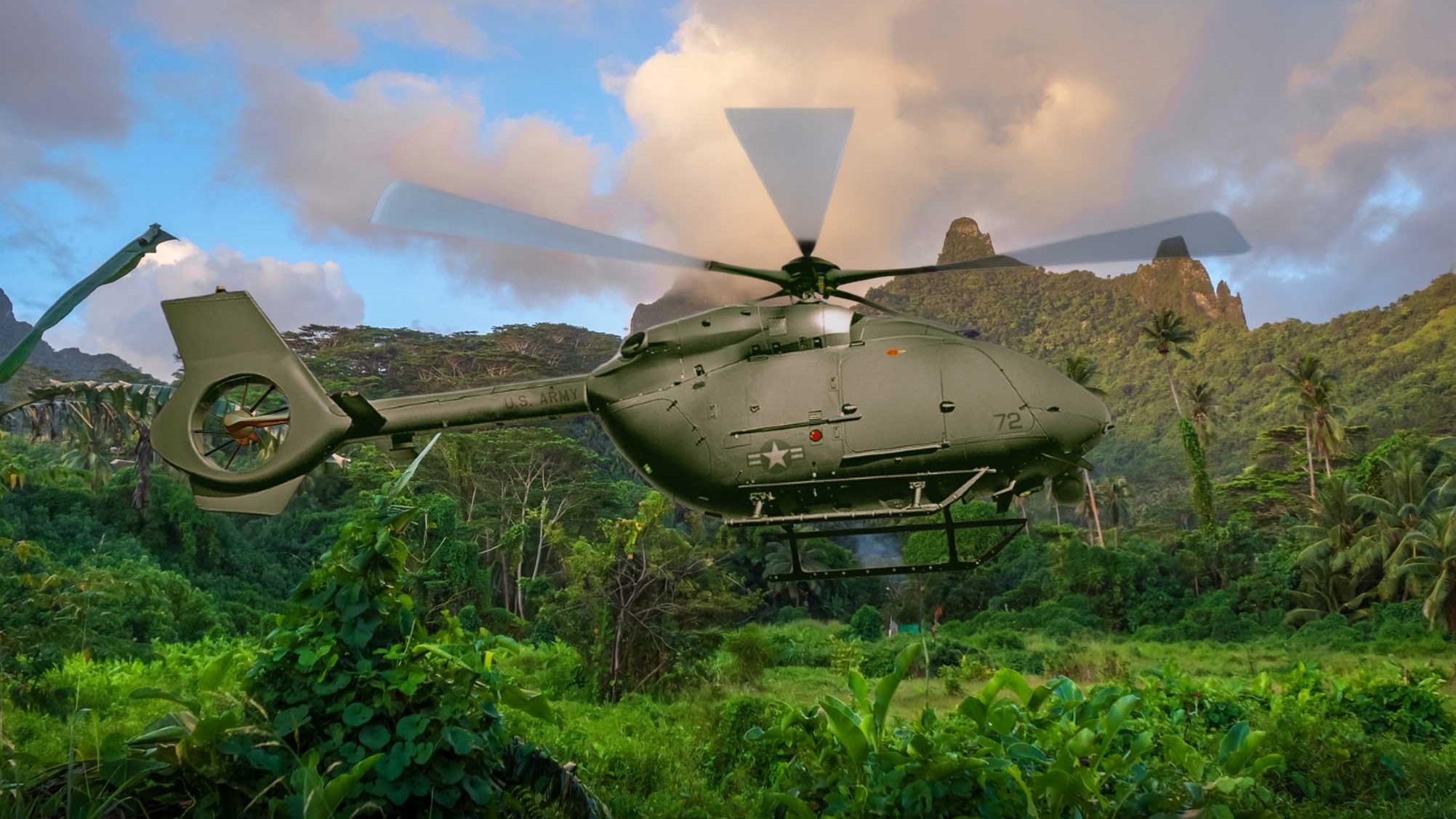

The United States Marine Corps’ push toward autonomous logistics in contested environments has taken a significant step forward, following the successful fourth autonomous flight test of the MQ-72C Lakota Connector under the Aerial Logistics Connector (ALC) program. Developed through a collaboration between Airbus U.S. Space & Defense, L3Harris Technologies, Shield AI, and Parry Labs, the test marked the first time all partner technologies operated together aboard an H-145 platform, demonstrating fully autonomous flight, obstacle avoidance, and safe landing in realistic operational conditions.
The MQ-72C, an autonomous variant of the UH-72 Lakota, reflects a strategic shift toward unmanned, scalable, and cost-effective logistics solutions designed to sustain distributed forces. As modern battlefields become increasingly contested, the platform is intended to reduce risks to personnel while ensuring uninterrupted supply chains. Built on an existing airframe with an active U.S. production line, the system leverages a Modular Open Systems Approach (MOSA), enabling rapid integration of new technologies, including signals intelligence payloads and future mission systems.
Table of Contents
ToggleAutonomous Logistics Strengthens Operational Flexibility
The ALC program emphasizes adaptability and rapid deployment, key requirements for the Marine Corps’ evolving operational concepts. By integrating advanced autonomy software with a proven helicopter platform, the MQ-72C offers a low-risk pathway to operational deployment while maintaining scalability across joint force requirements. Its open architecture ensures continuous upgrades, allowing the system to evolve in response to emerging threats and mission needs.
This capability is particularly critical in denied or high-risk environments where traditional logistics operations face significant challenges. Autonomous aerial resupply platforms like the MQ-72C enable sustained operations without exposing pilots or crew to hostile conditions, reinforcing operational resilience and mission continuity.
L3Harris Enables Digital Backbone for System Integration
A central component of the MQ-72C’s success lies in its integrated digital architecture, led by L3Harris Technologies as the system integrator. The company provides the core mission systems that unify multiple technologies into a cohesive, combat-ready platform. Leveraging decades of expertise in aircraft integration, electronic warfare, and communications, L3Harris ensures seamless interoperability between autonomy software, sensors, and payload systems.
The platform-agnostic integration model allows rapid addition of new capabilities without extensive redesign, significantly reducing development timelines and operational risk. This approach aligns with broader U.S. Department of Defense objectives to accelerate innovation and field adaptable, network-enabled systems capable of meeting dynamic battlefield requirements.
Future of Contested Logistics
As military operations increasingly prioritize distributed force structures and operational agility, autonomous logistics platforms are emerging as a decisive enabler. The MQ-72C Lakota Connector represents a scalable and adaptable solution designed to operate in complex and contested theaters, where traditional supply chains may be disrupted.
With continued testing and integration, the ALC program is expected to play a critical role in shaping the future of military logistics. By combining autonomy, open architecture, and proven aviation platforms, the initiative positions the Marine Corps to maintain operational superiority in environments defined by distance, denial, and disruption.