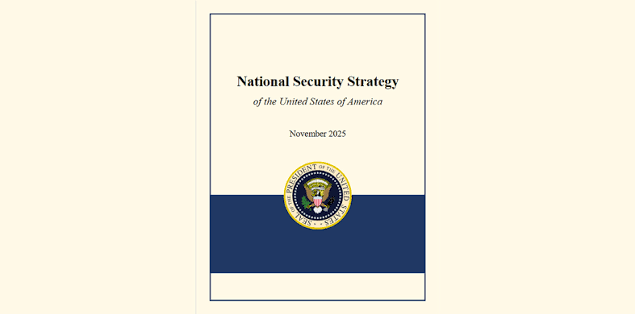

The US National Security Strategy (NSS) 2025 outrightly criticizes earlier Presidential administrations’ policy focus on global interventionism and offers a realist and interest-driven policy framework. The NSS 2025 specifies that the key priorities for Trump Administration include ensuring homeland security and management of borders, renewed focus towards Western Hemisphere through restoration of Monroe Doctrine, pursuing economic security through reindustrialization and securing supply chains and containing China’s economic and military rise in the Indo-Pacific. The NSS emphasises that rather than engaging globally as an ‘international policeman,’ the Trump administration will use selective engagement only to protect direct interests, where involved. It signifies a sharp strategic turn for US foreign policy that has been traditionally based on aspirations for permanent US domination across the globe. Conversely, the NSS 2025 narrows down the US ambitions which now appear more transactional and inward-looking, as domestic stability is given equal importance as compared to other security issues like foreign defence. Nevertheless, the document calls for strengthening military capabilities by asserting dominance in domains like artificial intelligence, space and other cutting-edge technologies.
China is not defined as the “primary threat,” rather more as an economic competitor and a source of supply chain vulnerabilities. The 2017 NSS termed this great power rivalry as “a geopolitical competition between free and repressive visions of world order”. Contrary to previous notions, the 2025 NSS has downplayed ideological framing of this rivalry. Rather than seeing Beijing as a systemic threat to liberal international order, Washington views it more as a practical problem that requires response across domains. Recognizing China’s exponential economic growth and its ability to effectively adapt to US tariffs approach, NSS commits to rebalance economic relationship with China. On military front, it underscores the need to deny ‘aggression’ in First Island Chain and urges allies to step up and share burden in this broader endeavour. This could mean intensifying military pressure around China. In context of renewed perception of adversary in Washington DC, the key means identified by NSS 2025 to achieve desired goals include economic statecraft, alliance diplomacy and a revitalized defence-industrial base. This requires recalibrated global military presence with more focus on deterrence, force modernization and protecting supply-chain chokepoints. In this regard, particular significance is given to establishing and strengthening a broad network of allies.
The focus of NSS on Indo-Pacific merits significant attention as it carries direct implications for regional stability in South Asia. As compared to Europe, Middle East or other regions, Indo-Pacific has been given more focus in the document. Although it frames competition with China in largely economic and strategic terms, it commits to employing military tools to contain China’s expanding influence. Towards this end, US is likely to continue employing ‘offshore balancing’ that heavily relies on regional alliances to preserve global hegemony. It implies that with respect to India and other partners, US is likely to continue empowering allies and partners to play greater role in containment strategy against its great power rivals. This approach helps US to minimize costs and overextension of military capabilities, while retaining adequate ability to exert influence and project power. In this context, the NSS 2025 calls for continued engagement within Quadrilateral Group, also known as Quad. This puts India at the forefront to project itself as a proxy state, willing to play role in containment of China, albeit with immense scepticism regarding its capabilities as witnessed in recent military crises.
While NSS 2022 recognized India as a major defence partner, the 2025 document acknowledges India as a crucial partner that could translate into deeper US–India ties in the domains of defence, trade and technology. Despite recent hiccups in the Indo-US relations, renewed commitment in the security strategy document to continue engagement with New Delhi could strengthening its regional position, economic reach and facilitation its military modernization drive, particularly under the already established framework of Quad. This shall have direct impact on regional security environment in South Asia as in the wake of increased technological and military ties between US and India, Pakistan might confront issue of military balance and growing asymmetry. It is worth mentioning here that the two states have signed foundational agreements including General Security of Military Information Agreement (GSOMIA), Logistics Exchange Memorandum of Agreement (LEMOA), Communications Compatibility and Security Agreement (COMCASA), and Basic Exchange and Cooperation Agreement for Geospatial Intelligence (BECA). These agreements enable New Delhi to gain access to critical technologies and information sharing mechanisms with the US.
NSS carries strong commitment to contain China in different domains. This may trigger alignment problems for smaller states and polarise South Asia more. States like Pakistan may be compelled to pick sides, thus having serious implications for policy choices particularly with respect to geopolitical relations, technological imports and defence procurements. This requires Pakistan to deepen its ties with other powers like Turkiye and Middle Eastern countries to minimize reliance on a single or two states. Further, in case of US adopting more inward-looking industrial policy based on reshoring, and export controls, it could reduce Pakistan’s access to advanced dual-use technologies particularly in a scenario where Islamabad does not directly align with Washington’s supply-chain/ security requirements.
Although US intervened in May 25 conflict between Pakistan and India, recognition to bolster ties with the latter may prevent it in future from mediating a crisis, should India choose to opt for launching Ops Sindoor 2.0. This shall complicate crisis de-escalation scenarios in South Asia. Despite closer ties with Washington at the moment, the Pak-US relations are likely to remain transactional in nature. This requires Islamabad to exploit areas where interests converge, including counter terrorism, logistics and regional stability to build upon transactional cooperation without a full geopolitical pivot.
To conclude, the US NSS 2025 reflects a growing awareness within the US of relative decline of its influence at the global level. Considering fiscal as well as capability shortcomings, the security strategy document highlights the importance of partnerships and alliances as key multipliers in containment strategy against China, instead of attempting to assert unilateral supremacy. This hegemonic overstretch requires Washington to rely more on coalition-based balancing strategies, thus positioning India in advantageous position to project itself as an enabling actor under the broader US Indo-Pacific strategy. Therefore, although NSS 2025 largely remains silent on South Asia, the recalibrated strategic approach of Trump administration to empower partners could adversely affect regional security environment.
Table of Contents
ToggleDr Sufian Ullah
Dr Sufian Ullah is Director of Maritime Centre of Excellence at Pakistan Navy War College, Lahore.