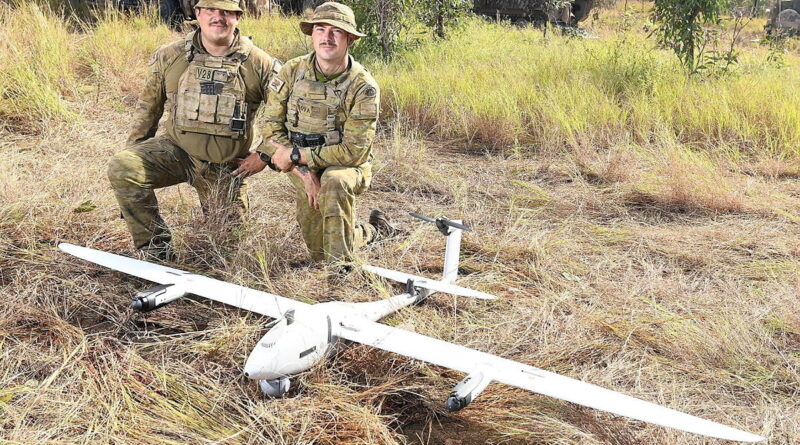

The Australian Army has tested one of its newest fixed-wing reconnaissance drones during Exercise Southern Jackaroo, using the AI-enabled Vector unmanned aircraft to identify targets, support artillery missions, and improve long-range battlefield surveillance.
Personnel from the 2nd Cavalry Regiment operated the Quantum Systems Vector at the Townsville Field Training Area in Queensland. During the exercise, the drone was used to detect targets in depth and provide information that enabled follow-on drone and artillery strikes against simulated enemy positions.
The deployment reflects the Australian Army’s growing emphasis on unmanned reconnaissance, artificial intelligence, and faster sensor-to-shooter coordination.
Table of Contents
ToggleVector Extends Australian Army Reconnaissance Range
The Vector is a fixed-wing vertical takeoff and landing unmanned aerial system developed by German defense technology company Quantum Systems.
According to the Australian Army, the platform can fly more than 60 kilometers while mapping operational environments in real time. Its AI-enhanced software can also assist operators in detecting and tracking objects during flight.
This allows reconnaissance units to observe areas beyond the immediate forward line without placing soldiers within direct-fire range or exposing them to a higher risk of detection.
Corporal Harrison Hinson of the 2nd Cavalry Regiment said mounted and dismounted reconnaissance would traditionally require soldiers to locate enemy positions through direct observation.
That approach can place personnel at greater risk of compromise and hostile fire.
“With our employment of drones, we have one more tool at our disposal to enhance our reconnaissance and strike capabilities,” Hinson said.
AI-Assisted Software Supports Target Detection
The Vector’s AI-enabled software is designed to help operators identify and track objects while the aircraft is airborne.
Rather than relying entirely on manual observation of live sensor feeds, AI-assisted processing can help highlight potential vehicles, personnel, or other objects of interest.
This may reduce operator workload and accelerate the movement of information from reconnaissance teams to commanders, artillery units, and other strike assets.
Real-Time Mapping Improves Battlefield Awareness
The aircraft can generate updated maps of the operating environment during flight.
This capability can help military units identify routes, terrain features, defensive positions, logistical activity, and potential movement by opposing forces.
When integrated with command-and-control networks, real-time mapping can improve situational awareness and support quicker tactical decisions.
The capability is particularly useful in contested environments where hostile forces frequently move equipment, conceal positions, or use deception to complicate surveillance and targeting.
Human Operators Remain in Control
Although the system uses AI-enhanced software, the Vector remains operated and supervised by trained personnel.
AI supports object detection, tracking, and information processing, but operational decisions remain within the military chain of command.
This distinction is important as armed forces increasingly integrate artificial intelligence into reconnaissance and targeting-support systems without transferring full decision-making authority to autonomous platforms.
Tiltrotor Design Combines Vertical Lift and Fixed-Wing Range
The Vector has a wingspan of approximately 2.8 meters and uses a tiltrotor configuration to transition between vertical and forward flight.
The design allows the aircraft to take off and land without a runway before shifting into more efficient fixed-wing flight.
This gives the platform the hovering flexibility of a rotary-wing aircraft while preserving the speed, range, and endurance associated with a fixed-wing drone.
For Australian Army units operating across large distances and difficult terrain, the ability to deploy without prepared airstrips can reduce logistical requirements and allow the system to operate from dispersed tactical positions.
Corporal Hinson, who has flown fixed-wing unmanned aircraft since 2022, said the flying characteristics were relatively straightforward for personnel already familiar with similar systems.
Vector Helps Shorten the Sensor-to-Shooter Cycle
During Exercise Southern Jackaroo, information gathered by the Vector supported simulated drone and artillery strikes.
This demonstrates the role of unmanned reconnaissance systems in shortening the sensor-to-shooter cycle.
That process includes detecting a target, confirming its identity and position, passing the information through command channels, assigning a weapon system, and conducting an engagement.
A reconnaissance drone can accelerate the process by maintaining observation of a target and providing updated location data to strike units.
Deep Reconnaissance Targets Rear-Area Activity
Fixed-wing drones can penetrate deeper into contested areas than many ground reconnaissance teams.
This allows them to observe artillery positions, command posts, reserve forces, supply routes, ammunition storage areas, and other rear-area targets.
Identifying these elements can help friendly forces disrupt an opponent’s ability to coordinate operations, move reinforcements, and resupply troops closer to the front.
The Vector’s range also allows the operating team to remain farther from the target area, reducing its exposure to direct threats.
Operational Experience Influences Vector Development
The Australian Army said the Vector belongs to a family of drones that has accumulated extensive operational experience in Ukraine and other conflicts.
Combat use in electronically contested and heavily surveilled environments has shaped subsequent upgrades to military unmanned systems.
Operational feedback can influence improvements in sensors, software, communications, durability, flight performance, and electronic protection.
The Australian Army’s use of the Vector therefore reflects a wider trend in which current conflicts are accelerating the development and adoption of tactical reconnaissance drones.
Drone Operations Highlight the Need for Better Concealment
The exercise also demonstrated how widespread drone surveillance is changing defensive tactics.
Hinson said experience with the offensive use of unmanned systems had influenced how Australian soldiers considered concealment and signature management.
Military units must increasingly assume they are being observed by drones, electronic sensors, satellites, or other intelligence systems.
This creates a greater requirement for camouflage, movement discipline, reduced electromagnetic emissions, and the concealment of vehicles, command posts, and logistical positions.
AI-assisted detection may make poorly concealed or stationary forces easier to identify, particularly when software is trained to recognize military equipment, movement patterns, and unusual activity.
Why the Vector Matters for the Australian Army
The Vector provides the Australian Army with a long-range reconnaissance platform that combines vertical takeoff, fixed-wing performance, real-time mapping, and AI-assisted object detection.
For cavalry and reconnaissance units, it can extend surveillance beyond direct line of sight and reduce the need to expose soldiers during target acquisition.
For artillery and other strike units, the system can provide faster and more persistent targeting information.
Its use during Exercise Southern Jackaroo also supports the Australian Army’s broader move toward networked warfare, in which sensors, command systems, drones, and weapons are connected to reduce decision-making and engagement timelines.
Future operational value will depend on how effectively the platform performs in electronically contested environments, integrates with Australian command networks, and delivers reliable information during joint and multinational operations.