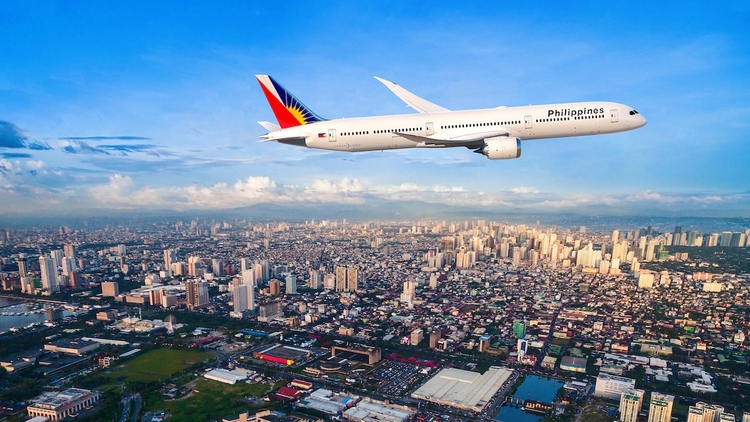

Philippine Airlines has committed to acquire up to 20 Boeing 787-10 Dreamliner aircraft, positioning the widebody jet at the center of its fleet modernization and regional growth strategy.
The agreement, announced at the Farnborough International Airshow on July 20, 2026, covers 15 787-10 aircraft with purchase rights for five additional jets. Once finalized, it would become the largest widebody order in the airline’s history.
The aircraft will strengthen Philippine Airlines’ medium- and long-haul fleet, complementing its existing Boeing 777 operations and supporting future growth across Asia and selected international markets.
Table of Contents
TogglePAL Selects Boeing 787-10 for Widebody Fleet Modernization
Philippine Airlines, the national flag carrier of the Philippines, plans to use the 787-10 to modernize its long-haul fleet while increasing capacity on high-demand routes.
The carrier currently operates 10 Boeing 777 aircraft. The larger 787-10 would provide PAL with another high-capacity widebody option while offering lower fuel consumption and operating costs compared with many older-generation aircraft.
The airline said the investment reflects confidence in the continued growth of air travel and the long-term development of its network.
Lucio C. Tan III, president and chief operating officer of PAL Holdings, said the 787-10 would strengthen the airline’s medium- and long-haul operations while improving efficiency and passenger experience.
“The Boeing 787-10 will strengthen our medium and long-haul fleet, allowing us to provide an even better travel experience for our customers while improving operational efficiency and supporting our long-term sustainability goals,” Tan said.
The announcement comes as Philippine Airlines marks its 85th anniversary and 80 years of cooperation with Boeing.
Commitment Covers 15 Aircraft and Five Purchase Options
The announced agreement consists of a commitment for 15 Boeing 787-10 aircraft and an opportunity to purchase five additional jets.
The transaction remains subject to finalization. Until a definitive purchase agreement is completed and recorded, it should be described as a commitment rather than a finalized firm order.
The potential 20-aircraft package would represent a major investment in PAL’s future fleet and provide the airline with flexibility to respond to changing passenger demand.
Purchase rights for five additional aircraft would allow PAL to expand the order later without immediately committing to the full quantity.
This structure is commonly used in major commercial aircraft transactions, particularly when airlines are planning fleet growth over several years.
Boeing 787-10 to Complement PAL’s 777 Fleet
The 787-10 is the largest member of Boeing’s Dreamliner family.
It is designed to carry approximately 300 to 375 passengers, depending on the airline’s cabin configuration, over distances of up to around 13,890 kilometers, or 7,500 nautical miles.
Its combination of capacity and range makes it suitable for high-density regional and long-haul routes that do not require the longer range of the smaller 787-9.
For Philippine Airlines, the aircraft could be deployed on routes connecting Manila with major destinations across Asia, the Middle East, Australia, and potentially selected markets farther afield, depending on payload and operating conditions.
The 787-10 will complement rather than directly replicate the role of PAL’s 777 fleet. The 777 offers greater range and, depending on configuration, higher payload capability, while the 787-10 is optimized for lower operating cost per seat on medium- and long-haul sectors.
This combination could give PAL greater flexibility in matching aircraft capacity with route demand.
Order Would Support Regional Network Expansion
Philippine Airlines said the aircraft would support expansion across its regional network.
The airline operates from a strategically located hub in Southeast Asia, connecting the Philippines with major cities across the Asia-Pacific region and international markets.
The 787-10 could help PAL increase capacity on routes where demand is growing but where deploying a larger or longer-range aircraft may not be economically necessary.
The aircraft could also support improved scheduling flexibility, higher frequencies, and the opening of new routes where passenger volumes justify widebody service.
For the Philippines, stronger long-haul connectivity could support tourism, business travel, overseas worker traffic, cargo movement, and broader economic links.
Boeing Highlights Fuel Efficiency and Lower Operating Costs
Boeing states that the 787 family uses approximately 25 percent less fuel than the aircraft types it typically replaces.
The company attributes much of this efficiency to the aircraft’s lightweight composite structure, advanced aerodynamics, modern engines, and integrated systems.
Lower fuel consumption can reduce operating costs and carbon emissions per passenger, although actual performance depends on route length, payload, cabin configuration, engine selection, and operational procedures.
For airlines operating long-distance services, fuel is one of the largest cost categories. A reduction in fuel use can therefore have a significant effect on route economics and fleet planning.
Boeing also describes the 787-10 as offering the lowest operating cost per seat among widebody aircraft in its category. Such claims should be understood as manufacturer assessments and may vary depending on airline-specific operating conditions.
Passenger Cabin Designed for Long-Haul Comfort
The 787 family includes several passenger-focused features intended to improve the long-haul travel experience.
These include larger electronically dimmable windows, higher cabin humidity, lower cabin altitude, improved air filtration, and systems designed to reduce the effects of turbulence.
The aircraft’s composite structure allows airlines to maintain a cabin environment with higher humidity than is generally possible in older aluminum airframes.
This can reduce the dry-air sensation commonly associated with long flights.
The cabin also uses larger overhead storage bins and modern lighting systems that can be adjusted during different phases of flight.
Philippine Airlines has not yet disclosed the final seating layout, cabin classes, or onboard product planned for its 787-10 fleet.
Largest Widebody Order in Philippine Airlines’ History
Once finalized, the agreement would become PAL’s largest-ever widebody aircraft order.
The scale of the commitment indicates that the airline expects the 787-10 to play a major role in its future fleet structure rather than serving as a limited niche type.
A fleet of at least 15 aircraft would allow PAL to standardize training, maintenance, spare parts, crew planning, and scheduling around the aircraft.
The five additional purchase rights could eventually bring the total to 20, creating a substantial 787-10 subfleet.
The order would also deepen PAL’s relationship with Boeing at a time when airlines across Asia are renewing fleets and preparing for long-term passenger growth.
Strategic Importance for Philippine Airlines
The commitment reflects several strategic priorities for PAL.
First, it provides a pathway to modernize the airline’s widebody fleet with a more fuel-efficient aircraft.
Second, it increases capacity for medium- and long-haul growth without relying exclusively on the larger Boeing 777.
Third, it supports the airline’s sustainability objectives by reducing fuel consumption and emissions per seat compared with older-generation aircraft.
Finally, the 787-10 could strengthen PAL’s competitive position against other major Asian carriers that are also expanding with newer widebody aircraft.
The success of the acquisition will depend on financing, delivery timing, network planning, crew preparation, maintenance infrastructure, and the airline’s ability to deploy the aircraft on routes where its size and range provide the strongest economic advantage.
What to Watch Next
The next major milestone will be the finalization of the purchase agreement.
Further details will also be important, including the delivery schedule, engine selection, cabin configuration, financing structure, and routes planned for the aircraft.
It will also be necessary to monitor whether PAL exercises the five additional purchase rights.
If completed in full, the 20-aircraft commitment would significantly reshape the airline’s widebody fleet and expand its ability to connect the Philippines with high-demand markets across Asia and beyond.