
The Global Combat Air Programme, or GCAP, is a joint initiative by the United Kingdom, Italy and Japan to develop a new generation of combat-air capability for introduction from 2035.
GCAP is often described simply as a programme to build a sixth-generation fighter aircraft. However, this description is incomplete. The programme covers the aircraft, engines, sensors, communications, electronic warfare, weapons integration, software, digital engineering, industrial infrastructure and the ability to operate alongside uncrewed aircraft and other military assets.
The future fighter will form the central element of this wider combat-air system, but GCAP is intended to deliver an integrated network rather than an isolated aircraft.
It is also a major strategic and industrial undertaking. Through GCAP, the three partner countries want to preserve their ability to design advanced combat aircraft, protect national technological expertise, support aerospace employment and reduce excessive dependence on foreign combat-air suppliers.
The aircraft is intended to replace the Eurofighter Typhoon in British and Italian service and the Mitsubishi F-2 in Japanese service. It is expected to operate alongside the F-35 and other current platforms rather than immediately replacing every existing fighter.
Table of Contents
ToggleWhat Is the Global Combat Air Programme?
GCAP is a trilateral government and industrial programme established by Britain, Italy and Japan.
Its principal objective is to develop a highly survivable, connected and adaptable combat aircraft capable of operating against threats expected from the 2040s onward. The programme targets an initial in-service date of 2035.
The aircraft is known as Tempest in the United Kingdom, although GCAP is the official name of the international programme. Italy and Japan may eventually adopt their own national service names for the aircraft.
GCAP incorporates several interconnected areas:
- A crewed next-generation combat aircraft
- Advanced engines and electrical-power systems
- Low-observable airframe technology
- Integrated radar and electronic-warfare sensors
- Secure communications and data-sharing systems
- Artificial intelligence-assisted mission systems
- Crewed-uncrewed teaming
- Air-to-air and air-to-surface weapons
- Non-kinetic effects, including electronic attack
- Digital design, testing and manufacturing
- Ground-support, training and mission-planning systems
- Long-term upgrades, exports and industrial support
The purpose is to create a combat-air capability that can detect threats, share information, coordinate other platforms and deliver military effects across a heavily contested battlespace.
How GCAP Was Created
GCAP was officially announced on December 9, 2022.
Before the programme was established, Britain and Italy were working on the Tempest future-fighter project as part of the UK-led Future Combat Air System initiative. Japan was separately developing the F-X fighter as a replacement for its Mitsubishi F-2 aircraft.
The three countries decided to combine these projects because they had broadly similar timelines and military requirements.
Britain and Italy needed a long-term successor to the Eurofighter Typhoon. Japan required a replacement for the F-2, which is expected to begin leaving service during the 2030s.
Combining the projects allowed the three governments to share development costs, engineering expertise, industrial facilities and technological risk.
The merger also brought together complementary strengths. Britain has considerable experience in combat-air design, systems integration, engines and weapons. Italy contributes expertise in aircraft production, electronics, sensors and multinational aerospace programmes. Japan brings advanced manufacturing, electronics, propulsion and experience gained from domestic fighter-development projects.
Why Britain, Italy and Japan Are Working Together
The partnership is significant because it connects major European and Indo-Pacific defence powers.
Britain and Italy require an aircraft capable of operating in NATO-led missions, protecting European airspace and conducting long-range expeditionary operations.
Japan requires a fighter capable of defending a large maritime region and operating across considerable distances in the Indo-Pacific. Range, endurance, air superiority, advanced sensors and networking are therefore especially important to Tokyo.
Despite their different geographic priorities, all three countries face similar technological challenges. Future fighters will have to survive advanced air-defence systems, electronic warfare, cyber threats, long-range missiles and increasingly sophisticated enemy aircraft.
Developing such a system independently would be extremely expensive. Cooperation allows the partners to pool their resources while retaining influence over the aircraft’s design, upgrades, weapons and export policy.
Japan’s Ministry of Defense has also emphasised that retaining a domestic fighter-manufacturing base is important for maintaining operational independence and national air-superiority capabilities.
GCAP’s Government Structure
The three countries signed the GCAP international treaty in Tokyo on December 14, 2023.
The treaty established the GCAP International Government Organisation, commonly known as GIGO. Its headquarters are located in the United Kingdom.
GIGO provides the government-level structure for the programme. It represents the three participating states and is responsible for directing, coordinating and managing the joint development effort.
Its responsibilities include:
- Agreeing common programme requirements
- Managing contracts
- Supervising programme performance
- Coordinating budgets and schedules
- Representing the three governments in dealings with industry
- Managing multinational decision-making
- Supporting future production and acquisition arrangements
The treaty established GCAP as a formal international programme rather than a loose arrangement between three national projects.
The three partners have stated that work distribution will be proportionate to each country’s financial and technical contribution while maintaining the principle of equal partnership.
What Is the GCAP Agency?
The government programme is managed through the GCAP Agency, operating within the treaty-based international structure.
The agency acts on behalf of the governments of Britain, Italy and Japan. It awards multinational contracts, manages the development process and works with the programme’s principal industrial organisation.
This structure is intended to reduce delays that could arise if three governments separately issued contracts and managed their own versions of the programme.
In July 2026, the governments announced a £4.6 billion international development contract covering the completion of the advanced concept and assessment phase and further detailed design and development work. The contract was awarded by the GCAP Agency to Edgewing.
What Is Edgewing?
Edgewing is the multinational industrial company responsible for designing and developing the GCAP aircraft.
It was established as an equal joint venture between:
- BAE Systems of the United Kingdom
- Leonardo of Italy
- Japan Aircraft Industrial Enhancement Company, or JAIEC
JAIEC represents major Japanese industrial participation in the programme, including Mitsubishi Heavy Industries.
Edgewing serves as the aircraft’s prime contractor and design authority. This means it has overall responsibility for integrating the airframe and its major systems into a single operational aircraft.
Its responsibilities include:
- Aircraft design
- Systems integration
- Engineering
- Airworthiness
- Certification
- Development coordination
- Configuration management
- Long-term design authority
Edgewing is not merely an alliance between three separate companies. It has been designed to operate as an integrated trinational organisation.
The company is headquartered in Britain but has operations and engineering teams across all three partner countries.
Because Edgewing retains design authority, it is expected to remain involved throughout the aircraft’s operational life, including future upgrades and modifications.
The July 2026 Development Contract
A major programme milestone was reached in July 2026 when the GCAP Agency awarded Edgewing an 18-month contract worth approximately £4.6 billion.
The contract supports:
- Completion of the advanced concept and assessment phase
- Further detailed aircraft design
- Engineering development
- Technology integration
- Programme planning
- Supply-chain activity
- Preparation for subsequent development phases
The agreement represented the transition from early national research and cooperation toward a fully integrated international design programme.
The United Kingdom stated that its wider planned commitment to GCAP under its Defence Investment Plan amounts to £8.6 billion, although this is not the total lifetime cost of the programme.
What Will the GCAP Aircraft Look Like?
The final aircraft design has not yet been confirmed publicly.
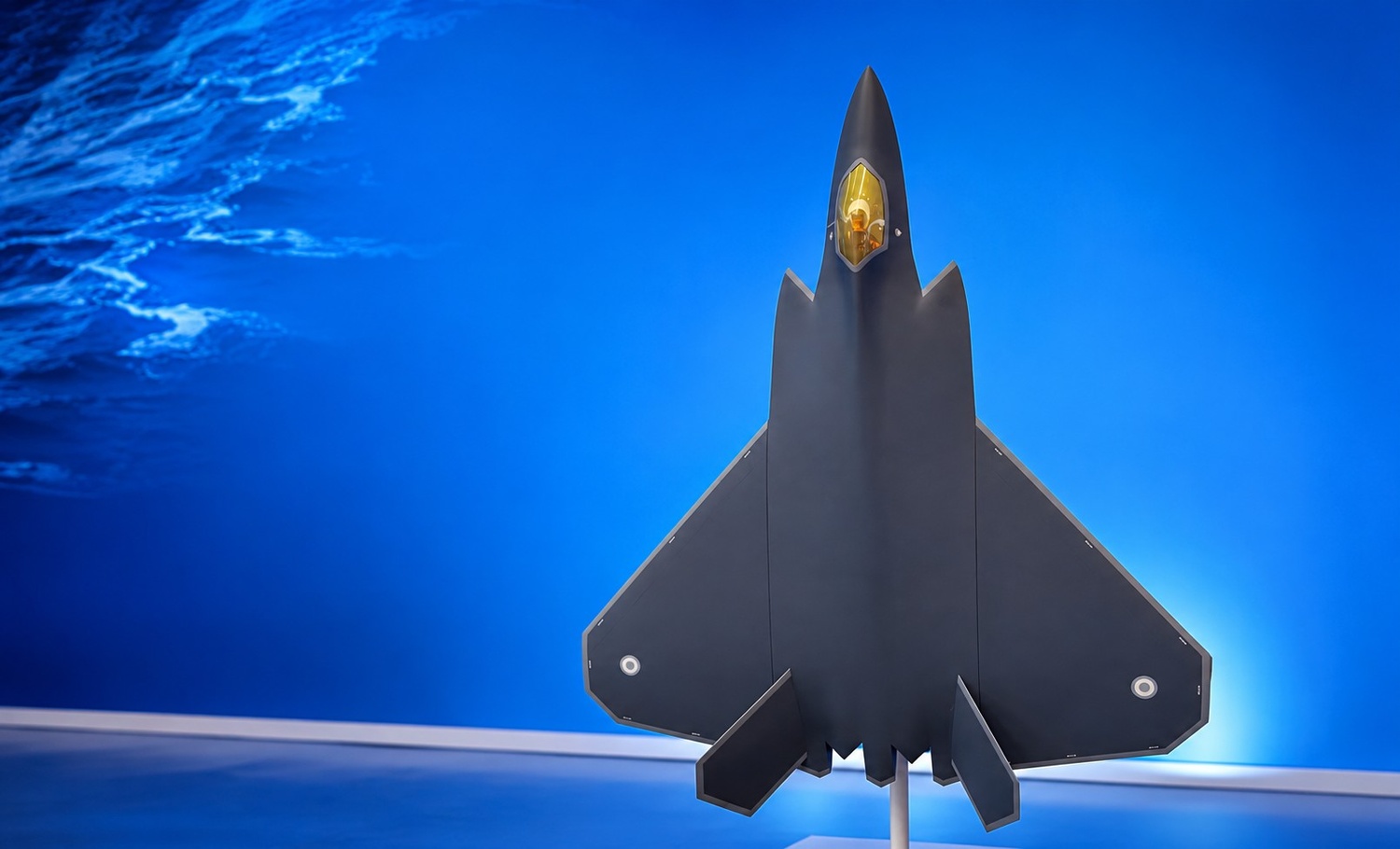
The three partners unveiled an updated concept model at the Farnborough International Airshow in July 2024. The design featured a large delta-style wing, a blended fuselage, two engines and low-observable shaping.
However, concept models should not be interpreted as the final production configuration. Major dimensions, internal arrangements and aerodynamic features can change as the aircraft moves through engineering development.
The relatively large concept design may reflect several operational requirements:
- Long combat range
- Significant internal fuel capacity
- Internal weapons carriage
- Large and powerful sensors
- Extensive computing and electronic-warfare equipment
- Electrical-power and cooling requirements
- Potential coordination of uncrewed aircraft
- Operations across the wide distances of the Indo-Pacific
A larger aircraft can provide more fuel, weapons capacity and electrical power than a smaller tactical fighter. However, it can also be more expensive to manufacture and operate.
Is GCAP a Sixth-Generation Fighter?
GCAP is commonly described as a sixth-generation combat aircraft.
There is no universally agreed definition of a fighter generation, but sixth-generation capabilities generally include:
- Advanced low observability
- Artificial intelligence-assisted systems
- Extensive sensor fusion
- Secure high-capacity networking
- Crewed-uncrewed teaming
- Open software architecture
- Electronic and cyber warfare
- Long-range weapons
- Greater electrical-power generation
- Rapid integration of new technology
- Distributed operations across several platforms
GCAP is expected to combine most or all of these characteristics.
The aircraft’s true capability, however, will depend on how successfully its sensors, engines, weapons, software and communications operate together. The term “sixth generation” is therefore a broad description rather than a fixed technical standard.
Stealth and Survivability
Low observability is expected to be one of the aircraft’s central features.
The aircraft will be shaped and constructed to reduce its detectability by enemy radar and other sensors. Weapons are likely to be carried internally during missions requiring the lowest possible radar signature.
Stealth does not make an aircraft invisible. It reduces the distance at which hostile sensors can reliably detect and track it.
GCAP’s survivability will depend on a combination of:
- Low-observable shaping
- Radar-absorbing materials
- Electronic warfare
- Threat detection
- Defensive countermeasures
- Secure communications
- Long-range weapons
- Mission planning
- Cooperation with other platforms
This layered approach will be necessary against future integrated air-defence systems that combine radar, infrared sensors, electronic surveillance and long-range surface-to-air missiles.
Range and Payload
GCAP is expected to have greater range and payload capacity than many current Western fighters.
Range is particularly important for Japan because its aircraft may need to cover large maritime areas and operate at significant distances from established airbases.
Britain and Italy also require an aircraft capable of supporting NATO missions and potentially conducting long-range operations beyond Europe.
The final combat radius, maximum range and payload remain classified or undecided.
The aircraft may carry:
- Long-range air-to-air missiles
- Short- and medium-range air-to-air missiles
- Anti-ship weapons
- Precision-guided bombs
- Cruise missiles
- Electronic-warfare payloads
- Future collaborative weapons
- Potentially directed-energy systems
The final weapons configuration will depend on national requirements and future integration decisions.
Sensors and the ISANKE System
One of GCAP’s most important elements is its integrated sensing architecture.
The programme uses the term ISANKE, meaning Integrated Sensing and Non-Kinetic Effects.
ISANKE will combine functions that are traditionally handled by separate aircraft systems, including:
- Radar
- Electronic surveillance
- Electronic warfare
- Infrared sensing
- Threat warning
- Target identification
- Electronic attack
- Defensive protection
The system is being developed alongside ICS, or the Integrated Communications System.
Together, ISANKE and ICS are intended to create a single sensing, communications and electronic-effects architecture.
Instead of operating as independent pieces of equipment, the aircraft’s sensors will exchange and process information through a common system. Leonardo describes this as a central element of the GCAP approach.
Information may also be received from:
- Other GCAP aircraft
- F-35 fighters
- Uncrewed aircraft
- Airborne early-warning aircraft
- Satellites
- Naval vessels
- Ground-based radar
- Command-and-control centres
The aircraft could then combine these inputs into a single operational picture.
Radar Capability
The GCAP radar is expected to be an advanced electronically scanned system capable of surveillance, targeting, electronic support and communications functions.
Future radar technology may be distributed across several parts of the airframe rather than concentrated only in the nose.
This could provide greater coverage and allow the aircraft to detect threats from multiple directions.
Advanced radar and onboard processing will generate large quantities of data. GCAP will therefore require powerful computing systems capable of analysing information rapidly and presenting only the most relevant details to the pilot.
Precise radar range, frequency and tracking performance have not been publicly released.
Artificial Intelligence
Artificial intelligence will support several elements of the GCAP mission system.
Potential applications include:
- Sensor management
- Data fusion
- Threat identification
- Target prioritisation
- Route planning
- Electronic-warfare management
- Predictive maintenance
- Control of uncrewed platforms
- Pilot decision support
AI could help manage the enormous volume of information generated by the aircraft and its supporting network.
For example, the system could compare radar, infrared and electronic signals to determine whether several detections represent the same target. It could then classify the threat and recommend a response.
AI is not necessarily intended to replace the pilot. Its primary purpose is likely to be reducing workload and accelerating decisions.
The final rules governing autonomous weapons employment will depend on national policy, operational requirements and legal restrictions.
The Digital Cockpit
GCAP is expected to feature a highly digital and configurable cockpit.
Early Tempest concepts included:
- Large-area displays
- Helmet-mounted information
- Augmented and virtual-reality technologies
- Eye tracking
- Gesture-based controls
- Reconfigurable digital instruments
- Voice-supported interaction
The cockpit could display different information according to the mission instead of relying entirely on permanent switches and physical controls.
Some of these technologies remain experimental and may not appear in their original form on the production aircraft. Nevertheless, software-driven displays and advanced human-machine interfaces are expected to be fundamental elements of GCAP.
Software and Open Architecture
Software will be one of the most important components of the aircraft.
Modern combat aircraft contain millions of lines of code. GCAP will require software for flight control, sensors, communications, weapons, electronic warfare, maintenance and mission planning.
The programme is expected to use an open and modular architecture.
This means new weapons, sensors and applications could potentially be added without redesigning the aircraft’s entire mission system.
Such an approach offers several advantages:
- Faster upgrades
- Easier weapons integration
- Reduced dependence on a single supplier
- Greater competition between technology providers
- More frequent capability improvements
- Adaptation to new threats
However, open architectures also require strict cyber security, software verification and configuration control.
Crewed-Uncrewed Teaming
GCAP is intended to operate with uncrewed aircraft.
These platforms may be described as collaborative combat aircraft, adjunct aircraft or loyal wingmen.
They could perform missions such as:
- Intelligence and surveillance
- Electronic attack
- Communications relay
- Reconnaissance
- Target identification
- Decoy operations
- Weapons delivery
- Suppression of enemy air defences
The crewed fighter could act as the command platform within a formation of uncrewed systems.
However, the pilot would not manually fly every aircraft. Autonomous systems would manage routine navigation, formation keeping and some mission functions.
The pilot could instead assign objectives, such as monitoring an area, disrupting a radar or investigating a suspected target.
Different GCAP countries may develop or purchase different collaborative aircraft. A shared communications architecture will therefore be essential for multinational operations.
Weapons and Sovereign Effects Partners
Weapons integration is a separate but central part of GCAP.
MBDA UK, MBDA Italia, Mitsubishi Electric and Mitsubishi Heavy Industries have established the Sovereign Effects Partners, or SEP, grouping.
At the Farnborough International Airshow in July 2026, the companies signed a collaboration agreement to support GCAP.
The partnership will work on:
- Effects optimisation
- Weapons integration
- Engineering support
- Digital integration of effector systems
- Coordination with the aircraft’s mission architecture
- Preservation of sovereign weapons capabilities
The term “effects” includes traditional weapons but may also cover electronic attack and other non-kinetic capabilities.
Future missiles may remain connected to the wider combat network after launch, allowing targeting information to be updated by different aircraft, ships, ground units or satellites.
GCAP may eventually integrate both common multinational weapons and weapons selected individually by each country.
Engine Development
The GCAP engine is being developed through cooperation involving:
- Rolls-Royce of the United Kingdom
- Avio Aero of Italy
- IHI of Japan
The propulsion system must provide high performance while also generating considerable electrical power.
Future combat aircraft will require energy for:
- Radar
- Electronic warfare
- Communications
- Mission computers
- Sensors
- Cooling
- Actuators
- Potential directed-energy systems
The engine must therefore operate as part of an integrated power-and-thermal-management system.
Heat management is especially important. Powerful electronics generate large quantities of heat, while excessive thermal emissions can increase an aircraft’s detectability.
The concept aircraft has generally been shown with two engines, although the final propulsion arrangement and official performance figures have not been disclosed.
Air-to-Air Refuelling
The future GCAP aircraft is expected to use boom-type aerial refuelling.
This is significant for Britain because the Royal Air Force’s current Voyager tankers mainly use probe-and-drogue refuelling equipment.
Britain may therefore require boom-equipped tankers or another refuelling solution to support GCAP operations.
Japan and Italy already operate or plan to operate tanker fleets with boom-refuelling capability, making the decision more compatible with their existing systems. Reports confirming the boom-refuelling requirement emerged during the 2026 Farnborough period.
Digital Engineering
GCAP is being designed using advanced digital-engineering methods.
Engineers use computer models and virtual environments to test:
- Aerodynamics
- Aircraft structures
- Production methods
- Sensor integration
- Maintenance procedures
- Mission systems
- Software
- Weapons carriage
A digital representation of the aircraft can be updated as the physical design develops.
This approach may identify problems before expensive prototypes are built. It can also allow engineers in Britain, Italy and Japan to work on common models.
Digital engineering does not eliminate the need for physical testing, but it can reduce the number of design iterations and accelerate development.
The Combat Air Flying Demonstrator
The United Kingdom is developing a crewed supersonic aircraft known as the Combat Air Flying Demonstrator.
This aircraft is associated with Team Tempest and supports technology development relevant to GCAP.
It will be Britain’s first new crewed combat demonstrator in approximately four decades.
The demonstrator is not necessarily a direct prototype of the final GCAP aircraft.
Its purpose is to test:
- Advanced manufacturing
- Digital design
- Flight-control systems
- Aerodynamics
- Systems integration
- Certification processes
- New engineering techniques
Lessons from the demonstrator will reduce technical risk and help maintain the specialist skills needed to develop the operational aircraft.
Excalibur Flight-Test Aircraft
The GCAP technology programme also includes specialised flight-test platforms.
One important example is Excalibur, a modified Boeing 757 intended to test sensors, communications and electronic-warfare systems.
A large test aircraft allows engineers to install experimental systems and carry technicians during flight tests.
These technologies can therefore be evaluated before being installed on a smaller and more complex combat aircraft.
Excalibur and similar platforms reduce the risk of discovering major integration problems late in the development process.
Programme Timeline
The broad GCAP timeline is as follows:
Before 2022
Britain and Italy worked on Tempest, while Japan pursued its F-X fighter programme.
December 2022
Britain, Italy and Japan announced the creation of GCAP.
December 2023
The three governments signed the international treaty establishing GIGO.
2024
All three countries completed the parliamentary or national procedures necessary to approve the treaty. The partners also unveiled an updated concept aircraft at the Farnborough International Airshow.
2025
Edgewing was established as the trinational aircraft joint venture and design authority.
April 2026
The GCAP Agency awarded Edgewing an initial £686 million contract for important design and engineering activities.
July 2026
The partners announced a larger £4.6 billion development contract covering the next 18 months.
Late 2020s
The programme is expected to advance through detailed design, engineering, testing and manufacturing preparation.
Early 2030s
Prototype production and flight testing are expected to intensify, although detailed official milestones have not all been disclosed publicly.
2035
The three governments are targeting entry into operational service.
The schedule is highly ambitious. Delays in design, engines, software, weapons or testing could affect the 2035 objective.
Will GCAP Replace the F-35?
GCAP is not intended to replace the F-35 immediately.
Britain, Italy and Japan all operate or are purchasing the F-35. These aircraft will remain in service for decades.
The F-35 and GCAP are expected to perform complementary roles.
The F-35 offers advanced stealth, sensors and multinational interoperability. GCAP may provide greater range, payload, electrical power, networking capacity and control over national upgrades.
A future force could combine:
- GCAP aircraft
- F-35 fighters
- Upgraded Typhoons
- Uncrewed aircraft
- Airborne early-warning platforms
- Tankers
- Satellites
- Ground and naval systems
GCAP may function as a high-capacity command, sensing and weapons platform within this wider force.
How Much Will GCAP Cost?
The complete development, procurement and lifetime-support cost has not been publicly confirmed.
The programme will require expenditure on:
- Research and development
- Aircraft prototypes
- Engine development
- Sensors and mission systems
- Weapons integration
- Test facilities
- Production infrastructure
- Training
- Ground equipment
- Aircraft procurement
- Maintenance and upgrades
The £4.6 billion contract announced in July 2026 covers only a specific development period and does not represent the entire programme cost.
The three countries expect international cooperation to reduce individual financial burdens. However, multinational programmes can become more expensive if countries request separate configurations or duplicate production facilities.
Affordability will influence how many aircraft are ultimately purchased.
Production and Industrial Workshare
Production work is expected to be divided among Britain, Italy and Japan.
The partners have agreed that workshare should reflect each country’s financial and technical contribution while preserving an equal partnership.
Likely industrial areas include:
- Airframe sections
- Engines
- Radar
- Electronic warfare
- Communications
- Mission computers
- Weapons
- Software
- Final assembly
- Testing
- Maintenance
The precise division has not been completely disclosed.
Industrial workshare is politically sensitive because each government expects GCAP to support domestic jobs and manufacturing.
The programme must balance industrial benefits with efficiency. Excessive duplication could increase costs, while concentrating too much work in one country could weaken political support elsewhere.
Economic Importance
GCAP is intended to protect high-value aerospace capabilities in all three countries.
Advanced combat-air programmes require specialist knowledge in:
- Aerodynamics
- Propulsion
- Radar
- Electronic warfare
- Materials science
- Software engineering
- Weapons integration
- Manufacturing
- Flight testing
- Certification
Without a major future programme, some of these skills could decline after the completion of Typhoon and F-2 production.
Britain has described GCAP as supporting thousands of skilled jobs and protecting its sovereign combat-air sector. The government has also presented the programme as an important element of its long-term defence-industrial strategy.
The technological benefits may extend beyond defence into artificial intelligence, digital manufacturing, advanced materials, communications and energy management.
Export Potential
Exports will be important to the programme’s affordability and industrial success.
A larger production run can reduce the average cost of each aircraft and sustain manufacturing for longer.
Potential customers may include countries seeking:
- A Western next-generation fighter
- Long range and large payload
- Access to advanced technology
- Greater influence over weapons integration
- An alternative to a completely US-controlled aircraft ecosystem
- Industrial participation
Export policy could nevertheless become complicated because all three founding countries would need to agree on technology release and sales arrangements.
Japan historically maintained strict defence-export restrictions, although these rules have been adjusted to allow the future export of GCAP aircraft under specific conditions.
Could More Countries Join GCAP?
The programme has remained open to additional international involvement.
Canada has explored closer participation and was reported in July 2026 to be moving toward observer status while reviewing its long-term combat-air options.
Italy has also indicated that several countries have expressed interest in GCAP.
Countries previously associated with possible involvement include:
- Saudi Arabia
- Canada
- Germany
- Australia
- Sweden
Interest does not mean that any country has become a full programme member.
Possible forms of participation include:
- Full government partnership
- Observer status
- Industrial cooperation
- Technology participation
- Weapons integration
- Future aircraft purchase
Adding another full partner could provide funding and technology, but it could also complicate requirements, workshare and decision-making.
New partners would need to join without delaying the 2035 schedule.
GCAP and Other Sixth-Generation Programmes
GCAP is one of several future combat-air projects underway internationally.
The United States is pursuing next-generation combat-air programmes for the Air Force and Navy. France, Germany and Spain are working on the Future Combat Air System, or FCAS/SCAF. Other countries, including China and Russia, are developing their own advanced combat-air technologies.
GCAP and the Franco-German-Spanish FCAS are separate programmes.
GCAP is centred on Britain, Italy and Japan, while FCAS involves France, Germany and Spain.
Both aim to combine a crewed fighter with sensors, networks, weapons and uncrewed platforms. They may therefore compete for exports, industrial partners and technological leadership.
Strategic Importance for Britain
For Britain, GCAP is the successor to decades of national and European combat-air development.
The programme is intended to:
- Replace the Typhoon
- Preserve sovereign fighter-design capability
- Support BAE Systems and Rolls-Royce
- Maintain radar and electronic-warfare expertise
- Support the Royal Air Force
- Strengthen strategic links with Japan and Italy
- Create export opportunities
Britain also hosts the headquarters of the international government organisation and the Edgewing industrial joint venture.
Strategic Importance for Italy
Italy has been involved in several major multinational combat-air programmes, including Tornado, Eurofighter and the F-35.
Through GCAP, Italy aims to:
- Replace its Typhoons
- Preserve Leonardo’s fighter-development capabilities
- Support Avio Aero and ELT Group
- Retain access to advanced sensors and electronic warfare
- Strengthen its aerospace industry
- Maintain influence over future European and NATO combat-air capability
Italy’s experience in both European fighter projects and the F-35 industrial programme makes it an important bridge between different defence-industrial ecosystems.
Strategic Importance for Japan
For Japan, GCAP marks a major expansion of international defence-industrial cooperation.
The programme will:
- Replace the Mitsubishi F-2
- Preserve Japan’s fighter-manufacturing base
- Support Mitsubishi Heavy Industries, IHI and Mitsubishi Electric
- Provide access to European technology
- Strengthen partnerships with Britain and Italy
- Increase Japan’s role in international defence exports
- Support long-range air-superiority requirements
Japan’s participation also gives GCAP a strong Indo-Pacific dimension that is absent from most European fighter programmes.
Major Programme Risks
GCAP faces several significant challenges.
Schedule Risk
Delivering a completely new combat aircraft by 2035 is ambitious. Software, engine, sensor or testing delays could affect the entry-into-service date.
Cost Growth
Advanced combat-air projects frequently become more expensive as technologies mature and requirements expand.
Requirement Differences
The three countries may seek different weapons, communications systems or operating capabilities.
Technology Sharing
Stealth, electronic-warfare, engine and sensor technologies are highly sensitive. The partners must agree on intellectual property and security arrangements.
Industrial Competition
Each country wants a significant share of development and production work.
Software Complexity
The aircraft will depend heavily on software. Delays or security weaknesses could affect the wider programme.
Export Restrictions
All three partners will need to coordinate export decisions and technology-release policies.
Changing Governments
GCAP will continue through several political and budget cycles. Long-term support must be maintained despite leadership changes.
Production Numbers
If the aircraft becomes too expensive, governments may purchase fewer units, increasing the cost of each aircraft.
Can GCAP Meet the 2035 Deadline?
The programme has made important institutional progress.
It has:
- Established an international treaty
- Created a government management organisation
- Formed a trinational industrial prime contractor
- Awarded major development contracts
- Begun engine, sensor and weapons cooperation
- Invested in demonstrator aircraft and test platforms
However, the most difficult work remains ahead.
The partners still need to complete the design, build development aircraft, test the engines, validate software, integrate weapons, establish production lines and complete military certification.
The 2035 target is possible, but it will require stable requirements, continuous funding and disciplined management.
The Future of GCAP
GCAP is likely to remain one of the world’s most important aerospace and defence programmes for several decades.
If succesms built around a crewed combat aircraft, advanced sensors, weapons, artificial intelligence and uncrewed platforms.sful, it will produce more than a new fighter. It will create a family of connected syste
The programme could reshape defence-industrial cooperation between Europe and the Indo-Pacific. It could also provide Britain, Italy and Japan with greater control over future combat-air technology and reduce their reliance on aircraft developed entirely outside their national industries.
The aircraft’s final appearance and exact performance remain uncertain. Much of the technology is still being developed, and many specifications will remain classified.
Nevertheless, GCAP’s overall direction is clear: the programme seeks to combine stealth, range, sensing, networking, electronic warfare, software and human-machine cooperation in a platform capable of remaining operationally relevant beyond the middle of the century.
GCAP should therefore not be understood simply as a replacement for the Typhoon and F-2.
It is a long-term effort to build an entire future combat-air ecosystem—and to preserve the strategic, technological and industrial independence of the countries developing it.