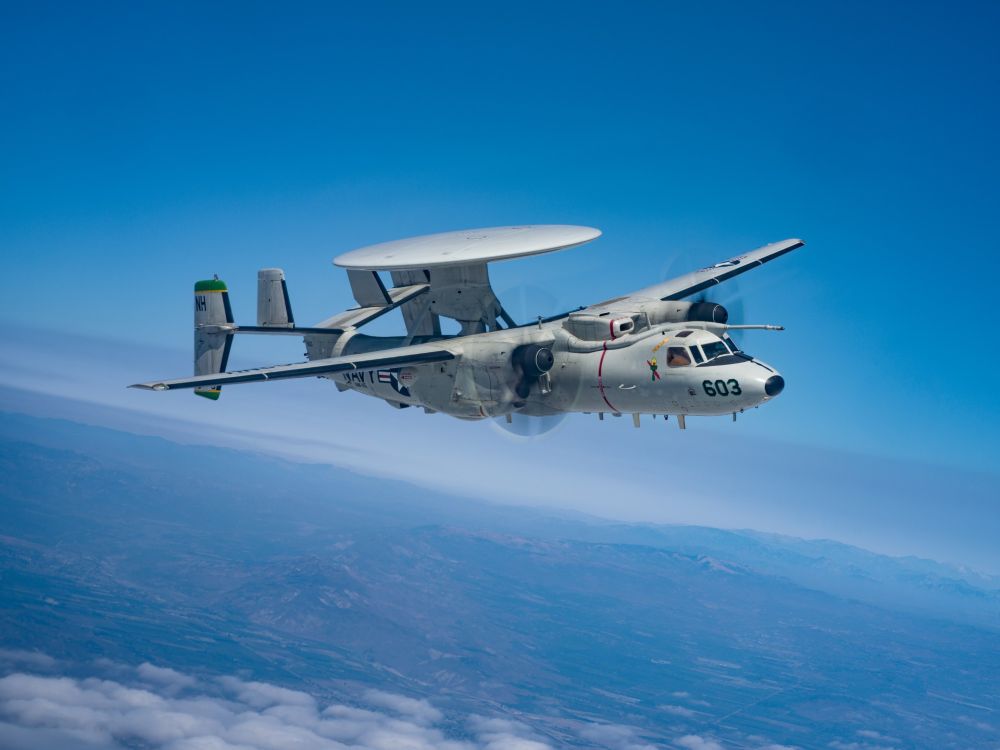

Northrop Grumman has completed a government-led critical design review (CDR) for the E-2D Advanced Hawkeye’s Block II upgrade, the company announced Aug. 18, 2026, clearing the way for integration and testing of what it describes as the most significant upgrade in the platform’s history. The Melbourne, Florida-based company said it will begin integration and testing immediately, with Block II aircraft deliveries planned before the end of the decade.
The E-2D Advanced Hawkeye is the U.S. Navy’s carrier-based airborne early warning and battle management aircraft, tasked with detecting and tracking airborne and surface threats at range for the carrier strike group. It succeeded the earlier E-2C Hawkeye and has been in fleet service since reaching initial operational capability in the mid-2010s. Completion of the CDR represents a formal government-industry checkpoint confirming the Block II design satisfies program requirements before moving into hardware and software integration.
Table of Contents
ToggleInside the Block II Upgrade
A Comprehensive Software and Hardware Overhaul
Northrop Grumman describes Block II as a full overhaul of the E-2D’s mission system software and hardware, intended to sharpen situational awareness, reduce crew workload, and keep the aircraft ahead of evolving threats. The company frames the effort as foundational rather than incremental, built to absorb future capability growth as sensor, data-link, and processing requirements evolve.
Modular Open Systems Architecture
Central to the redesign is a modular open systems approach combined with commercial off-the-shelf (COTS) components. Northrop Grumman said this architecture is intended to lower long-term costs and support sustainment and future modernization, an approach increasingly common across U.S. military avionics programs seeking to reduce vendor lock-in and shorten technology refresh cycles.
Production Line Integration and Fleet Retrofit
Block II will be built into the E-2D’s active production line for new aircraft, while existing fleet aircraft will be retrofitted. Northrop Grumman said this dual-track approach will increase the program’s overall upgrade capacity and help field improvements across the deployed fleet more quickly than a single production or retrofit path alone.
Program Scope and Industrial Base
The E-2D Advanced Hawkeye program supports more than 4,000 jobs across 411 companies in 40 U.S. states, according to Northrop Grumman, underscoring the platform’s footprint within the broader U.S. defense industrial base. Beyond the U.S. Navy, the E-2D family is also flown by international operators including Japan and France, giving the Block II architecture potential relevance for allied airborne early warning fleets over time, though this announcement centers on the Navy program.
Program Leadership Perspective
Janice Zilch, vice president and program manager for the E-2D Advanced Hawkeye at Northrop Grumman, said the completed review reflects the work of the company’s team and partners. She said the upgrade strengthens the aircraft’s capability suite, reduces crew workload, and paves the way for future technology insertion, and that the company remains focused on delivering capability at speed to the Navy and its international partners.
Strategic and Operational Significance
As an airborne early warning and command-and-control platform, the E-2D shapes how carrier strike groups detect, track, and respond to threats at range, including low-observable aircraft, cruise missiles, and small unmanned systems. A modernized mission system and lighter crew workload translate directly into faster decision cycles for battle managers, a priority for the Navy as adversary air and missile threats grow more sophisticated. Upgrading the E-2D fleet through software and hardware refreshes rather than a clean-sheet replacement also reflects a broader Pentagon pattern of extending proven platforms to control cost and schedule risk.
What to Watch Next
With the CDR complete, the next milestones center on integration testing and flight test activity ahead of planned Block II deliveries before 2030. Analysts and program observers will also be watching how quickly the retrofit track moves through the existing fleet, how the open-architecture approach shapes future capability insertions, and whether international E-2D operators eventually pursue equivalent upgrades for their own aircraft.
Key Facts
- Milestone: Government-led critical design review for E-2D Block II completed Aug. 18, 2026
- Next step: Immediate start of integration and testing
- Delivery target: Block II aircraft by end of the decade
- Approach: Modular open systems architecture with COTS components
- Fleet plan: New-production integration plus retrofit of existing aircraft
- Industrial footprint: 4,000+ jobs, 411 companies, 40 U.S. states
- Program lead: Janice Zilch, VP and Program Manager, E-2D Advanced Hawkeye, Northrop Grumman