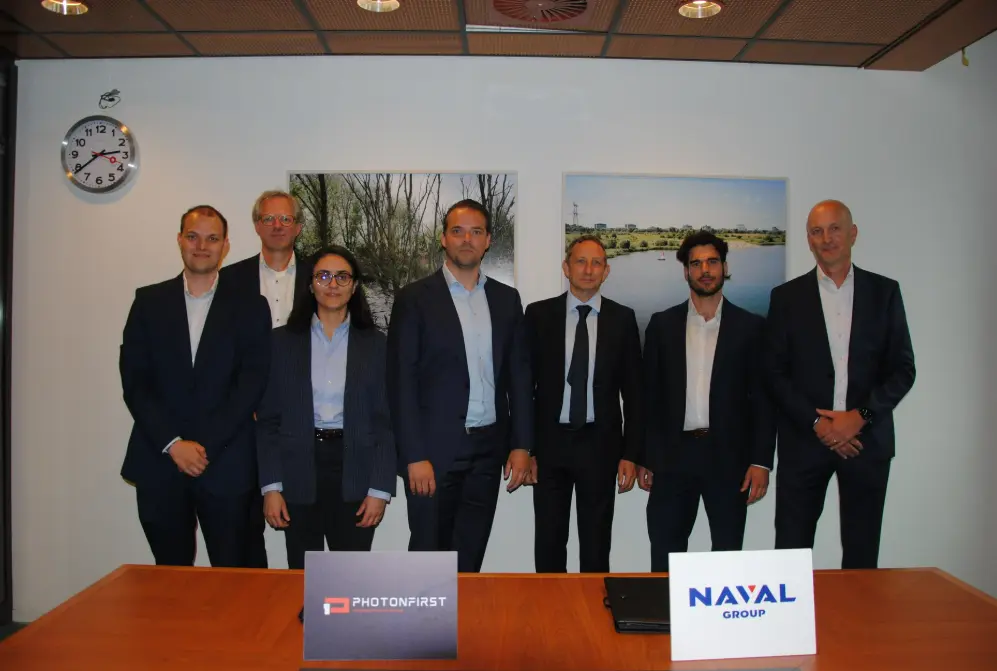

Naval Group and Dutch technology company PhotonFirst have launched a partnership to test fiber-optic sensors for structural monitoring on Naval Group’s surface vessels and submarines, aiming to improve operational availability and reduce maintenance requirements.
The partnership will combine PhotonFirst’s Fiber Bragg Grating (FBG)-based sensing technology with Naval Group’s naval engineering expertise to assess how fiber-optic sensors can provide real-time information on structural behavior and critical onboard systems.
According to the companies, the technology will be evaluated for its ability to monitor strain, temperature, and structural responses under operational loading conditions. The initiative forms part of Naval Group’s cooperation with the Netherlands’ defense technological and industrial base (DTIB).
Table of Contents
ToggleFiber-Optic Sensors Target Naval Platform Reliability
Fiber Bragg Grating technology uses optical fibers to measure changes in physical conditions, including strain and temperature. Applied to naval platforms, the technology could help operators monitor structural conditions and identify changes that may require maintenance or further inspection.
The companies highlighted several potential advantages of FBG-based sensing, including immunity to electromagnetic interference, reliability in harsh environments such as subsea conditions, reduced cabling weight and complexity, and straightforward installation.
These characteristics could make fiber-optic sensing particularly relevant to submarines and other naval vessels, where equipment reliability, weight management, and access for maintenance are important considerations.
By providing real-time insight into structural behavior, the partnership aims to support improved platform health management, operational uptime, and mission readiness. However, the technology’s intended benefits will depend on the results of the planned testing and its eventual application to operational platforms.
Partnership Supports Naval Innovation and Submarine Programs
PhotonFirst CEO Leendert-Jan Nijstad said fiber-optic sensing and integrated photonics would play an important role in the next generation of naval structural monitoring and platform health management. He added that real-time structural data could help improve operational availability, mission readiness, and lifecycle performance.
Olivier Doucy, CEO of Naval Group Netherlands, said the cooperation would enable Naval Group to leverage Dutch technology in its shipbuilding activities. He noted that the specialized expertise and sensing capabilities developed through the partnership could support submarine programs as well as a wider range of naval vessels.
The collaboration highlights the potential role of advanced sensing technologies in naval maintenance and vessel lifecycle management. By monitoring structural conditions more effectively, naval operators may be better positioned to assess platform health, plan maintenance activities, and support long-term fleet availability.
The partnership also reflects cooperation between French naval defense expertise and Dutch technological capabilities, with the planned testing intended to assess the application of fiber-optic sensing across naval platforms.