
Since the eruption of Russia-Ukraine war, Russian Black Sea Fleet has failed to establish sea control in the Black Sea despite its overwhelming numerical and technological superiority over Ukrainian Navy. From sinking of the flagship Moskva cruiser, to targeting of Russian vessels at sea and port, Ukraine has successfully employed asymmetric means to undermine combat efficiency of Russian Black Sea Fleet. From using suicide surface drones to coastal anti-ship missiles, Ukraine has established new trends in modern naval warfare. But the recent Ukraine’s strike on a Russian Navy submarine inside the naval base at Novorossiysk is unique as it reportedly marks first instance when an underwater suicide drone has been used to target a submarine docked at well-protected harbor. The drone used in this attack has been dubbed as Sub-Sea Baby which is probably an autonomous torpedo. This drone can be guided towards the general vicinity of it targets via waypoints before its own systems take over and steer the weapon autonomously to its target. This could explain how the Sub-Sea Baby was able to navigate inside the naval base and towards the submarine, a route that requires several turns in confined spaces.
Over the past several months, the Black Sea conflict has largely been characterized by what can best be described as a tanker war. In initial phase of Black Sea conflict, Ukraine focused on targeting naval assets and infrastructure of Russian Black Sea Fleet. However, later it began to attack so called Russian shadow oil tankers by using unmanned surface vessels and naval mines. These operations, while less dramatic than missile strikes on warships, have undermined Russia’s ability to export oil through the Black Sea and imposed economic costs on Moscow.
The recent attack on Novorossiysk is a sudden shift from recent targeting pattern. The target in question is an Improved Kilo-class submarine, the key underwater asset of Russia’s Black Sea Fleet. These boats are among the most active and capable Russian naval platforms in the theater. Although these are conventional submarines and are not equipped with Air Independent Propulsion (AIP) system, but their true strategic value lies in their ability to launch Kalibr land-attack cruise missiles. These submarines have been used repeatedly to launch long-range Kalibr missiles to strike Ukrainian land based infrastructure. Beyond cruise missiles, Kilo-class submarines can deploy torpedoes, anti-ship missiles, and naval mines, making them pivotal asset in Black Sea.
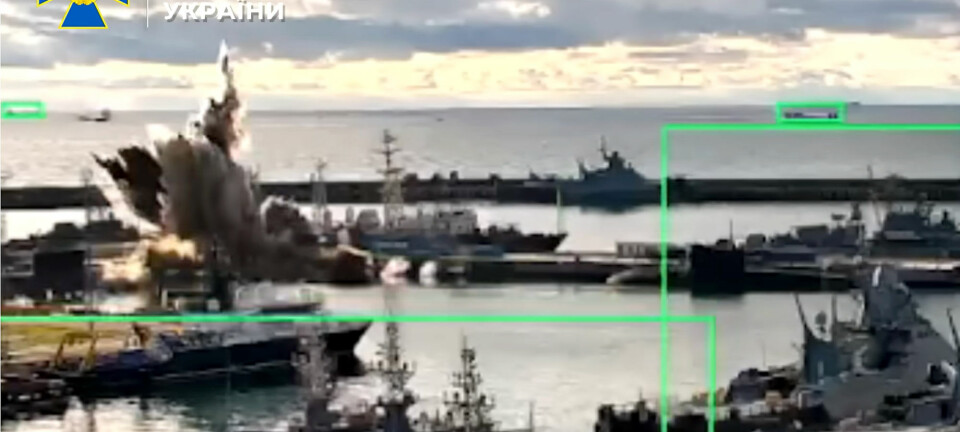
Video footage released by Ukraine’s Security Service appears to have been captured from a camera inside the Novorossiysk harbor itself. The footage shows the harbor entrance open, suggesting that Russian defenses were caught off-guard as they were not anticipating a sub-surface threat. The footage also provides a rare outlook of the concentration of Russian naval assets inside Novorossiysk. In footage, a Vinusha class intelligence-gathering ship, a Krivak class frigate, Alexanderit class mine countermeasure (MCM) vessels, a pair of Bykov class patrol ships, Buyan-M class missile corvette, a Ropucha-I class landing ship and three Kilo-class submarines are visible. The fact that sea-baby drone ignored surface combatants and opted for submarine targeting, suggests that this was a well-calibrated strike rather than an opportunistic one. The Improved Kilo-class submarines are typically berthed in predictable locations, and at least two are clearly visible in the imagery, with indications of a third nearby.
The sub-sea baby drone apparently penetrated the port through the opening at harbor. The explosion occurs at the stern area of one submarine, suggesting that submarine propulsion system must have received substantial damage. The current fate of submarine is unknown. But even if the submarine is not completely destroyed or sunk, then at least it has received mobility kill suggesting that it won’t be participating in any mission any time soon. Since the propulsion section would require extensive repairs and the only realistic facility capable of handling such repairs is the shipyard at Sevastopol. But that’s the very location where another Kilo-class submarine, Rostov-on-Don, was previously crippled in dry dock after it was struck by Storm-Shadow cruise missile fired from fighter aircraft of Ukrainian Air Force. Therefore, the immediate consequence of this attack is that the submarine in question is almost certainly out of action. This suggests that out of total six conventional submarines of Black Sea Fleet, two have been struck leaving only two operational. Two Improved Kilo-class submarines were located in the Mediterranean at the start of the conflict and remained outside the Black Sea to this day.
The broader strategic impact, however, is far more than a single submarine. Russia has only two major naval bases in the Black Sea: Sevastopol and Novorossiysk. And both are vulnerable to Ukrainian attacks. Sevastopol has already been largely abandoned due to repeated Ukrainian missiles and surface drone attacks. Novorossiysk was supposed to be the safe station. But the fact that now even the submarines can be struck inside this port fundamentally alters Russia’s risk calculus. In that sense, this strike represents a strategic dilemma rather than a tactical setback. While more details will emerge in coming days, but the key lessons that can be crafted from this attack are: naval dominance in modern warfare cannot be achieved through fleet size only; and through innovative asymmetric tactics, even a numerically superior adversary can be subdued to operational paralysis.