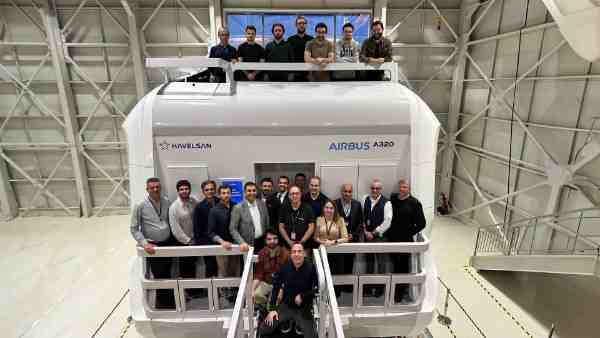

Turkish aerospace and simulation leader HAVELSAN has secured EASA Level D certification for its newly developed Airbus A320 Full Flight Simulator (FFS), officially delivered to Turkish Airlines to enhance the carrier’s pilot training capability.
The certification marks a major milestone for Türkiye’s simulation technology sector, positioning HAVELSAN among a select group of global companies capable of producing commercial flight simulators that meet the highest European safety and fidelity standards.
Advanced Simulation Features for A320 Pilots
The new A320 Full Flight Simulator has been engineered to support training for three different engine configurations, covering both CEO and NEO variants. The system will provide Turkish Airlines pilots with immersive cockpit environments, improved motion accuracy, and enhanced procedural realism, enabling more efficient training cycles and cost savings.
STARVIEW Display System Receives First EASA Certification
A key technological advancement within the simulator is HAVELSAN’s in-house developed STARVIEW Collimated Display System, which also received EASA Level D certification for the first time. This achievement highlights HAVELSAN’s expanding capabilities in visual simulation engineering and optical design.
Installed in İstanbul and Now Operational
The simulator has been delivered to Turkish Airlines’ training centre in İstanbul and has entered active operational use. With this installation, Turkish Airlines now operates three HAVELSAN-manufactured A320 Full Flight Simulators, further strengthening the carrier’s in-house training infrastructure and reducing reliance on external facilities.
Growing Demand for Pilot Training Solutions
The development comes as global pilot demand continues to rise, driven by aviation sector expansion, fleet growth, and operational recovery post-pandemic. HAVELSAN states that it aims to support both airlines and flight schools worldwide through high-fidelity, scalable, and modular simulation platforms capable of meeting evolving commercial training requirements.