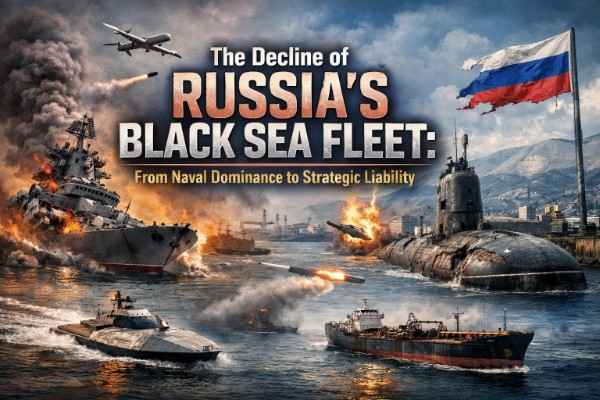

If we discuss Russia’s Black Fleet, it provides a strong illustration of how a militarily complacent and technologically lagging force can be steadily weakened by a smaller but more adaptive opponent. It was once the dominant force of the Baltic Sea’s supreme naval force, but now it operates mainly on the defensive side, exposed to constant risk, and has now been stripped of its earlier role as a contributor to regional power projection. The fleet was a symbol of Russian maritime power, but now it has become a gradually strategic burden. In my view, this aftermath was not predetermined; rather, it appeared from the merger of Ukraine’s innovative technology, which persisted in Russian tactical and operational missteps, and the mounting pressures imposed by contemporary economic and technological warfare.
A Strategic Retreat and a Shrinking Battlespace
The clearest indication of the Black Sea Fleet’s decline is its forced pullback from the Baltic Sea front lines. Under sustained Ukrainian pressure, Russia has had little choice but to shift its core maritime operations away from Sevastopol, long regarded as the fleet’s strategic anchor in occupied Crimea. Intelligence analysis suggests that most major combat ships have been shifted around 250 kilometers eastward to Novorossiysk on Russian mainland. In my view, this move goes well beyond routine redeployment. It amounts to an evacuation from a forward base that once underpinned Moscow’s ambitions to dominate the northwestern Black Sea and control access to the Sea of Azov.
That move creates immediate practical problems. Novorossiysk simply can’t support the fleet as well, undermining its ability to project force or maintain a grip on the sea. By pulling back, Russia has quietly surrendered control over the western Black Sea, which is precisely why Ukraine managed to restart crucial grain shipments from its ports. In my view, a navy that must abandon its primary forward base to preserve itself has already lost the strategic initiative.
Quantifiable Degradation: A Fleet Decimated by Drones and Missiles
The retreat was necessitated by staggering material losses. Open-source intelligence consistently indicates that Ukraine has damaged or destroyed at least one-third of the Black Sea Fleet’s major combatants since the war began. The symbolic starting point was the sinking of the flagship Moskva in April 2022 by Ukrainian Neptune missiles, a strike that, in my analysis, exposed critical failures in Russian readiness and air defense.
However, the more transformative threat has been Ukraine’s fleet of unmanned surface and underwater vehicles (USVs/UUVs). Low-cost maritime drones like the “Sea Baby” and “Magura V” have successfully struck landing ships, patrol boats, and even the Admiral Makarov frigate. The campaign reached a new peak in December 2025 with the first-ever successful UUV strike on a submarine, using a “Sub Sea Baby” drone to critically damage a Russian Kilo-class submarine at its pier in Novorossiysk.
This attack, in my opinion, represents a strategic inflection point. It demonstrated that even Russia’s most secure alternative port and its stealthiest underwater assets are now vulnerable. Each loss creates a compounding problem: as noted in defense assessments, replacing a modern warship or submarine under stringent Western sanctions is exponentially more expensive and time-consuming than building the original.
The Innovation Gap and the “Shadow Fleet” Dilemma
At the core of this transition, in my perspective, lies a stark opening in innovation. Ukraine entered the conflict with almost no conventional maritime force, yet it has developed a highly effective model of asymmetric maritime warfare. By integrating coastal missile systems, long-range drones, and real-time intelligence, it has consistently placed a much more substantial and traditional fleet under threat. Russia, by contrast, has struggled to respond in kind, falling back on outdated measures such as floating barriers and nets—methods ill-suited to counter modern underwater drones.
Russia’s primary adjustment has instead been to expand grey-zone practices, particularly through greater dependence on a so-called “shadow fleet” of aging commercial tankers to bypass oil sanctions. While this proposition sustains short-term revenues, it also highlights the fleet’s declining conventional effectiveness. At the same time, the industrial foundation needed for maritime force recovery is severely weakened. Sanctions have curtailed access to advanced microelectronics and specialized maritime components, leaving the defense industry focused on keeping existing vessels operational rather than replacing losses. Thus, in my opinion, it is locking Russia into a cycle of long-term naval degradation.
Global Implications: A Warning from the Black Sea
In my assessment, the consequences of this setback reach well past who holds power in the region. I believe navies worldwide, particularly in the Indo-Pacific, are closely studying these events. The conflict provides a template for how a smaller power can use distributed, affordable unmanned systems and precision missiles to deny sea control to a larger, traditional navy.
For Russia, the damage to its reputation as a naval power is severe. Its ability to sustain a credible Mediterranean squadron, historically supplied from the Black Sea, is now in question. The message to allies and adversaries is clear: a navy that cannot secure its home waters cannot be a reliable global actor.
The evidence shows that Russia’s Black Sea Fleet has undergone a fundamental transformation from an asset to a liability. It has been physically degraded, strategically displaced, and operationally contained by a combination of sustained Ukrainian pressure and its own systemic weaknesses. The fleet’s remaining ships, while still dangerous, operate under severe constraints, their utility sharply curtailed. This case demonstrates that in modern warfare, technological agility and tactical innovation can fundamentally rewrite the rules of naval dominance, a lesson with enduring relevance for global security.