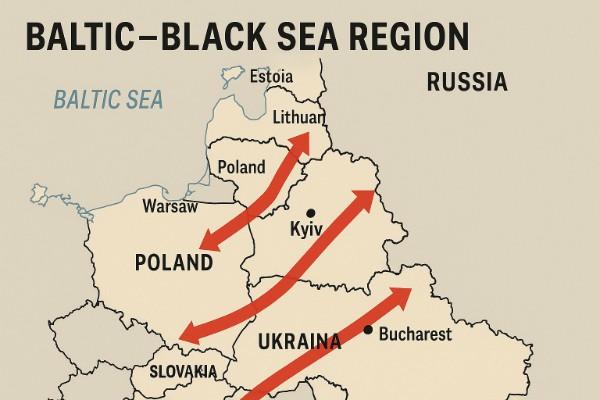

For decades, Europe’s eastern frontier looked like a patchwork of vulnerabilities. Small states along the Baltic and Black Seas stared uneasily at the same adversary but lived in separate worlds. The Baltic states worried about energy blackmail, cyberattacks, and the militarization of Kaliningrad. The Black Sea countries faced encirclement, frozen conflicts, and the constant shadow of Russian power projection. Yet the same geography that once fragmented Europe’s periphery is now being reassembled into a single strategic shield.
When Estonia’s Prime Minister Kaja Kallas met Romania’s President Klaus Iohannis in Tallinn in February 2025, their discussion of port connectivity and cyber readiness symbolized a shift that Moscow had failed to anticipate. The Baltic and Black Sea regions, once treated as separate frontlines, have fused into a single operational theater. This new axis links Tallinn, Warsaw, Bucharest, and Kyiv in a defense network that no longer waits for transatlantic consensus. The integration of infrastructure, intelligence, and energy systems has turned Europe’s eastern periphery into the most coherent line of deterrence since the Cold War.
After the 2022 Nord Stream sabotage, Lithuania accelerated expansion of its Klaipėda LNG terminal while Poland extended the Świnoujście facility and completed the Baltic Pipe connecting to Norwegian gas fields. In parallel, Romania and Bulgaria opened new Black Sea extraction blocks in cooperation with OMV Petrom, providing alternative supply routes for Central Europe. These projects linked the two seas through the emerging Constanța–Gdańsk energy corridor, an initiative revived under the Three Seas framework and co-funded by Poland and Croatia. Energy independence became the first layer of deterrence, cutting Moscow’s most effective non-military weapon.
At the same time, the Baltic–Black Sea Cyber Initiative was launched in 2023, formalizing real-time data sharing between Estonia’s NATO Cyber Defence Centre, Poland’s national CSIRT, Romania’s cyber command, and the Ukrainian CERT-UA. The partnership grew out of multiple Russian-origin ransomware and phishing campaigns against Lithuanian and Romanian logistics systems during the first winter of the war in Ukraine. By late 2024, the initiative had intercepted several coordinated attempts to breach port management servers in Gdańsk and Constanța. The incident reports, now jointly compiled in Warsaw, have become a model for EU-wide cyber coordination that Brussels is only beginning to replicate.
Physical defense followed. The Baltic Defense Line, a 700-kilometer chain of anti-tank trenches, bunkers, and sensor arrays, began construction in January 2024 with joint Estonian-Latvian-Lithuanian funding. It connects directly to Poland’s upgraded defenses around the Suwałki Gap, now integrated with the U.S. 2nd Cavalry Regiment’s forward-stationed units and Finnish reconnaissance teams. Southward, Romania expanded its Mihail Kogălniceanu Air Base into NATO’s main Black Sea hub, hosting rotational forces from Italy, Spain, and the Netherlands. A 2025 bilateral accord between Romania and Poland established a shared logistics corridor linking their defense industries through the Carpathians, facilitating movement of armored units and spare parts from the Baltic states to the Black Sea within seventy-two hours.
Lithuania’s permanent border closure with Belarus in August 2024 served as both a political and security marker. The decision came after repeated airspace violations, prompting Latvia and Poland to increase drone detection networks and establish a shared air-monitoring center in Vilnius.
Diplomatically, the convergence of the Baltic and Black Sea blocs solidified through the Bucharest Nine and the Three Seas Initiative. At the Bucharest Nine summit in Warsaw in April 2024, presidents of all member states jointly endorsed Ukraine’s eventual NATO membership and announced new intelligence-sharing protocols with Moldova and Georgia. A follow-up Three Seas meeting in Vilnius later that year adopted a plan for cross-border pipeline defense and cyber-resilience audits, chaired jointly by Poland’s President Andrzej Duda and Romania’s Iohannis.
Ukraine’s inclusion transformed the alliance’s operational reach. The LITPOLUKRBRIG, based in Lublin, evolved into a logistics coordination cell distributing lessons from the Ukrainian front to partner armies. Kyiv provided drone countermeasure algorithms and field data on Russian electronic warfare systems, while Estonia contributed software for secure communications. In November 2024, Ukraine, Lithuania, and Poland conducted “Brave Partner,” a tri-national exercise testing electronic jamming resistance and rapid troop redeployment across simulated Black Sea and Baltic fronts.
Romania’s naval modernization expanded the southern end of this shield. Its purchase of French-designed Gowind corvettes and Turkish Bayraktar TB2 drones created a layered defense network linking with Bulgaria’s Varna base and Turkey’s radar systems under NATO command. The Black Sea’s western shore now fields continuous maritime surveillance capable of tracking Russian drone launches from occupied Crimea. Constanța has become a dual-use logistics hub where NATO vessels resupply under EU customs exemptions introduced in 2024.
On the energy front, coordination between Poland’s Orlen, Romania’s Transgaz, and Croatia’s LNG operators resulted in a new interconnector allowing liquefied gas from the Adriatic to reach the Baltic states via the GIPL pipeline extension. This network was tested during the winter of 2024–2025, when Russia attempted to disrupt Baltic heating supplies through coordinated cyberattacks on grid management software. The system held, aided by emergency rerouting through Romania’s SNTGN and a temporary boost from Norway’s offshore fields. Romanian shipyards in Galați, revived under French contracts, employ over three thousand workers, while Estonia’s cyber-training programs began exporting expertise to other EU states. Poland’s opposition, once critical of defense centralization, endorsed the 2025 Defense Industrial Act aligning production standards with Baltic partners. Regional security turned into an economic growth narrative.
Hybrid threats, however, did not disappear. Russian intelligence networks adapted, shifting focus from political propaganda to sabotage and organized crime. In 2024, Polish and Czech counterintelligence uncovered a Russian-directed ring targeting ammunition depots and rail lines used for Ukrainian aid transit. Similar cells were found in Bulgaria and Slovakia. Their discovery led to the creation of the Regional Counter-Sabotage Task Group headquartered in Kraków, combining intelligence feeds from eight countries. Within a year, arrests and deportations disrupted more than a dozen attempted operations, reinforcing confidence in collective vigilance.
The 2023 Baltic Cyber Shield exercise, originally limited to Estonia, expanded to include Romania and Moldova by 2025, simulating joint responses to attacks on hospital networks and energy regulators. The same year, coordinated disinformation campaigns tried to stir anti-refugee sentiment in Latvia and Slovakia. Instead of chaos, the result was rapid exposure: media analysis centers in Riga and Bucharest released synchronized reports tracing false narratives to Russian IP clusters. Public resilience became measurable, and the concept of “information defense” entered national security doctrines across the region.
Rail2Sea, an EU-funded project once dismissed as bureaucratic fantasy, entered its operational phase. The line now connects Gdańsk to Constanța through Warsaw and Bucharest, providing a dual-use artery for commercial and military transport. In parallel, Via Carpathia, a north–south highway network, reached completion in Poland and Slovakia, giving NATO forces an alternative deployment route bypassing congested western infrastructure, reducing response time and expanding strategic depth. Finland, after joining NATO in 2023, began contributing Arctic surveillance data and signal-intelligence intercepts relevant to Baltic operations. Turkey, despite its complex politics, is quietly supporting the Black Sea component by hosting regional naval coordination under the Montreux Convention’s limits.
The intelligence integration is centered in Warsaw’s National Security Bureau connecting satellite feeds from Estonia, Romanian maritime sensors, and Ukrainian frontline data into a shared threat picture distributed through encrypted NATO-compatible systems. Energy ministries use the same network to monitor critical infrastructure vulnerabilities. The Baltic–Black Sea area became a continuous sensor web linking the European and NATO command structures with unprecedented granularity.
Russian attempts to manipulate elections in Moldova and Lithuania through financial proxies were exposed within days by regional financial intelligence teams. Sabotage attempts on undersea cables off Estonia and Romania triggered joint naval patrols that located and documented Russian surveillance vessels, drawing sharp diplomatic protests.
This architecture of defense has reshaped Europe’s internal balance. The eastern flank’s rapid mobilization contrasts sharply with Western Europe’s slower adaptation. Yet the difference no longer divides; it complements. France and Germany now fund Baltic air defense through joint EU programs, recognizing that deterrence on the frontier stabilizes the whole continent. NATO’s posture, once dependent on heavy deployments, now relies on networked readiness.
The shield’s durability will depend on sustaining political cohesion amid shifting leadership. Energy interconnectors, shared cyber platforms, and common procurement standards create material incentives for continuity. Even populist governments find it hard to dismantle structures that deliver visible security and economic benefits.
The transformation of Europe’s eastern frontier demonstrates how regional pragmatism can achieve what grand diplomacy often cannot. The cooperation across the Baltic and Black Seas is not rhetorical; it is infrastructural, digital, and operational. Moscow misread these small states as dependents when in fact they were becoming innovators.
In the new security geography of Europe, deterrence no longer flows from capitals to frontlines; it radiates outward from the frontlines themselves. The shield that Moscow did not see coming was forged in shipyards, server rooms, and joint drills, not in summits. It represents the quiet return of collective security built from the edge inward, a reminder that Europe’s periphery has once again become its center of gravity.

Irina Tsukerman
Irina Tsukerman is a US national security lawyer and president of the geopolitical risk strategic advisory Scarab Rising, Inc. She is also a board member of The Washington Outsider Center for Information Warfare. Her work and media appearances can be found on her profile.