
As Pakistan seeks to strengthen its indigenous defence and aerospace capabilities, the role of private industry has become increasingly important in advancing technological innovation and industrial self-reliance. With over seven decades of engineering excellence, Alsons Group of Industries has established itself as one of Pakistan’s leading industrial groups, serving the defence, automotive, healthcare, energy, and advanced manufacturing sectors while supplying both domestic and international markets.
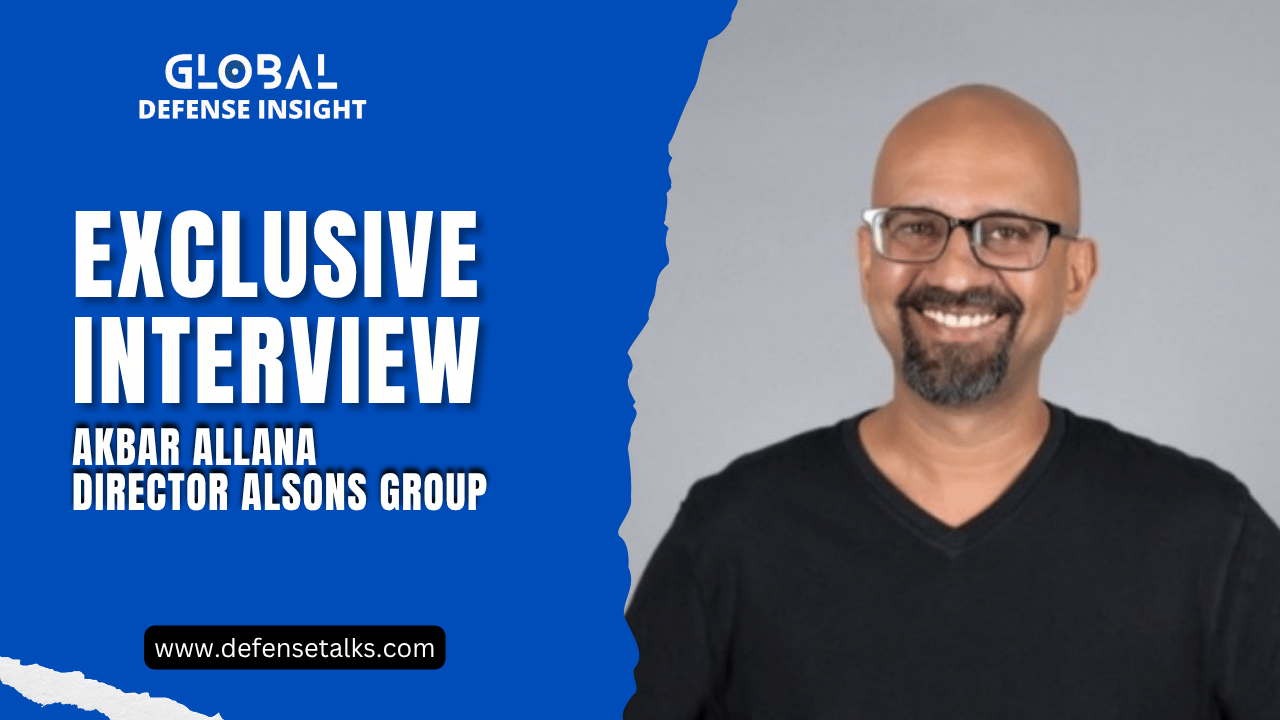
In this exclusive interview with Global Defense Insight (GDI), Akbar Allana, Director of Alsons Group and Founder of Advanced Kinetic Aerospace Labs (AKAL), discusses the company’s journey from precision engineering to aerospace innovation, the successful unveiling of Pakistan’s first indigenous UAV engine at Eurosatory 2026, the future of AKAL, challenges facing Pakistan’s defence industry, and his vision for building globally competitive aerospace and defence technologies from Pakistan.
Alsons Group has built a strong industrial presence over the years. How would you describe the company’s current role in Pakistan’s defence and advanced engineering ecosystem?
Alsons is one of Pakistan’s most diverse engineering groups, working in multiple sectors and technologies where precision, reliability, and long-term trust matter.
Our industrial legacy began in 1953, when we started manufacturing clocks and watches in Pakistan. Our family had been involved in the trade and repair of watches since the 1880s and, after Independence, realised the need for industrialising the newly established state. In 1971, we began supplying precision components, assemblies, and munition fuzes to Pakistan Ordnance Factories, and since 1992 we have been exporting similar products to global defence OEMs, such as Thales Group and Junghans Defence.
We are suppliers of high-tech automotive products—such as speedometers, switches, and brake assemblies—to companies like Honda, Suzuki, and Toyota. We supply critical parts, assemblies, and IoT embedded devices to major power and energy companies, including K-Electric, WAPDA, Pakistan State Oil, and Sui Southern Gas Company. We are globally qualified to manufacture and assemble lighting products for brands such as Philips and Osram. More recently, Alsons became the first company to indigenously design and manufacture an ICU ventilator in Pakistan—the AlnnoVent AVB100.
Across the Group, we have built capabilities in precision machining, die casting, plastic injection moulding, sheet metal fabrication, surface treatments, assembly, tooling, electronics, embedded systems, calibration, testing, quality assurance, research, and product development. This gives Alsons a vast and integrated engineering base that allows us to design, manufacture, validate, and support complex products internally, instead of relying entirely on external and/or foreign suppliers.
Now we want to take this industrial depth, and apply it to more advanced technologies. Through our new division AKAL – Advanced Kinetic Aerospace Labs, we are moving up the value chain into UAV propulsion, autonomous systems, and more advanced defence technologies. We believe this is especially important for Pakistan, because indigenous capability has to be built on real industry, not just ambition.
What was the core vision behind Alsons Group’s entry into the defence and aerospace sector, and how has that vision evolved with time?
Our vision in 1971 was to use our precision engineering base to support Pakistan’s industrial and defence needs. Whilst the core vision has remained pretty much the same, it has understandably expanded and evolved over the decades.
Our legacy as a clock and watch manufacturer shaped our approach to engineering. Watchmaking demands manufacturing accuracy, precise tooling, assembly discipline, strict quality parameters, and repeatability. It was a natural progression for us to move into manufacturing timing devices and munition fuzes for the defence industry. In some ways, we followed a path similar to many European watchmaking and precision engineering industries, especially in Switzerland.
Over time, our vision expanded from manufacturing critical defence components into more complex products and assemblies. We moved from local sales to global exports, diversified from defence to automotive, power & energy, lighting, healthcare devices, and now aerospace. UAV propulsion is simply the next logical step in our journey.
Alsons Group recently unveiled Pakistan’s first indigenous UAV engine at Eurosatory 2026. What does this milestone mean for the company and for Pakistan’s aerospace industry?
For Alsons, the unveiling of AKAL, and its first UAV engine, at Eurosatory 2026 was an important moment. Firstly, it showed that we were no longer just talking about entering the aerospace sector—we had actually taken our first step.
What made it even more significant is that it wasn’t just a mechanical engine that we displayed. The engine, Engine Control Unit (ECU), and Engine Starter Generator (ESG) have all been designed, engineered, and mostly manufactured in Pakistan—primarily using our own industrial base and capability. That’s what makes it so important for us. It showed that Pakistani industry has the ability to develop complete propulsion technologies locally, and eventually deliver them to the world at scale.
For Pakistan’s aerospace industry, as well as for Alsons, I see this as just the beginning. UAV propulsion requires meticulous design, precision manufacturing, electronics, control systems, testing, validation, integration, and continuous improvement. If we seriously want to build this capability as a country, then somebody had to make a start.
For Alsons, this milestone opens a whole new chapter. The overwhelmingly positive response we got on AKAL from Eurosatory gives us the confidence to keep investing in propulsion, UAV technologies, and advanced aerospace systems.
The UAV engine has been designed, engineered, and manufactured in Pakistan. What were the major technical or industrial challenges involved in developing a local UAV propulsion system?
Developing a UAV propulsion system locally was not easy, because we are not just talking about a mechanical engine.
The main challenge was bringing together mechanical design, precision manufacturing, complex materials, fuel systems, ignition, cooling, vibration control, electronics, ECU and ESG development, testing, and integration. All these elements have to work together as a system. Even if one area is weak, the entire propulsion system suffers.
The bigger challenge was validation. In aerospace, you cannot rely on theory, or a few successful tests. You need extensive endurance testing, repeatability, documentation, data, access to platforms and runways, and continuous improvement. That takes time, investment, patience, and proper infrastructure.
This is where the state has to play its part. If Pakistan wants local industry to develop serious defence and aerospace technologies, then companies need proper support—such as testing facilities, certification and validation support, R&D facilitation, local procurement, export support, and long-term policy confidence.
Financing is another major issue. The State Bank of Pakistan should direct banks to create lower-interest financing lines for companies investing in key strategic areas such as defence, aerospace, healthcare, R&D, testing, and advanced manufacturing. These are not industries that offer quick short-term benefits. They require time, and for that you need patient capital.
Private industry can make investments, take risks, and build capability, but it cannot do this in isolation. The state has to support local companies, give them opportunities, and then hold them to international standards. This is the model we see in countries like China, Turkey, and India, where private industry has been brought into major defence and aerospace programmes.
AKAL, Advanced Kinetic Aerospace Labs, made its international debut at Eurosatory 2026. What role will AKAL play in Alsons Group’s long-term aerospace and defence strategy?
AKAL has been created to give Alsons a dedicated structure for aerospace, UAV propulsion, autonomous systems, AI-enabled engineering, and advanced defence technologies.
Whilst we already have the industrial base, aerospace needs its own focused team and development path. It requires engineering, testing, validation, electronics, software, integration, documentation, and a lot of patience. AKAL gives us a way to bring all of that together.
UAV propulsion is the first major step we’ve taken, but we do not see AKAL as limited to engines alone. We want to work on complete propulsion systems, platform integration, embedded electronics, AI-enabled design & simulation, additive manufacturing, and advanced defence products—including next-generation technologies, such as proximity & multi-function fuzes.
So AKAL is not a side project for us. It is the structure through which Alsons will build dedicated aerospace/defence capability—starting with UAV propulsion, but gradually expanding into systems integration, intelligent engineering tools, and advanced defence and dual-use technologies.
Defence manufacturing requires precision, reliability, and long-term investment. What key capabilities make Alsons Group a trusted name in this sector?
Defence manufacturing is not a business where you can survive on claims alone. You have to deliver consistently, over many years, and under very strict requirements, regulations, and controls.
For Alsons, the trust comes from the fact that we have actually been doing this work for decades. We have been supplying Pakistan’s defence sector since 1971, and exporting defence components and sub-assemblies to Europe since 1992. That kind of continuity is only possible if your quality, documentation, process control, and delivery discipline are in place.
A very important example is that our largest European defence customer gives us delegation of control for the items we supply to them. This means that they trust our internal quality systems, inspection processes, and manufacturing controls to the point where Alsons can release goods under delegated authority directly to their final assembly lines, without the need for any receiving inspection at their end. In defence manufacturing, that level of trust is not given easily.
Our strength is also that we are not dependent on one process, or one capability. We have the type of vertical integration that gives us complete control over the lifecycle of a product, from concept and design through manufacturing and validation.
So I would say that Alsons is trusted because we are not short-term suppliers. We are a serious engineering group, with a long history, a broad industrial base, and the systems required to meet international aerospace and defence standards.
How is Alsons Group contributing to local defence production, import substitution, and the strengthening of Pakistan’s indigenous industrial base?
For me, import substitution doesn’t simply mean taking an imported part and making a local version of it. That is just one aspect of it. Real import substitution means building the capability to design, manufacture, test, improve, and support critical products locally in Pakistan, and then prepare them for global markets.
Alsons has been doing this in defence since 1971, through precision components, munition fuzes, assemblies, and later through exports and supply to international defence OEMs. Over time, this has helped us build local manufacturing depth, skilled human resources, supplier networks, quality systems, and confidence.
But this thinking is not limited to defence. We applied the same approach to healthcare, when we designed and manufactured Pakistan’s first ICU ventilator, the AlnnoVent AVB100. That was important because ventilators are highly regulated and life-critical products. We proved that Pakistani industry can move into complex technology if it has the will, the discipline, and the right support.
Through AKAL, we are now applying the same strategy towards UAV propulsion, engine controls, embedded electronics, and advanced defence technologies. If we can build these capabilities locally, Pakistan reduces dependence on foreign supply chains in areas that are strategically important.
This is how true import substitution can be achieved—through forward engineering, precision manufacturing, process control, testing, validation, long-term industrial discipline, and continuous improvement. The real indicator of success is when you become globally competitive, and start exporting your products across world markets.
In your view, what are the biggest opportunities for Pakistan’s private sector in defence manufacturing, UAV technologies, and advanced aerospace engineering?
I think the biggest opportunity is for Pakistan’s private sector to move from basic manufacturing into the real defence and aerospace value chain. UAVs are a very important opportunity, because the technology is still evolving. It is not like older defence platforms, where the ecosystem is already mature and closed for newcomers.
With the advent of UAVs, smaller and more agile engineering companies can play a serious role in engines, airframes, electronics, payloads, communications, and support systems.
Pakistan has great engineers and a fairly well-developed industrial base. What we lack is an organised and structured link between the state, the armed forces, universities, research organisations, and private industry. If that link is created properly, Pakistani companies can credibly support local defence needs, and also become part of international supply chains.
For me, the opportunity is not just import substitution and local manufacturing. The real opportunity is to build capability that can eventually be exported. This is where the private sector can make a real difference. However, this cannot happen without adequate support from the state.
As global defence requirements shift toward unmanned systems, automation, precision technologies, and advanced materials, how is Alsons Group preparing for the next phase of defence industry transformation?
We are preparing by accepting that defence manufacturing is no longer just about a man making accurate parts on a machine, and then sending them for inspection, assembly, and delivery. That will, of course, remain important, but the future is moving towards integrated workflows, complex systems, smarter products, faster development cycles, advanced manufacturing processes, and much stronger engineering control.
Within Alsons, we are building these capabilities step by step. We are improving our design processes, simulation capability, testing culture, documentation, process controls, and product-development systems. We are also seriously exploring AI-enabled engineering workflows, not as a replacement for engineers, but as a way to improve design, simulation, manufacturing, inspection, analysis, and decision-making.
AKAL is a major part of this preparation. It gives Alsons a focused structure to work on the technologies that will define our next phase: autonomous platforms, propulsion, systems integration, intelligent engineering tools, smart manufacturing, and advanced defence products. This transformation is both technical and organisational. We already had the industrial base; now we are combining our engineering depth with the digital tools and systems needed for the next stage.
Looking ahead, what is your long-term vision for Alsons Group and AKAL, both in Pakistan and in potential international defence and aerospace markets?
Our long-term vision is to make Alsons Group and AKAL internationally credible names in advanced engineering, defence, aerospace, and UAV technologies—companies that originate from Pakistan, but are able to compete, supply, and partner globally.
In Pakistan, we want to build capability in areas where the country should not remain dependent on foreign suppliers.
Internationally, there are areas where Alsons can be very competitive: precision manufacturing, complex assemblies, UAV propulsion, specialised defence components, and cost-effective engineering solutions.
For me, the aim is simple. Pakistan should not just be a buyer of defence and aerospace technology. We should also be able to design it, manufacture it, support it, and export it to the world.
What message would you like to give to young Pakistani engineers and innovators who want to contribute to the country’s aerospace and defence future?
My message would be simple: build real capability.
University gives you a foundation—but everything is not taught in a classroom, or learnt from books. You have to get your hands dirty to really understand materials, manufacturing, testing, failure, improvement, documentation, and real-world constraints.
Young engineers must learn the new tools, such as AI, simulation, automation, data analysis, embedded systems, software, and additive manufacturing. At the same time, soft skills also matter: communication, teamwork, discipline, writing, creativity, and the ability to explain your work clearly.
Pakistan needs engineers who are curious, practical, and willing to keep learning. Patriotism in engineering means competence. Build something your country needs, and build it well.