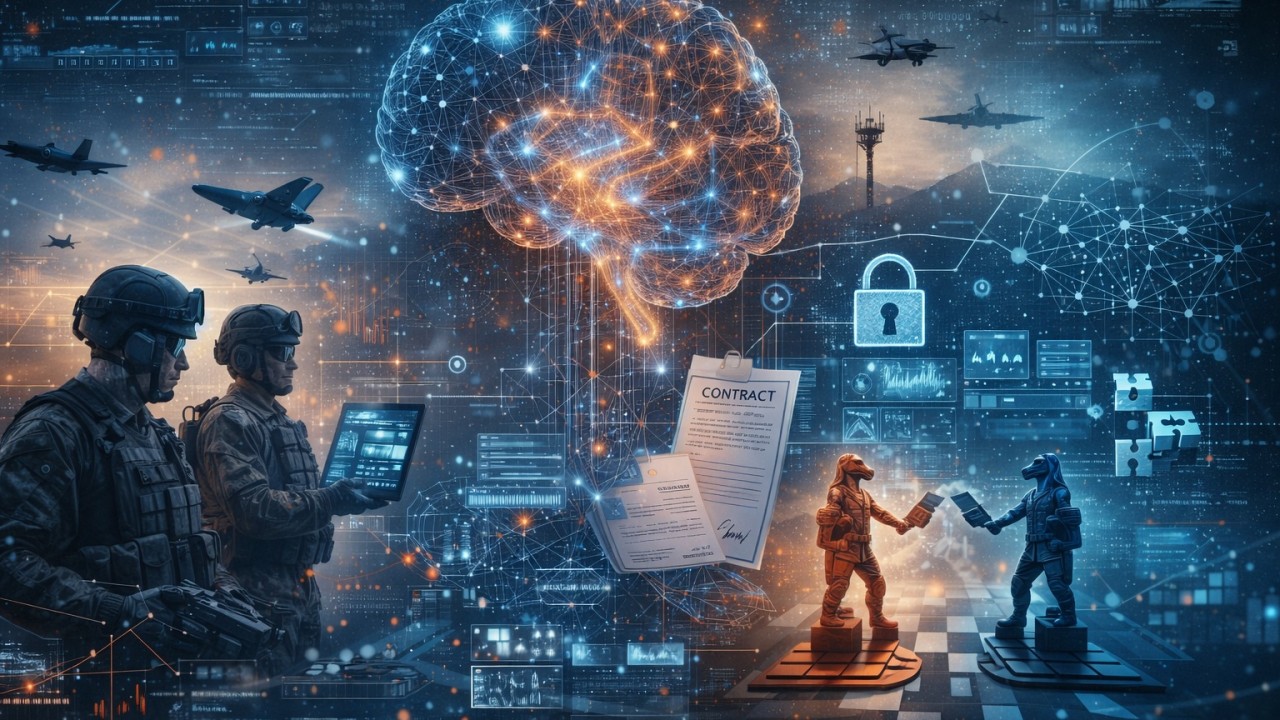

Every consequential military program of the last decade has come with a familiar promise: Artificial Intelligence(AI) will transform war fighting. From Collaborative Combat Aircraft (CCA) to Golden Dome missile defense architecture, the assumption threading through the traditional defense acquisition strategies is that autonomy and AI can deliver the speed and quality of decision-making needed to prevail against peer adversaries ( like China in case of USA).
There is a quiet assumption running through every major military in the world right now — in Washington’s Pentagon corridors, in Beijing’s defense procurement bureaus, in Moscow’s weapons development programs. The assumption is that Artificial Intelligence, fed enough data and given enough compute, will eventually figure out how to fight. That it will, on its own, learn to make the split-second decisions that determine whether a mission succeeds or whether people die. That the same technological arc that gave us self-driving cars and large language models will, with sufficient investment, deliver autonomous warfighters.
It is a seductive assumption. It is also, in its current form, a dangerous fiction — and the race to act on it uncritically may be one of the most consequential strategic errors of our time.
The problem is not that AI cannot transform military power. It can and it will. The problem is foundational: the data being used to train these systems is, in large part, fabricated, synthetic. made up. And when you build an algorithm on made-up data, you don’t get made-up results. You get results that look convincing until the moment they catastrophically aren’t.
The civilian AI industry’s success has created a dangerous set of expectations inside the defense circles. Defense practioners look at ChatGPT’s or Claude’s apparent reasoning, or Waymo’s self-driving cars navigating complex urban environment, and assume comparable outcomes that would be achievable for military systems on a similar timeline. Self-driving car companies spent years training their algorithms on synthetic, computer-generated data before hitting a wall. Only after deploying actual vehicles in the real world — gathering sensor readings, edge cases, and human-labeled corrections at massive scale — did performance become safe enough for public use. Tesla, to take one example, has an entire fleet of customer vehicles feeding real-world data back into its training models continuously. The result is a relatively constrained problem space: a deer crossing a road, an icy patch, an erratic lane change. The computer either brakes or it does not.
The irreducible truth about military AI is that the environment it must operate in is categorically different from any commercial application. A self-driving car faces a constrained problem: brake or don’t brake. The variables are physical, finite, and largely non-adversarial. A combat AI faces an enemy that is actively probing its logic, denying its sensors, inducing errors, and revealing capabilities it has deliberately concealed until that moment.
Now consider the tactical air environment. A pilot has a specific fuel state, a particular electromagnetic environment, degraded sensors, an adversary that is not accidentally wandering into the road but actively probing for weaknesses, deploying electronic warfare, and revealing war reserve modes that no simulator has ever modeled.
The parallel to human learning is precise. Fighter pilots learn through repetition, but repetition alone is not enough — they learn through debriefs, through the patch-wearer pulling apart every decision in a hop, through understanding not just what happened but whether it should happen again.
Here is what the world’s militaries are missing, and what no amount of compute can substitute for: context. Not data in the abstract, but the accumulated, expert-weighted, deeply human understanding of why a decision was right or wrong in a specific moment. What the commander intended. Whether the briefed tactics were even valid for those conditions. Whether the crew executed the plan at all, or improvised under pressure.
China understands the prize even if it faces the same data problem. Beijing has been explicit that military-civil fusion — the deliberate cross-pollination of commercial AI development and defense applications — is central to its long-term dominance strategy. Chinese tech giants like Baidu, Alibaba, and Huawei are not merely commercial entities. These large companies are also nodes in a national AI development infrastructure that feeds into the PLA’s modernization. China’s sheer volume of data from its surveillance systems, its commercial fleet, and its civilian AI sector , gives it a training base that is broader in some respects than what Western militaries can access. Whether it is tactically richer is a different question. Quantity of data and quality of input context are not the same thing, and Beijing faces the same fundamental challenge: it cannot synthesize real-time combat scenario judgment.
Russia, for its part, has moved aggressively toward autonomous and semi-autonomous systems born of battlefield necessity. The war in Ukraine has been an inadvertent live-fire laboratory for drone autonomy, electronic warfare adaptation, and AI-assisted targeting. Moscow is learning from that environment in real time, feeding actual combat outcomes — however crude — into its developmental programs. That is a form of contextual data. It is not the same as the deep tactical annotation that separates a useful algorithm from a reliable one, but it represents a kind of adversarial field-testing that Western militaries have largely not experienced at the same tempo or intensity.
Speed of decision, persistence of engagement, and reduction of human risk are not marginal improvements. They restructure the mathematics of conflict. And right now, every major military power is in a race to reach that threshold while building on foundations that are, in significant part, sand.
The alternative is already visible. AI companies, without a government-supplied data set, are doing what rational actors do: they are making up their own. They are generating synthetic scenarios, running them at massive scale, and delivering algorithms that hit a ceiling of roughly 70 percent accuracy — a number that sounds tolerable until you remember that being wrong 30 percent of the time in a lethal autonomous system cannot be a trade-off at all, even if normative arguments are cast aside.
The race to field autonomous weapons is real. China is running it. Russia is running it. Every significant military power on earth is running it. The question is not whether AI will reshape warfare , it definitely will. The question is whether the systems that emerge from this race will be ones that actors trust enough to use when it counts, or ones that look impressive in peacetime and fail when the adversary does something the simulator never imagined. That answer depends almost entirely on what goes into the training data. And right now, in every capital that is funding this race, not enough people are asking that question seriously enough.

Hammad Waleed is a Research Associate at Strategic Vision Institute, Islamabad. He graduated with distinction from National Defence University, Pakistan. He writes on issues pertaining National Security, Conflict Analysis, Strategic forecast, and Public Policy. He can be reached at hammadwaleed82@gmail.com.