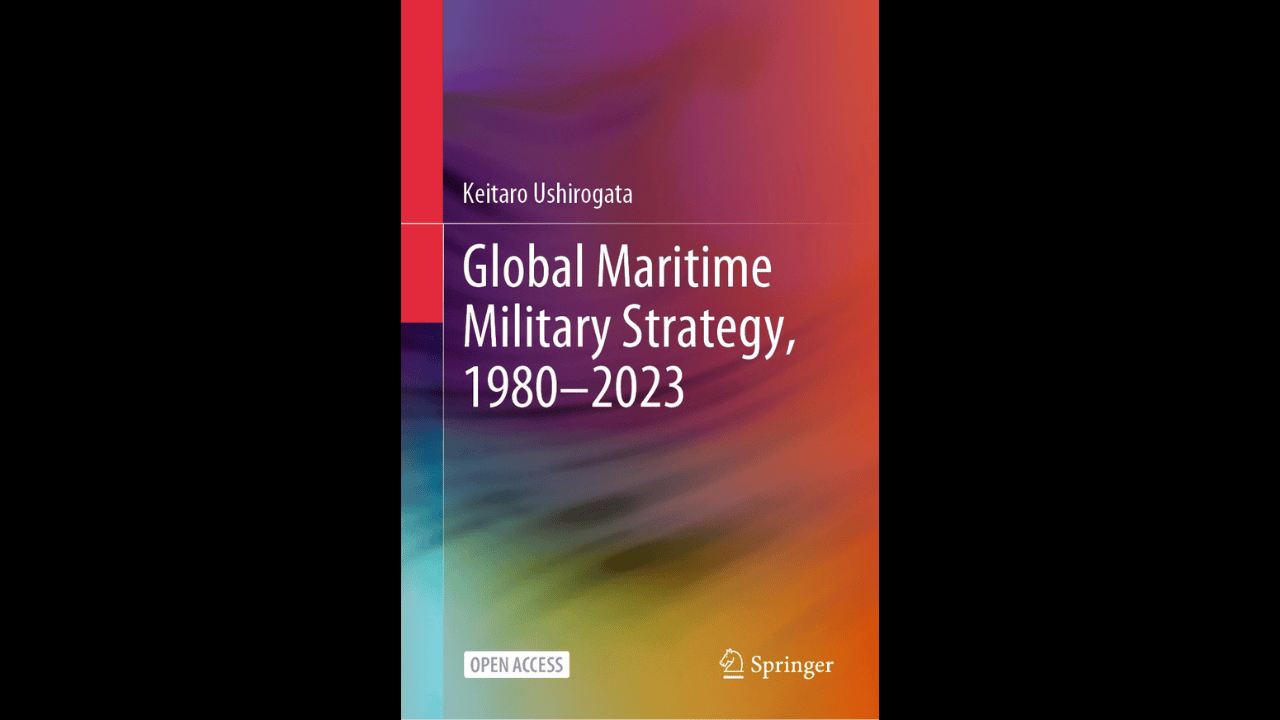

The book “Global Maritime Military Strategy 1980–2023”, written by Keitaro Ushirogata, a Captain in the Japan Maritime Self-Defense Force-JMSDF, provides an insightful and comprehensive analysis of maritime military strategies of major Naval powers (US, UK, Japan, Russia, India, and China) from the time period of 1980 to 2023, through the lens of the Casual Inferences methodological framework (determining whether one variable causes a change in another variable), taking United States maritime strategy as an independent variable and how it is influencing the maritime strategies other powers. Other nations’ strategies are primarily determined by whether they accept or reject U.S. maritime superiority. If the superiority is accepted, the nations focus on Sea Control to expand interests, but must reinvest in Area Denial if a regional threat emerges. If the superiority is rejected, the nations focus on Area Denial to block U.S. power projection. The author categorizes the study of the evolution of maritime strategies of naval powers into two major classifications: a) Maritime strategies of Maritime Nations (which includes the United States, United Kingdom, and Japan), b) Maritime strategies of Land Powers ( which includes Russia, India, and China).
In the analytical framework, the author critically discusses the conventional theories of sea power ( Alfred Mahan’s theory of Sea Power and Julian Corbett’s theory of Maritime Strategy), in which the argument is built upon the limitation of conventional theories that they ignore the Area Denial discipline and mainly focus on Sea Control and Power Projection and introduces the Maritime Triad (Area Denial, Sea Control, Power Projection) based on direction of power. Further, the four key assumptions are discussed by the author that underpin the contemporary maritime environment are the Rational Actor Model (the states are rational actors, work for their national interests, ensure the survival, avoid total war that leads to mutual destruction), Nuclear Deterrence (in principle, to deter the use of nuclear weapons by an enemy, leads to high-intensity of conventional forces as active military strategy), the Proliferation of advanced technology (spread of Command, Control, Communications, Computers, Intelligence, Surveillance, Reconnaissance, and Targeting-C4ISRT networks and Precision Guided Munitions-PGM has revolutionized the warfare) and the Tyranny of Distance (conventional power projection capability decreases in proportion to the distance from homeland, leads to forward deployment of bases essential for maintaining military influence).
Maritime strategies of Maritime Nations, which include the United States, the United Kingdom, and Japan. The maritime strategy of the United States shifts its focus from the rise of the Soviet Navy and the emphasis on “sea control” during the Cold War to the “power projection” based on sea control in the post-Cold War period (1990–2009), and a return to sea control (2010–2023) to counter China’s maritime expansion. The maritime strategy of the United Kingdom has undergone a “strategic contraction” after 1968, prioritizing its independent nuclear deterrent over conventional fleet size while remaining a “complementary force” to the U.S. Japan’s maritime strategy historically served as the defensive “shield” (area denial) to the U.S. “sword,” but is currently reinvesting in autonomous area denial and counterstrike capabilities to offset China’s rise.
Maritime strategies of Land Powers, which include Russia, India, and China. Russia’s maritime strategy is consistent in its “Bastion Strategy,” focusing on area denial to protect its nuclear submarines’ second-strike capabilities in enclosed seas. India has shifted from an area denial against the U.S. in the 1970s to seeking sea control in the Indian Ocean to act as a regional security provider against China. China, initially focused on Anti-Access/Area Denial (A2/AD) to block U.S. forces (1990s–2009), is now building a “blue-water navy” to achieve “open seas protection” and secure its energy routes (Malacca dilemma).
The interaction of these strategies yields three major implications explained by the author in different contexts: a) Stability-Instability Paradox: Stability at the nuclear level but paradoxically increased instability at the conventional level, resulting in prolonged “gray zone” conflicts and low-intensity confrontations where the states believe the situation will not escalate to nuclear or full-scale war, b) Mutual Area Denial Stalemate: When two opposing powers both have strong Area Denial capabilities, it leads “maritime no man’s land”. In this circumstance, no actor has freedom of navigation, leading to a military stalemate that makes achieving strategic objectives extremely difficult, and c) Emergence of New Technology: Laser Weapon Systems and advanced anti-submarine warfare may overcome the current dominance of area denial, making power projection feasible once again. If these technologies allow surface ships to neutralize saturated missile attacks or strip submarines of their stealth, the current maritime stalemate could be broken.
Critiques:
The author admits that the distinction between sea and land power is subjective and intuitive, lacking a strict definition, and notes that he struggled to overcome these “stereotypes” during his research. The Causal Inference Model treats the United States as the primary independent variable, assuming that all other nations’ strategies are merely reactions to U.S. priorities, which also invokes evidence of Military Orientalism, particularly through the book’s theoretical and structural choices. By framing the strategies of Russia, China, and India primarily as “rejecting” or “accepting” these Western paradigms, the author centers Western experience as the universal standard. The “Othering” of Land Powers: The book’s structure separates the Western “Sea Powers” (US, UK, and Japan) from the Non-Western “Land Powers” (Russia, China, and India).

Suffian Zafar
Suffian Zafar is a Mphil Scholar of International Relations at the University of Punjab, Lahore. He is currently working as a Junior Research Fellow at the Maritime Centre of Excellence MCE. His Gmail address: suffianzafarmce@gmail.com.