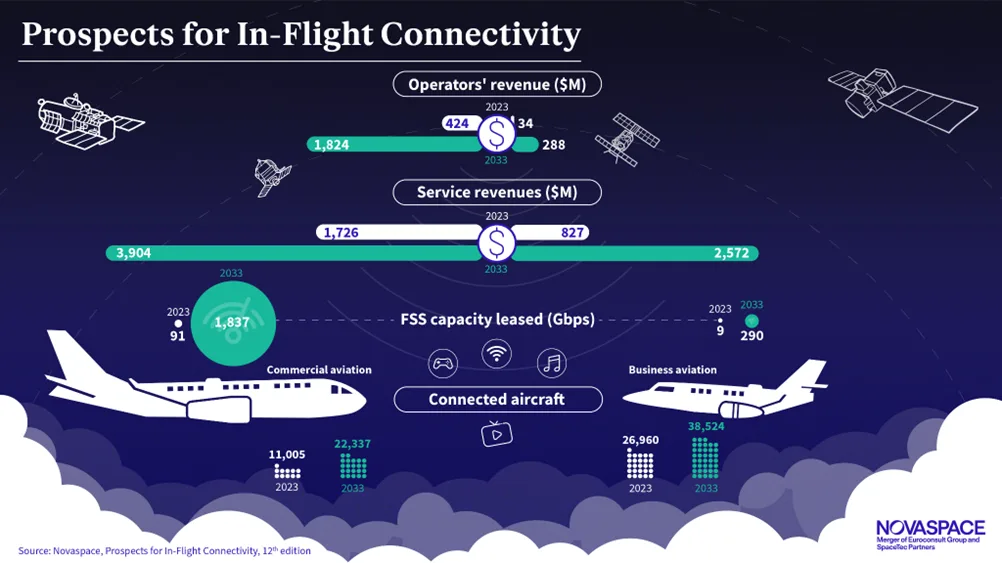

The global in-flight connectivity (IFC) market is set for substantial expansion over the next decade, with the number of connected aircraft expected to exceed 70,000 by 2035, according to a new report released by market intelligence and consulting firm Novaspace.
The report highlights strong growth across both commercial and business aviation segments, driven by rising passenger expectations for seamless onboard connectivity and the rapid adoption of next-generation satellite technologies.
By the end of 2025, nearly 39,500 aircraft worldwide were connected, with business aviation accounting for approximately 70% of the connected fleet. However, Novaspace forecasts that commercial aviation will become the primary engine of future growth as airlines increasingly invest in advanced connectivity solutions.
“By the end of 2025, nearly 39,500 aircraft were connected globally, with business aviation accounting for around 70% of the fleet,” said Vishal Patil, Senior Consultant at Novaspace. “Momentum is now clearly shifting, with commercial aviation adoption set to accelerate significantly in the years ahead, driving a substantial increase in capacity demand and supporting long-term revenue growth across the IFC value chain.”
Table of Contents
ToggleCommercial Aviation Connectivity Penetration Continues to Rise
According to the report, in-flight connectivity penetration in commercial aviation is projected to increase from 48% to 72% by 2035, reflecting airlines’ growing emphasis on enhancing passenger experience and digital services.
Business aviation is also expected to maintain strong momentum, with connectivity penetration forecast to rise from 67% to 88% over the same period.
The continued expansion of connected aircraft is expected to create significant opportunities for satellite operators, service providers, equipment manufacturers, and airlines worldwide.
NGSO Connectivity Reshaping the Aviation Communications Landscape
A key trend identified by Novaspace is the rapid adoption of Non-Geostationary Satellite Orbit (NGSO) connectivity solutions, including Low Earth Orbit (LEO) and Medium Earth Orbit (MEO) satellite constellations.
NGSO’s share of commercial aviation connectivity has already grown from 1% in 2024 to 14% in 2025. Over the next decade, that figure is expected to surge to 82%, fundamentally transforming the global IFC market.
The transition toward NGSO-based services is being driven by several advantages, including:
- Higher bandwidth availability
- Lower latency performance
- Improved network resilience
- Enhanced passenger connectivity experiences
As airlines seek to deliver faster and more reliable onboard internet services, NGSO networks are expected to play an increasingly central role in aviation communications.
Satellite Capacity Demand Forecast to Grow Nineteen-Fold
The expansion of connected fleets and rising passenger data consumption are expected to significantly increase satellite bandwidth requirements.
Novaspace forecasts that total leased satellite capacity dedicated to IFC services will increase from 212 Gbps in 2025 to approximately 3.9 Tbps by 2035, representing a 19-fold increase over the forecast period.
By 2035, NGSO-based solutions are expected to account for 89% of total leased IFC capacity, highlighting their growing dominance in the market.
IFC Operator Revenues Projected to Reach $2.9 Billion
Despite declining unit capacity pricing, the financial outlook for the in-flight connectivity sector remains strong.
According to Novaspace, total IFC operator revenues are expected to reach $2.9 billion by 2035, representing a compound annual growth rate (CAGR) of 16% over the next decade.
NGSO-driven demand is projected to generate approximately 87% of total operator revenues by the end of the forecast period, underscoring the critical role of next-generation satellite networks in shaping the future economics of the industry.
Strong Long-Term Outlook for In-Flight Connectivity
The report concludes that the global aviation sector is entering a new era of connectivity, supported by technological advancements, increasing passenger expectations, and expanding satellite infrastructure.
As commercial airlines continue to prioritize onboard digital experiences and satellite operators deploy increasingly capable NGSO constellations, the IFC market is expected to remain one of the fastest-growing segments of the aerospace communications industry through 2035.
About the Report
Novaspace’s In-Flight Connectivity Report provides a comprehensive assessment of the evolving cabin connectivity market across commercial and business aviation. The study examines industry trends, service provider market shares, the impact of emerging competitors, developments in IFC equipment, and the regulatory landscape.
Supported by a ten-year forecast, the report evaluates key market segments including addressable market size, active IFC-equipped aircraft, capacity usage, service revenues, average revenue per aircraft (ARPA), capacity ARPU, and operator revenues.
Read the Full Report
For a detailed analysis of the global In-Flight Connectivity market, visit:
🔗 Prospects for In-Flight Entertainment & Connectivity (IFEC)
https://nova.space/hub/product/prospects-for-in-flight-entertainment-connectivity/