
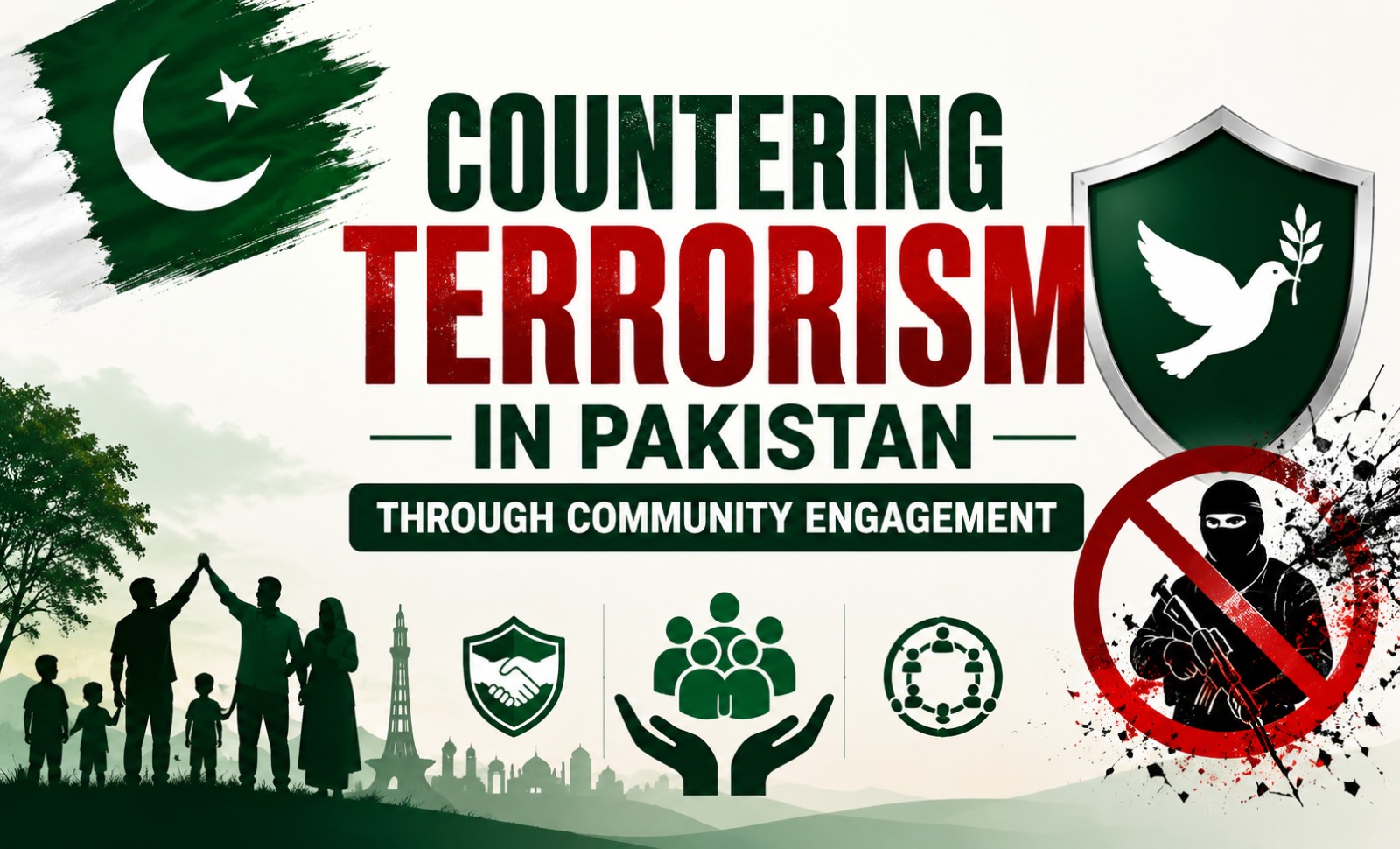

Many countries around the world now face the issue of violent extremism as a societal challenge, and for Pakistan, extremism and terrorism pose threats that undermine its national security. Internationally, in the context of power politics, the projection of power is carried out through might-is-right. Still, while living in any society, community, or country, the right approach is not to be a radical or extremist, but a person or citizen can improve their own personality in accordance with the rules and laws. Leaders should provide support to people through community initiatives to help them secure their due rights, and citizens should fulfill their duty towards their society, country, or state. For political gain in the power struggle, violent non-state actors use terrorism to influence stronger state actors by creating fear and disrupting law and order, rather than through direct military action. In accordance with the peace perspective, terrorists through terrorism, increase the insecurity and undermine the stability and block the conflict resolution process by the use of grievances, mistrust, and violence. Due to an increase in poverty, inflation, and lack of equality in education opportunities, and a rise in unemployment, extremist groups exploit the weak or vulnerable individuals, youths, and poor segments of society. Focusing on the long-term state-to-state cooperation among Pakistan, China, and the United States, the three countries, according to their governmental policies and national interests, keep in close contact to improve counter terrorism efforts.
Pakistan Armed Forces, sometimes near or far away from their homes, are stationed across the country to perform their duties to safeguard the national borders and national sovereignty. Soldiers and officers always performed their national responsibilities for the safety and security of the state and the welfare of the citizens. The military operations and strict security measures alone can’t stop or eliminate the violent extremists and terrorists’ activities. The countering of violence and terrorism can be achieved through involving citizens, community members, leaders, and politicians, and strengthening individuals through local peace initiatives in society. Strong citizens’ involvement is equally important to reducing or stopping extremist or terrorist activities as a preventive measure, because strong participation empowers citizens. Serving the community is important for the believers of Islam and/or followers of any other religion. The freedom is protected through the collective national strength by learning, growth, and progress. Through local policing, the government needs to focus on winning the hearts and minds of the people. A crisis of radicalization and extremism has been causing terrorism around the world and has particularly affected Pakistan because of hostile elements in the region, events such as the Pakistan-Afghanistan relations from 1978 to 2001, the 9/11 international scenario, and transboundary terrorism, the war on terror, continues to impact human society today.
On Margalla Dialogue 2024 – Emerging Global Realities: Challenges and Response, Pakistan’s civilian and military leadership highlighted that “Terrorism is a major challenge to world peace. Violent non-state actors and state-sponsored terrorism are a threat to traditional governance and state sovereignty. Terrorists in Pakistan use the umbrella for various violent and extremist outfits and organizations. Terrorism can be defeated through corrective peace efforts on regional and global fronts. All countries need to step up efforts toward regional peace and economic connectivity.” Other than this, many cases are being reported of illegal drug trafficking and smuggling in Punjab and Sindh, badly harming the quality of life of youth, professionals, and elderly citizens. In contrast, prevention measures and techniques with treatment options should be available for individuals who are adversely affected by the use of drugs. The Global Terrorism Index 2026 reported that Pakistan was most impacted by terrorism in 2025, and violence or extremist incidents have increased in Pakistan’s two provinces, including Khyber Pakhtunkhwa and Balochistan. Separatist violence emerges through underdevelopment, political alienation, ethnic grievances, and foreign intervention. Such issues affect Pakistan’s growing tourism industry and economy, especially in the Northern areas, including Gilgit-Baltistan, Skardu, and Azad Jammu Kashmir. Whereas Pakistan’s major regional security challenges, including economic disparities and cross-border terrorism, lead to geopolitical tensions emerging from the situation in Pakistan, India, and Afghanistan, beyond South Asia to the Middle East crisis, including the conflict of Iran, Israel, and America.
1st International Conference on Countering Terrorism and Violent Extremism (ICCTVE-2026) Held on 23-May-2026 at Minhaj University Lahore, Dr. Ahmed Javed Qazi, Secretary, Home Department, Government of Punjab, Keynote Speech at ICCTVE 2026 discussed that the National Action Plan was updated in 2019 and revised in 2021 as a national resolve, and the National Prevention of Violent Extremism Policy 2024 is also a significant policy initiative. Pakistan takes bold steps domestically, focusing on the diplomatic arena as terrorism is a global threat faced by nation-states across the world. Non-violent, educated youth is a strength for the Pakistani nation; internal resilience and national unity are a very important path that can lead us to peace, greater societal cooperation can lead to fewer threats of terrorism, and greater hope through community engagement, which is the need of the hour. The narrative of countering violent behaviour reflects Pakistan’s society, free from violence and harm for anyone. Terrorism is a reflection of two social diseases, including extremism and unemployment. Moreover, the violent non-state actors use the religious jihad narrative and the sectarian jihadi narrative, which have badly affected pluralistic and inclusive democratic values in society at large. Pakistan needs a diversified educational system and to give space for education to children and students from all walks of life, liberal, secular, or religious. Religious and community centers, worship place representatives, mosques’ imams, university professors, and students are considered the voice of peace; with the help of knowledge, youth can play their role on the internal and external fronts of Pakistan through constructive dialogue and social cooperation on national issues, including education and the economy.
Khurshid Ahmad Nadeem, Chairman, National Rahmatul-Lil-Aalameen Wa Khatamun Nabiyyin Authority, highlighted that Knowledge reproduction is the duty of universities around the world by critically analysing the problems and taking a solution-centric approach. With the community engagement approach, our society at the local and national level needs an alternative religious discourse that should not be sectarian but inclusive of Islamic values, as during the golden age of Islam, when religion, science, and technology combined traditional knowledge with modern scientific application. The government model of the state of Pakistan (Islamic Republic of Pakistan) can move from the security-centric state model to the welfare-centric state model. Paigham-e-Pakistan (Message of Pakistan) significant document, as Pakistan must move forward fast in its counterterrorism approach in the world, as Pakistan is a multi-religious, multi-ethnic country at its core; therefore, community dialogue comes first, and force is the last option to deal with the terrorists. Training for psychological well-being can help in strengthening the mental narrative. Teachings of the Prophet Muhammad (PBUH) are not only for Muslims but for all humans, as he (PBUH) has been declared “Blessings for All.”
Broadly focusing on peace education while linking to the community-based model for de-radicalisation, the PEACE framework is proposed by Prof. Dr. Hussain Mohi-ud-Din Qadri, Pakistan’s first-ever UNESCO Chair on Peace Education and Intercultural Dialogue. The framework comprises five pillars: Prevention, Engagement, Accountability, Counter-Narrative, and Economic Empowerment. Prevention focuses on early intervention through community institutions. Engagement emphasizes dialogue and family involvement in rehabilitation. Accountability calls for institutional reforms to build public trust. Counter-Narrative highlights the importance of educational and ideological reform. Economic Empowerment addresses the socio-economic conditions that fuel radicalisation. Dr. Hassan Farooq Maswani, Academician and Scholar, stated that strengthening the national narrative for strategic prevention of radicalization and counter-violent extremism (CVE) can help to achieve sustainable peace by connecting academia, policymakers, and communities for long-term peacebuilding relevant to the people’s welfare and national defence. Dr. Sara Raza Jafree, a Renowned Academician, discussed encouraging civic values among students for crime and terrorism prevention. Whereas Pakistan is a religiously pluralistic society, she further stated that reducing social marginalization through peaceful cooperation to address radicalization and reconciliation among members of society for better community engagement is possible by empowering local governance in the country.
Sometimes, a specified goal-oriented, peaceful, and non-violent struggle brings long-term results. Peaceful, constructive stability in Pakistan can be achieved without neglecting any segment of society, but with a deeper understanding of national and rights movements and by giving constitutional rights their due share to reintegrate people into Pakistan’s governance system, as our existence is due to an inclusive, stable, and strong Pakistan. It is necessary to maintain interprovincial harmony through students’ societies and university exchange programmes, supported by the Higher Education Commission, in order to advance academically and to bring close coordination between academia and industry. At the community or national level, the educational and economic well-being of researchers and scholars should be prioritized so they can effectively rise to the leadership level that Pakistan needs today and in the times to come.
Aimen Yousuf Mughal, Policy Analyst (Peace & Security), recommends that, moving forward, these conferences play a vital role in highlighting the milestones and challenges on the ground of CVE involving stakeholders; however, only focusing on the countering or preventive measures/models is not enough. We should even go beyond the complex-hybrid analysis and carefully design the governance structure in a way which starts right at home, securing early childhood first. If the state can ensure the basic needs, education, security, and welfare of the families and parents, radicalization will be minimized to the maximum extent. The collective family unit will be the first checkpoint, even if any such element erupts. Secondly, it is equally important to train the primary teachers and caregivers to teach children in a way that they embrace differences as well, and clashes of beliefs and opinions become a progressive way, not avenues of social boycott in the future. Instead of incorporating separate sections into the curriculum to promote peace and harmony, the entire education system needs a reset.
Salman Abid, Political Analyst, argues that reducing radicalisation requires addressing the root cause of youth alienation, economic insecurity, exclusion, and lack of opportunities through inclusive, practical public policies and community welfare. The significant challenge is to prevent youth involvement in extremism, radicalization, polarization, and terrorism, so the PEACE framework supports community engagement. It prioritizes human development in our daily lives, fostering stronger belief in social cohesion and national integration. The government and private sector of Pakistan’s job market, industry and businesses should engage or involve properly educated, skilful youth to work for halal earnings, so that productive citizens can’t be involved in extremist or terrorist activities. Brig (r) Dr Tughral Yamin, Senior Research Fellow and Associate (Institute for Policy Studies, Islamabad), drew attention to the fact that reducing radicalization and extremism, controlling insurgencies, and terrorism in Pakistan require a winning strategy and policy implementation that can be achieved through winning the trust of the common people across the country, which can contribute to improving their welfare, political inclusion, and post-conflict rehabilitation.
Wajahat Ali
The writer is a researcher and analyst with a focus on Pakistan Affairs and International Relations. He can be reached at communications.wajahatali@gmail.com.












One Response
The author deserves significant credit for constructing a highly cohesive bridge between macro-level state strategy and localized, grassroots interventions. By meticulously integrating perspective data from key civilian, military, and academic stakeholders, Wajahat Ali provides an invaluable scholarly service that elevates the discourse on human security within South Asia. For researchers in international relations and security studies, this commentary suggests that the next frontier of empirical study should not be what policies Pakistan needs to draft, but how local government institutions can be practically empowered to implement the localized frameworks (like the PEACE model) articulated in this text.