
As American bombs fall on Iran, public explanations focus on nuclear risk, deterrence, and regional stability. Some argue that sustained pressure could even open the door to a freer Iran. Each contains some truth, but none fully explains the underlying logic of the conflict.
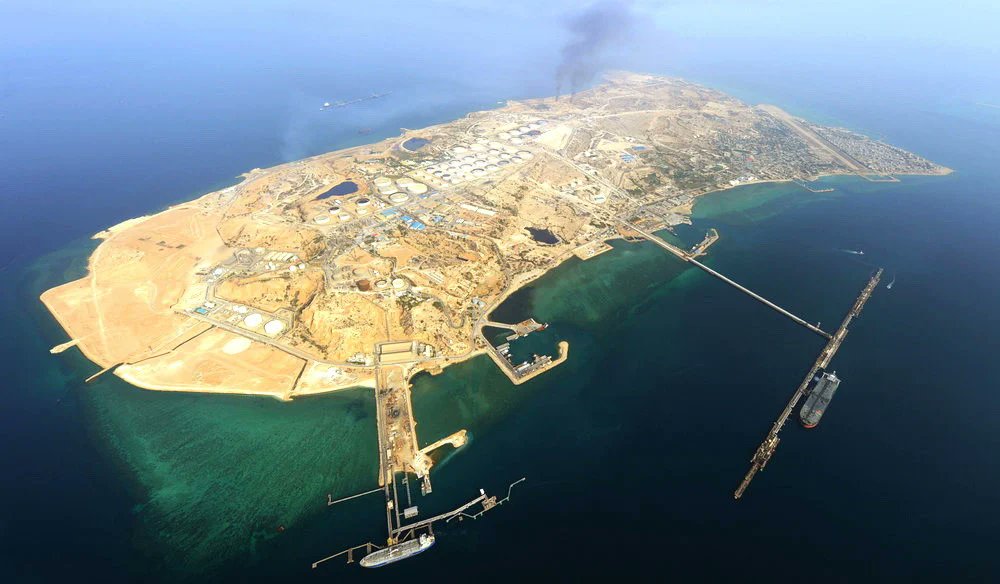
That logic becomes clearer when viewed through a single point on the map: Kharg Island, the terminal through which Iran converts energy into state power.
In modern warfare, logistics, not ideology, defines the limits of power.
Kharg Island: The Heart of Iran’s Oil
In the northern Persian Gulf sits one of the most important logistical nodes in the global energy system.
Kharg Island is small, narrow, and geographically unremarkable. It is roughly half the size of Manhattan and lies about an hour by boat from the Iranian mainland. Yet through its terminals, pipelines, and loading infrastructure flows roughly 90 percent of Iran’s crude oil exports.
In logistics terms, Kharg is not simply an island. It is a single point of throughput for the financial lifeblood of the Iranian state.
Tankers dock there. Pipelines converge there. Revenue flows outward from there.
Disrupt that node and the entire system constricts.
Recent behavior suggests Iranian leaders understand this vulnerability clearly. As American forces assembled across the region, Iran surged oil exports through Kharg from roughly 1.5 million barrels per day to nearly 4 million, pushing the island’s infrastructure toward maximum capacity.
That surge was not just an economic move. It was strategic signaling.
Tehran appears to believe the confrontation is not primarily about ideology or regime change. It believes the target is the logistical system that sustains the Iranian state.
Patronage and Power
Former advisers close to the Trump team reportedly described a possible post-conflict arrangement in which a new Iranian government would cooperate with Washington on oil production, similar to the evolving U.S. relationship with Venezuela. Analysts have been even more direct. If the Islamic Revolutionary Guard Corps cannot sell oil, it cannot fund the system of coercion and patronage that keeps the regime intact. Control the revenue stream, and the regime’s internal power structure begins to fracture.
When viewed through a logistics lens, recent military developments across the region take on a clearer pattern.
Military Operations: Shaping the Battlespace
Israeli strikes have targeted senior leadership, internal security headquarters, and frontier military posts. The effect is particularly significant along Iran’s northern and western borders, where Kurdish militant groups operate from mountainous terrain and cross-border bases in Iraq. As those security forces are degraded, Tehran’s grip on the frontier weakens, opening space for Kurdish fighters to pressure the regime from the outside.
Whether intentionally coordinated or opportunistic, the operational effect is the same. Iranian ground forces that might otherwise defend southern energy infrastructure are increasingly tied down securing border regions and suppressing unrest.
Every brigade positioned in Kurdistan is a brigade not positioned along the Persian Gulf.
Meanwhile, U.S. strikes, supported by Israeli operations, have crippled Iran’s maritime capabilities, destroying dozens of vessels and targeting naval infrastructure across a wide operational range, even as far as Sri Lanka.
Pressure builds along the borders. Naval reach recedes. Leadership falters. Slowly, the defenses around Iran’s most critical export node erode.
That node is Kharg. Its narrow geography and isolation make it especially exposed. External naval forces could, in theory, secure the island: destroyers offshore could protect tanker traffic, convoys could shepherd shipments through the Persian Gulf, and financial mechanisms could insure cargo even if commercial insurers pulled back.
In practical terms, whoever controls Kharg controls the primary valve on Iran’s oil revenue.
Choking the Artery: Global Stakes
The consequences extend far beyond Iran itself.
The Persian Gulf remains one of the central arteries of the global energy system, supplying enormous volumes of oil and natural gas to Asian economies. China in particular depends heavily on these flows. While Beijing has invested heavily in naval power, its maritime strategy focuses primarily on defending sea lanes closer to home, especially around the Strait of Malacca.
Directly contesting control of the Persian Gulf would be far more difficult.
If control over Gulf energy exports shifted, China would face a strategic dilemma. Its most immediate alternative would be greater reliance on Russian supply — exactly the dependency Beijing has spent decades trying to prevent.
Viewed from this perspective, the confrontation with Iran fits into a broader pattern of strategic thinking focused not on territory, but on critical chokepoints in the global system.
Greenland. Panama. Venezuela. The Persian Gulf.
Each location represents a bottleneck, resource pool, or transport corridor that underpins control over critical resources and influence.
Logistics: The True Driver of Conflict
Modern geopolitics increasingly revolves around these arteries. The states that control them gain leverage not only over battlefields, but over entire economic systems. Wars are often framed as moral struggles or ideological crusades, but logistics offers a colder explanation. Control the energy flow, and you control the system. Whether such a strategy would succeed is another matter. Tehran could resist. Global markets could react violently. China could accelerate alternative supply chains. Still, if logistics is the true driver behind events in the Persian Gulf, the confrontation with Iran is less about ideology than about controlling the infrastructure that powers the modern world.

Travis Veillon
Travis Veillon is a former marine infantryman and a federal employee with the U.S. Army Corps of Engineers. He has extensive education and experience in logistics, emergency management, and deployments to austere environments through disaster and recovery operations. His work focuses on operational realities, military adaptation, and strategic forecasting.