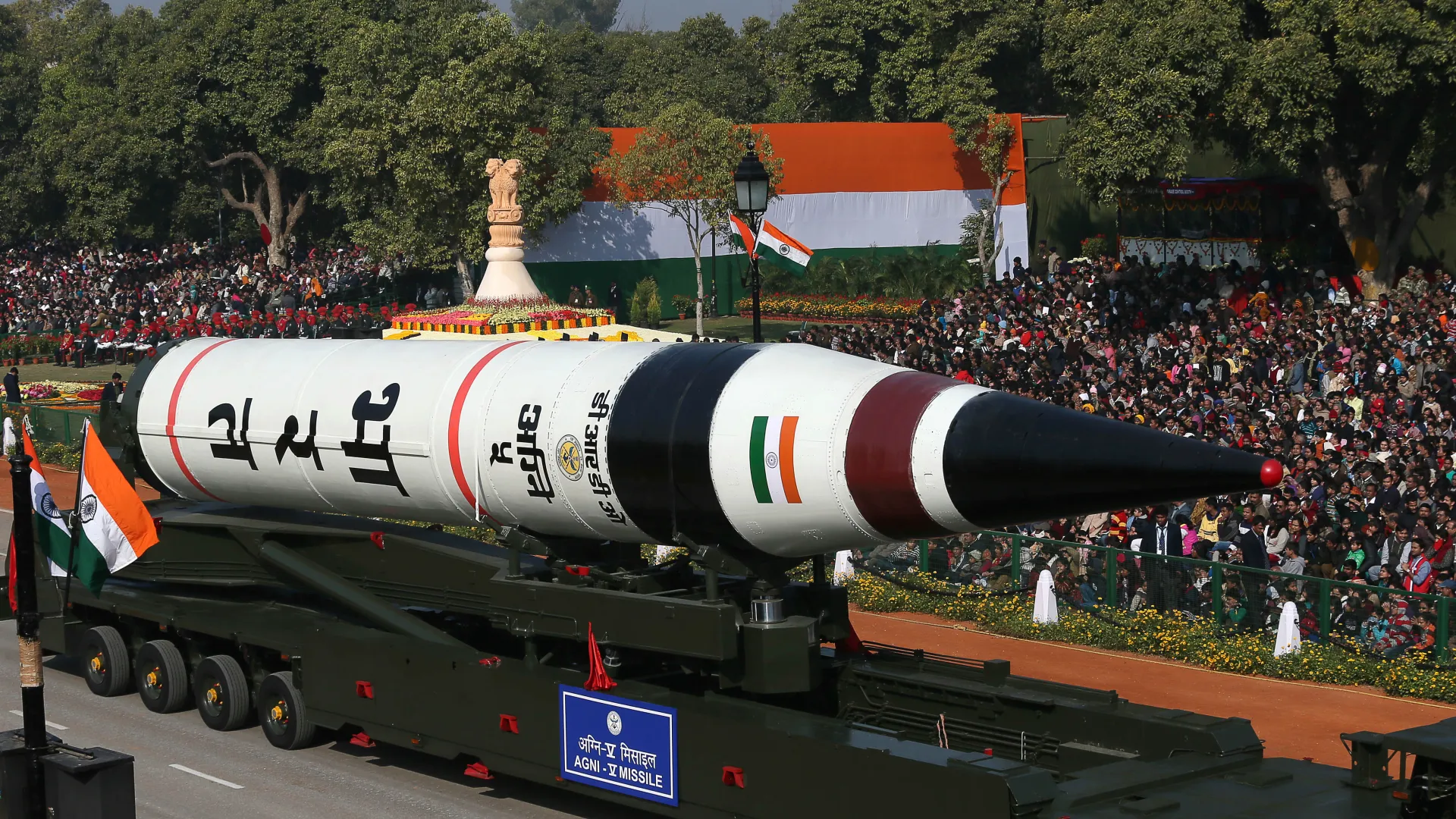

On April 30, 2026, at the ANI National Security Summit 2.0, Defence Research and Development Organisation Chairman Dr. Samir V. Kamat delivered a statement that deserves far more scrutiny than it has received in Western policy circles. Speaking directly on the Agni-VI ballistic missile, Dr. Kamat declared, “It is the government’s decision. We are ready whenever the government gives us the go-ahead.” These words were measured in tone but radical in implication. Kamat highlighted that “all preparatory work” for Agni-VI has been completed, indicating that the programme has moved beyond conceptual or design phases into a state of execution readiness
India’s long-range missile ambitions are no longer quiet, incremental, or easy to dismiss. The remarks by the head of the DRDO , cut through the usual ambiguity surrounding India’s strategic programs and pointed directly toward an expanding intercontinental horizon. His framing of technological progress and future capabilities, particularly in relation to the prospective Agni-VI, signals more than routine modernization—it reflects a deliberate push to extend reach, diversify deterrence options, and recalibrate India’s strategic posture.
In a region already marked by fragile deterrence dynamics, such signals are unlikely to remain neutral. They sharpen threat perceptions, complicate stability, and underscore a reality that policymakers can no longer afford to understate.
From an academic standpoint, this suggests a transition from latent capability to deployable potential, a critical threshold in deterrence theory where capability begins to carry signaling value even prior to deployment. The prospective Agni-VI is framed as a system that will significantly extend India’s strike range and may incorporate Multiple Independently Targetable Reentry Vehicle (MIRV) technology. The Agni-VI is expected to carry up to ten MIRV warheads and achieve a strike range of 10,000 to 12,000 kilometers, with DRDO having completed the missile’s design phase in 2025 and prototype manufacturing already underway. What Dr. Kamat announced was not a research ambition. It was a weapons program waiting for a green light .
A central theme in Kamat’s address was the accelerated progress of India’s hypersonic weapons development. He indicated that hypersonic glide vehicle (HGV) technologies are advancing more rapidly than conventional cruise missile systems, reflecting a prioritisation of technologies that operate at speeds above Mach 5.
Alongside hypersonics, Kamat emphasised the continued expansion and diversification of India’s conventional missile arsenal. This includes short-, medium-, and long-range systems within the Agni and Prithvi families, as well as cruise missile platforms such as the BrahMos series.
India’s desire to join the ICBM club, purported to be prestige driven requires an academic inquiry into the subject, especially its drivers, the correlation of capability ,intent and the strategic calculus behind the quest of beyond region ranges.
Bharat Karnad is widely regarded as the high priest of India’s maximalist or expansionist school of nuclear thought, a philosophy that has consistently argued for a larger, more powerful, and more globally reach-oriented nuclear arsenal than what India’s stated doctrine of credible minimum deterrence would seem to permit. His influence on Indian strategic culture has been substantial and enduring, and his advocacy for ICBMs and thermonuclear weapons represents the intellectual foundation on which programs like the Agni-VI have been justified. Karnad’s argument rests on a core claim: that India’s status as a rising great power demands a nuclear arsenal commensurate with global ambition rather than regional deterrence. In his academic work, Karnad has proposed that India should field 328 nuclear warheads, of which 253 should be thermonuclear devices with megaton yields, arguing that “if a counter-cities or counter-value nuclear bombardment strategy is the only one that makes sense, then thermonuclear bombs, with megaton yields, are the most convincing instruments of this strategy.” This is not the language of minimum deterrence. It is the language of nuclear warfighting at a civilizational scale. In one of his article, Karnad argued that India is “the only big state which manifests a stunning level of nuclear complacency and incompetence,” and called for new tests, augmented thermonuclear capability, and a shift toward a first-use nuclear doctrine and posture.
India’s justification for pursuing ICBM capability centers on deterrence requirements, particularly the need to credibly threaten targets across the full geographic depth of China. This is a legitimate but insufficient explanation. A careful examination of the program’s logic reveals that prestige, great power signaling, and status competition are equally powerful motivations, and these motivations carry consequences that pure deterrence rationales do not. This prestige imperative has been visible even in the commentary of senior Indian military officials. In June 2011, then IAF Chief Marshal Pradeep Vasant Naik argued that “India should pursue an ICBM programme to acquire ranges of 10,000 km or more,” explicitly stating that “breaking out of the regional context is important as the country’s sphere of influence grows.”
The most consequential and least discussed dimension of the Agni-VI program is its direct operational relevance to the United States and the Western hemisphere. A missile with a range of 10,000 to 12,000 kilometers, launched from Indian territory, can reach virtually any target in the continental United States, Europe, and beyond. This is a fact that Washington has chosen, with remarkable consistency, to overlook in its accommodation of India as a strategic partner.
From the perspective of great power competition, the coming decade may see the US confronting four military powers capable of striking the American homeland: China, North Korea, Russia, and India ( if it tests and inducts its ICBM) . This is more arithmetic than mere alarmism because a missile that can travel 12,000 kilometers does not respect the intentions of the state that built it. Intentions change. Governments change. The capability, once established, is permanent.
The pressing effect of India acquiring a credible ICBM capability may not be limited to the strategic level at all. It may be at the conventional and sub-conventional level, where the psychological assurance of a robust nuclear umbrella historically emboldens states to take greater risks. This dynamic, sometimes described in the strategic studies literature as the stability-instability paradox, holds that the presence of robust nuclear deterrence at the strategic level can produce greater instability and risk-taking at lower levels of conflict. A state that possesses the ability to strike any point on the planet with nuclear warheads is a state that calculates risk differently at every level below that threshold. It can be more aggressive in limited war, more willing to conduct cross-border strikes, more resistant to external pressure, and more dismissive of conventional military setbacks, because it ‘presupposes’ that it holds the ultimate insurance policy.
Coming to Dr Kamat’s remarks, the manner in which India’s mainstream media and defence commentariat have covered Dr. Kamat’s remarks is itself analytically significant. Rather than subjecting the announcement to critical examination on the grounds of arms control, regional stability, or nonproliferation norms, the dominant response has been celebratory, nationalist, and strategically incurious. India TV News ran a headline declaring that DRDO’s readiness signals India is “stepping closer to strategic supremacy. Analysts have observed that Indian television coverage of strategic and defence matters has adopted “an increasingly theatrical tone,” framing complex geopolitical developments as “triumphant spectacles of Indian ascendancy” while offering “little insight into India’s evolving strategic posture.”Likewise, the social media reporting in India utilized graphics that show missile reach to be USA mainland and Canada.
To summarize, it is very important to understand the motivations for an Indian ICBM range that go beyond China and Pakistan. A sea-based ICBM capability differs from land based ICBMS. Furthermore, ICBMs are not the instrument to be used for conventional strikes. Multipolarity will grow and India will seek to bolsters it “prestige driven” program, albeit the technical details highlight a different aim. It’s not a matter of if India makes an ICBM, but when……and for whom?

Hammad Waleed is a Research Associate at Strategic Vision Institute, Islamabad. He graduated with distinction from National Defence University, Pakistan. He writes on issues pertaining National Security, Conflict Analysis, Strategic forecast, and Public Policy. He can be reached at hammadwaleed82@gmail.com.