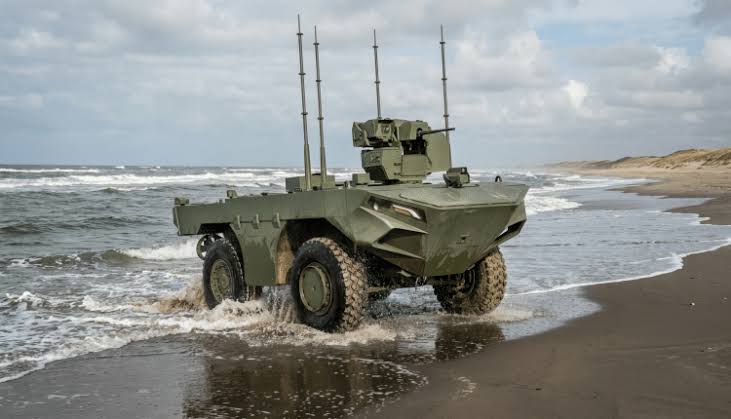

FNSS has unveiled U-MAV, a Multi-Purpose Modular Unmanned Amphibious Vehicle, at TEKNOFEST Mavi Vatan 2026, hosted by the Gölcük Naval Shipyard Command from August 20 to 23. The platform is designed to remove crews from the first wave of an amphibious assault, the phase of any beach landing that carries the highest risk, by operating as an unmanned manoeuvre element alongside the Marine Assault Vehicle (MAV/ZAHA) already in service with the Turkish Naval Forces Command.
In an amphibious assault, the defending force typically uses layered minefields, fixed obstacle belts, and machine gun or anti-tank guided missile emplacements to dominate the shoreline and slow the attacking force into kill zones. The interval between the assault force coming within range and crossing the waterline is often decisive, and defenders use that window to break the attacker’s momentum before the main force can land. U-MAV is built to absorb that risk instead of a manned crew: it makes first contact with shore defences ahead of the manned wave, works to neutralise mines and obstacles, and prepares the beach for the MAV/ZAHA’s approach and landing, continuing to support the operation through the seizure and securing of the beachhead.
Specifications and mobility
U-MAV weighs 8 tonnes at amphibious combat weight and is powered by a 300-horsepower powerpack, giving it a power-to-weight ratio of 37.5 hp/tonne. It swims at 7 knots and reaches 70 km/h on land, transiting from sea to shore without interruption. An independent suspension system and selectable tyre options are built in for varied ground conditions, while low visual, thermal, and acoustic signatures are intended to keep the platform difficult to detect.
Ten mission configurations on one common platform
The core of U-MAV’s design is modularity. Mission payloads can be swapped in the field in roughly 40 minutes, giving the platform ten configurations: Fire Support, Mine Clearance, Combat Engineering, Electronic Warfare, Reconnaissance, Deception, Counter-Drone, Navigation and Obstacle Marking, Logistics Support, and Casualty Evacuation. Multiple variants can be deployed together within a single operation, with a shared base platform and sustainment infrastructure intended to keep the logistics footprint low across all ten roles.
Command, control, and autonomy
U-MAV operates in autonomous, remote-controlled, or hybrid modes. An encrypted mesh network, a combined GNSS/INS navigation system, and an IFF identification module maintain command and control through the mission, with the inertial navigation unit holding position estimates when satellite signals are denied or degraded. Line-of-sight communications range out to 3 km, extendable through UAV relay across all variants. If the datalink is interrupted, the platform moves into a safe hold state before either returning to base along a pre-programmed route or continuing its assigned task, depending on configuration. Because operators stay aboard ship throughout, FNSS says the vehicle removes the casualty risk normally carried by a traditional vanguard force.
AI-enabled targeting and structural monitoring
An onboard AI image-processing system analyses camera feeds directly on the vehicle’s mission computer, sending detection data rather than raw video over the radio link, which preserves low-latency awareness in bandwidth-constrained conditions. Detected elements are tagged with threat scores and status through colour-coded overlays and intelligence cards, with automatic target detection prioritising items for the operator and logging every detection with a timestamp.
U-MAV is also the first unmanned platform to integrate Armor Integrity, a structural integrity monitoring system from Nurol Teknoloji. With no crew aboard to assess battle damage, the system’s sensors detect an impact’s location, direction, and severity, calculate the vehicle’s remaining structural capacity, and track damage that accumulates over time, feeding that picture to the operator and chain of command. If connectivity drops, the data is stored locally and transmitted once the link is restored, so the decision cycle continues uninterrupted. Commanders are presented with options based on the readout: manoeuvre to protect the weakened area, take cover, continue the mission, or shift to a passive role.
Deployability
U-MAV can move by road, rail, and sea using standard military transport, and is compatible with heavy-lift helicopters and strategic airlifters including the CH-47F Chinook, Mil Mi-26, C-130 Hercules, A400M, C-17 Globemaster, C-5 Galaxy, An-124, and Il-76, positioning it for rapid deployment to distant operational areas.
FNSS leadership on the launch
FNSS CEO and Board Member Selim Baybaş linked U-MAV to the company’s broader push into unmanned systems: “FNSS continues to grow its work and its R&D investment in unmanned and autonomous vehicle technologies. U-MAV brings together our engineering capability, the field success of the Marine Assault Vehicle (MAV) and our continuing R&D effort in a new-generation, heavy-class unmanned amphibious vehicle. Very few companies worldwide can build an unmanned amphibious vehicle of this size and capability. With more than 35 years of experience in the industry and an active production line able to build several different platforms concurrently, FNSS is one of a small number of NATO suppliers that can do so. I am proud to say that U-MAV opens a new era for FNSS.”