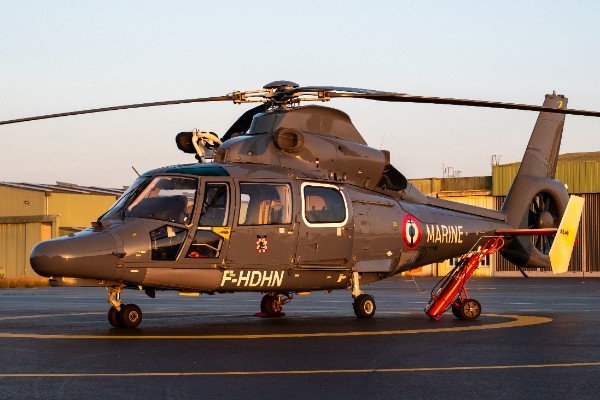

At the edge of the Crozon Peninsula, where the land sharply extends into the Atlantic, and the weather changes quickly and harshly, sits the French naval air station of Lanvéoc-Poulmic. It is here that Escadrille 34F/ESHE (Ecole de Spécialisation sur Hélicoptères Embarqués) carries out some of the most challenging missions in Europe and abroad.
This article looks behind the hangar doors at the people who lead, fly, and plunge into the water to keep the Atlantic safe.
For this interview, Roelof-Jan Gort spoke with Lieutenant Commandant Vallerie, Lieutenant David (pilot), Petty Officer Eva (System operator), and Second Master Delon (helicopter diver).
Escadrille 34F-ESHE – Mission, History, and Organization
Established in 1974, the Flottille 34F is one of the French Navy’s most storied helicopter squadrons. Originally part of the naval aviation corps under the Aéronautique Navale, it traditionally focused on anti-submarine warfare (ASW), liaison, and maritime patrol. Operating out of Base d’Aéronautique Navale Lanvéoc-Poulmic, 34F has been instrumental in linking naval air support with surface fleet operations. Over time, the unit has adapted to emerging threats and new mission profiles, reflecting France’s broader maritime strategy. Throughout most of the Cold War and beyond, the flotilla’s identity was closely tied to the Alouette III—a light, agile helicopter known for its versatility that served both on land and aboard ships. However, by the early 2000s, the aging airframe was no longer suitable for the demanding roles required in modern naval operations.
Introduced into French naval service in the 1960s, the Sud Aviation Alouette III was a light utility helicopter widely recognized for its reliability and adaptability. The aircraft was a staple across French military branches and proved particularly useful for maritime operations due to its compact size and robust design. Initially known for its long service operating the Alouette III, the squadron has evolved over decades from traditional naval missions to become a key part of national SAR coverage. When the venerable Alouette III retired, a new chapter began. The Ministry of Armed Forces contracted several AS365N3 Dauphin helicopters, which NHV Group, based in Belgium, would maintain and support, to ensure readiness remained uninterrupted.
The ESHE detachment at Lanvéoc-Poulmic embodies this evolution. While it forms part of Escadrille 34F, it operates with a hybrid structure: military crews work with aircraft managed under a state leasing model. The detachment is relatively small— a close-knit community of pilots, hoist operators, technicians, and the renowned nageurs-sauveteurs (helicopter divers). Despite its size, it bears significant responsibility. Each year, the crews handle dozens of missions ranging from minor assistance to daring nighttime rescues in rough seas.
The Commanding Officer – Leadership on the Edge of the Atlantic
The heart of 34F-ESHE is the commanding officer, Lieutenant Commandant Vallerie, a naval aviator with years of operational experience and about 400 flight hours on the Dauphin, but having logged most of his total flight hours on the Lynx (2,000 hours in total). He joined École Navale in 2008 and completed his studies with the Jeanne d’Arc mission in 2011. After passing the Cap 10 aircraft selection, he transferred in 2012 to the Army’s Initial Helicopter Pilot Training School in Dax. Following his instrument flight training in 2013 at Le Luc, he joined Squadron 22S at the Lanvéoc-Poulmic Naval Air Station, where he advanced his naval aviation career and assumed increasing leadership responsibilities.
Since June 2015, he has served in Flotilla 34F, operating Lynx helicopters on anti-submarine frigates such as Lamotte-Picquet and Primauguet. As the detachment commander, he led helicopter operations and managed a team of 12 sailors, demonstrating strong leadership and management skills.
After years at sea—during which the Lynx was retired—he was assigned in 2020 to the training division at ALFAN Headquarters in Toulon, where he helped prepare crews for operations. In 2022, he rejoined Flotilla 34F in Lanvéoc, now with Dauphin helicopters. He served as Deputy Operations Commander, Executive Officer, and Commanding Officer, demonstrating his professional growth and dedication.
His office overlooks the ramp where the Dauphins rest, though he rarely stays seated for long. His leadership philosophy is based on three pillars: competence, trust, and calm. Competence is maintained through rigorous training and strict adherence to procedures; trust develops from transparency and shared operational experience; calm is what keeps a mission together when weather and sea seem determined to break it apart.
Lieutenant Commandant Vallerie discusses his duties as Commander. “The Flotilla 34F/ESHE is a unit with multiple missions, which makes it both complex and fascinating. As Commander, I am responsible for ensuring the maritime training of future French Navy helicopter pilots before they are assigned to operational forces. We also provide functional support to three (soon four) overseas detachments (Tahiti, Réunion, and Nouméa). This is why we like to say that the sun never sets on 34F! Finally, we maintain two detachments that embark on French Navy vessels and help protect the oceanic component of our nuclear deterrent, a critical element of France’s strategic defense.
He continued about the missions and training he is doing: “As commanding officer, I mainly focus on training flights for our student pilots, as well as instructing already-qualified pilots, particularly to certify them for sensitive missions such as night hoisting, night deck landings, and anti-ship warfare, a new capability for the flotilla that we are gradually strengthening. When needed, I can, of course, contribute to the successful completion of the flotilla’s operational objectives.”
He goes further into the core missions at 34F: These are our core missions:
- Protection of maritime approaches
- Surveillance and control of maritime areas
- Combating drug trafficking at sea
- Countering surface threats (anti-ship warfare)
- Policing and control of fishing activities
- Combating marine pollution
- Transport of personnel and cargo
- Fast-roping operations
- Initial and advanced helicopter pilot training (ESHE)
He speaks openly about the difficulty of managing a unit that must work smoothly with many external partners. “We are military,” he says, “but we save civilian lives. We work with the Préfecture Maritime, CROSS, medical emergency services, and, at times, neighboring countries. Coordination is essential – one link breaking can cost a life.”
Looking ahead, the commandant outlines his vision for Flotilla 34F: “My goal is to transform the unit by enhancing our anti-ship warfare capabilities and preparing for the transition from Dauphin aircraft to the next-generation HIL helicopters. While the Dauphin is renowned for its speed and agility, new models like the H160M Guépard will shape the future of French naval aviation. Our mission remains unchanged, but our implementation, especially under challenging conditions, will improve with technological advancements. Professionalism will always be our core value.”
École de Spécialisation sur Hélicoptères Embarqués (ESHE)
At the 34F at Lanvéoc-Poulmic, they also operate the Embarked Helicopter School (ESHE). This school is the final stage of training for French Naval Aviation helicopter pilots before they join operational squadrons. The program includes IFR navigation, low-altitude navigation, night navigation using night-vision goggles, maritime overflights (day and night), hoisting exercises (rescuing shipwrecked persons or persons aboard ships), and deck-landing exercises.
The school also trains Army, Air Force, and National Gendarmerie helicopter pilots in deck-landing through “deck-landing qualification” courses. Occasionally, foreign trainees attend to obtain this certification and bring our aviation culture back to their home countries.
The first phase focuses on basic flying, allowing trainees to become familiar with the Dauphin N3’s routine and emergency procedures. Next, students train for maritime missions (radar navigation, hoisting, and deck landings), followed by night navigation using night-vision goggles. Finally, they complete a military instrument flight qualification.
The Pilot – Mastering the Machine and the Sea
Lieutenant David, who has been a pilot on the Dauphin helicopter since 2025 and has more than 100 flight hours on this type of helicopter, explains his work as a pilot and his experiences.
Pilot training in the French Navy takes about three years. All French Navy pilots undergo flight selection tests in an aerobatic aircraft, the CAP10. These tests determine the pilot’s future specialty: fighter aviation, maritime patrol, or helicopter operations. Helicopter pilot training begins in Dax at an Army Aviation base, where all French armed forces helicopter pilots receive their initial training for approximately 1.5 years. The next phase takes place at HUTC in Angoulême, where pilots earn their instrument flight qualification. Training concludes in Lanvéoc on the Dauphin helicopter over about ten months, with a focus on French Navy missions.
Regarding his role as a pilot, Lieutenant David explains: “My primary role as a pilot is to fly the aircraft. The captain is also a pilot, but his role is to lead the mission. This gives him the perspective needed to manage the operational environment and places him in the best position to ensure overall safety. At sea, we fly with a fixed crew, meaning the crew composition remains the same. However, at the squadron in Lanvéoc, crews rotate frequently. This rotation allows us to combine each pilot’s experience and enhance overall safety.”
He goes further: “Most of the time, we fly the Dauphin with a three-person crew: one captain, one pilot, and one crew member responsible for the cargo bay and the winch. During maritime patrol missions, the crew members help assess the tactical situation, assist with landings in confined areas, and manage checklists. If required, a diver may also be on board to rescue individuals from a shipwreck. If necessary, we can either put a machine gun on board or take a sniper on board.
For a real mission at the 34F, the day begins with a briefing covering the weather forecast, the mission plan, airspace constraints, and any helicopter-related technical considerations. All training flights begin with a detailed briefing, during which the exercises are thoroughly explained. The aim is to ensure the student fully understands the flight and has no confusion. During the flight, exercises are conducted while the instructor shares insights to help the student progress rapidly. Afterward, a debriefing session allows the student to ask any remaining questions. For a training mission, a briefing session takes about one hour, but when needed, they can take off in about ten minutes. Everyone in the squadron has a “fonction sol,” which refers to ground duties. Some of us are responsible for flight planning or ensuring aeronautical safety. Lieutenant David serves as the squadron’s communications and partnerships officer.
At the 34F, pilots are also training in a simulator. In this simulator, pilots conduct IFR training and practice shipboard landings. The simulator is located in another building and features a Dauphin helicopter cockpit with a large screen that provides a 180-degree view, enabling highly realistic simulations.
When asked by Lieutenant David about the most challenging aspect of a night mission for a pilot, he explains: “Procedures allow us to manage risks and hazards. Winching operations over a boat are the most dangerous because of the high risk of collision. Hovering above the sea without a landmark requires a lot of experience.” He goes further: “But during a training flight, when the weather is too poor, we do not take the risk of flying. However, when a mission requires it, we can afford to push the limits.”
The System Operator – Where Technology Becomes Survival
On the Dauphin helicopters, the system operator sits in the back of the aircraft. Petty Officer Eva, who has been in service at the 34 since 2023, talks about her job and experiences as a system operator on the Dauphin helicopter.
Petty Officer Eva explains how she became a system operator at the 34: “I became a system operator on the Dauphin N3 right after I finished “school,” so the 34F/ESHE is my first unit. I chose the Dauphin N3 because during our “school” training we were flying with it and thought it would be a good idea to continue gaining experience before going to another helicopter.
The job of a system operator is very different from that of the pilots. Petty Officer Eva: “First of all, in the basic mission, we are only with three crew members in the helicopter, two pilots and one system operator. And of course, one diver if we go on a winching mission. Our jobs differ. The pilots “drive” the helicopter, handle the radio, and check all parameters that could affect the flight. My job, on the other hand, is to assist them in checking the helicopter’s parameters, such as fuel pressure and engine temperature. We are often the first to notice a problem because we sit a little farther from the dashboard and have a clear view of most of it. We also handle everything at the rear of the cargo, as pilots can’t move from their seats and can’t see what’s happening behind them. My job also requires me to open the back doors, either to winch the diver out or to check for obstacles on the tail or the ground to avoid damaging the landing gear. The pilots can land on their own, but when landing on unknown ground, we have a better view and can tell them whether it’s clear to land.”
Before each flight, the crew briefing typically takes place one hour before departure. For the briefing, the system officer is responsible for obtaining the helicopter’s performance data, including the total weight before departure and any weight or wind limitations for specific phases of the flight. For the winching mission, she is also responsible for verifying the integrity of all equipment, including the stretcher. She then checks the helicopter’s exterior and interior for any issues. She also checks the hoist and its cable to ensure they are safe for the winching mission and prepares the cargo as she deems necessary, including seat positions, where the passenger will sit, and where he’ll place the equipment he is bringing.
During typical missions, they are responsible for everything that enters and exits the helicopter, including passengers and divers. They are responsible for their safety at all times. They also check all aircraft parameters and fuel quantity, even though pilots are responsible for these as well. We serve as the safety net for the crew when the pilots are occupied elsewhere. During the winching operation, the hoist is the primary piece of equipment, so before departure, she must check it to ensure it is in good working order. If the diver is next to her during the test, she checks it as well. Then, during the winching operation, she uses a hoist handle to control the hoist’s up-and-down movement. She doesn’t use the hoist during deck operations, so it’s turned off to avoid any accidents.
Petty Officer Eva explains how she assists with navigation and communications alongside the pilots: “During navigation, the pilots use their tablets, so when they are looking for specific objects, they tell us what they are looking for, and I look out for it and help them find it. If their tablet isn’t working, I always have a map with me. For communications, it’s mostly the pilots’ responsibility. Still, I can hear the radio at the back, so during any operations I can follow what’s being said, what’s happening around us, and I can also talk on the radio if needed.” She continues: “For deck landings, I help ensure safety by confirming with the pilots that everything in the helicopter is ready. Then, when above the deck, I sometimes help them get into the correct landing position. Another demanding phase is deck takeoff at night. It’s a phase when pilots must be very focused, so no one talks except the pilot in command. For winching evolutions, it’s really a conversation between the pilot in command and me.
Once the pilot is stabilized and ready, she listens to and trusts my directions when winching the diver down from a ship or from the water. At first, the pilot might see where we want the diver to land, but as we come closer to the vessel or the decided point, he won’t see it anymore because the hoist is behind him. If he needs to make any corrections, the pilot tells me what he wants to do, and I ensure it can be done safely for everyone, whether it’s us in the helicopter or the diver/person at the end of the hoist cable. There are also VERTREP operations, where we have something loaded under the aircraft. We don’t have much control over it, so I have to check outside to ensure it’s not moving too much, as it could put us in danger. The load can exceed 300 kg and affect flight. If it starts moving, I inform the pilots and try to control it using a rope attached to the sling. Then, when we have to land it on the ship’s deck, I guide the pilots to the right place.”
When asked about the key safety concerns he monitors in the cabin during the flight, Petty Officer Eva explains: “The key safety concern is fuel quantity. Ensuring consistent consumption is essential; otherwise, there might be a leak. You can imagine how serious this is above water, where the ship or the nearest land could be far from us. There are also other parameters to monitor, such as engine temperature, fuel pressure, hydraulic pressure… everything related to what makes the helicopter fly.”
What’s the most rewarding aspect of being a system operator in 34F? I’d say it’s the chance to fly almost daily, stay involved in the action, and feel useful to the mission. For instance, during winching operations, the diver couldn’t descend independently. Plus, there’s a sense of pride in knowing we have a unique job that few others do, giving us a real sense of purpose.
How will the role of the system operator change with future helicopters like the Guépard HIL? “I believe a system operator will always be necessary. While automation has taken over many functions as helicopters evolve, certain tasks, such as winching, still require human involvement. We may need to develop new skills or adopt new methods, but I don’t think the fundamental nature of our job will change significantly,” he said.
The helicopter diver – The Last Link Between Life and Death
If the pilot guides the aircraft, the helicopter diver carries the emotional and physical burden of the mission. The nageur-sauveteur is the one who leaves the safety of the cabin, harnessed to a steel cable, and descends into cold, turbulent water to reach a person who may be injured, hypothermic, or panicking.
Second Master Delon, 34 years old, has been serving at the 34F as a helicopter diver since March 2025. He shares his job and experiences as a helicopter diver at the 34F.
He describes what the training as a helicopter diver entails: “First of all, it is important to know that in the French Navy, you must be at least 30 years old to enter the selection. Training to become a helicopter diver takes three years. The 3-year training begins with medical and physical selection. After that, there are two modules at CESSAN, the Naval Aviation Survival and Rescue Training Center, based at BAN Lanvéoc-Poulmic. At this training center, we have a six-week shipboard diver course, followed by a VOL module. At CESSAN, trainees learn survival at sea and how to evacuate personnel who have fallen overboard. The diver course provides diving training equivalent to Level 3 in French civilian diving. Finally, the VOL module focuses on personnel rescue, from shore operations to helicopter evacuations.”
At BAN Lanvéoc-Poulmic, the helicopter divers typically train at sea two to three times a week. To manage stress and pressure during operations, they are taught to channel it through meditation (TOP: Technique for Optimizing Potential). In addition, they sometimes interact with personnel from other countries (CROSSDECK). However, these exchanges remain rare. When asked how a SAR training session looks for a helicopter diver, Second Master Delon explains: “Everything is conducted as if it were real, except we cannot place personnel in the stretcher during hoisting exercises because it is considered too risky. For this, we use substitutes such as mannequins.” When not engaged as a helicopter diver, he performs maintenance on the Dauphin helicopter as a mechanic.
The primary mission of a helicopter diver is medical evacuation (EVAMED). For helicopter divers, the absolute priority is the safety of the crew and their own lives. However, they operate under the aircraft commander’s orders to ensure mission success. When asked whether he ever felt fear when entering the water, for example, during storms or when facing very high waves, he explains: “The immensity of the ocean can be intimidating, especially when it is rough. We are just a small thing in the middle of this vastness. That said, we have all the necessary equipment to handle potential complications, either in the water or in the helicopter. There are circumstances in which I may choose not to enter the water. But these circumstances are scarce. The assessment is personal. If the aircraft commander instructs me to descend and I know it would cost me my life, I have the final say to refuse. Conversely, if I believe I can do it and the commander says no, I must follow his orders.”
NHV Dauphin N3s Strengthen 34F Embedded Helicopter Training
On 24 December 2025, the DMAé (Direction de la Maintenance Aéronautique) notified NHV Group of a contract to rent helicopter flight hours for the benefit of the 34F flotilla, particularly the School of Specialization on Embedded Helicopters (ESHE).
This contract was awarded following a public procurement procedure launched by DMAé in early 2025. It covers the daily provision of three to four airworthy AS365N3 helicopters to 34F/ESHE. Under this contract, NHV is responsible for helicopter supply, maintenance, logistics support, and fleet airworthiness management. Operations are conducted by the Marine française 34F/ESHE.
To ensure the required daily availability, NHV will deploy five AS365N3 helicopters to perform 2.500 flight hours per year. This additional capacity allows us to maintain operational availability during scheduled and unscheduled maintenance periods. NHV employs a local team of approximately 15 personnel in Lanvéoc, supported by our headquarters in Ostend.
The contract duration is 78 months, ending in 2032.
Conclusion – The Enduring Role of 34F-ESHE
As long as sailors venture into the Atlantic, units like 34F-ESHE will remain indispensable. Their mission demands a rare blend of discipline, courage, and technical mastery. While equipment may evolve and procedures may refine, the essence of their work remains unchanged: saving lives when the sea becomes unforgiving.
Lanvéoc-Poulmic, perched on the rugged Breton coast, may appear quiet at a distance. But inside its hangars, crews are always ready, knowing that the next call could come at any moment – and that someone, somewhere offshore, may be waiting for the sound of a Dauphin approaching through the wind.
Roelof-Jan Gort thanks Ms. Chelbi from SIRPA MARINE, Ms. Canévet and Ms. Le Roux from the communication section at BAN Lanvéoc-Poulmic, and Lieutenant Commandant Vallerie, Lieutenant David (pilot), Petty Officer Eva (system operator), and Second Master Delon (helicopter diver) for making this article possible.

Roelof-Jan Gort, a Dutch photographer based in the heart of the Netherlands, has been capturing the world of military aviation across Europe since the 1990s. He is the co-founder of FlyHighAeromedia.com, where for over five years he has co-authored numerous articles on military exercises and both military and civilian helicopters, published internationally.