Armored warfare is undergoing a significant transformation as modern battlefields demand greater mobility, survivability, autonomy, and integration with emerging technologies. The growing threat from drones and loitering munitions, alongside the rise of hybrid propulsion, autonomous systems, directed-energy weapons, and networked operations, is reshaping how armored vehicles are designed, protected, and employed. FNSS is responding to these developments through a new generation of platforms focused on mobility, modularity, layered self-protection, and adaptable mission capabilities.
Against this backdrop, Global Defense Insight (GDI) interviewed Gökhan Tekin, Programs and Business Development Director, International Markets at FNSS, to discuss the company’s evolving land systems strategy. The conversation explores the KAPLAN family, CFL-120 KARPAT, PARS ALPHA, autonomous and hybrid technologies, counter-UAS capabilities, international partnerships, localization, and FNSS’s outlook for the future of armored warfare over the next five to ten years.
With the KAPLAN APC nearing full production and the CFL-120 KARPAT medium tank recently unveiled on the same platform, how do you see the KAPLAN family evolving toward higher firepower roles?
KAPLAN family itself. It’s FNSS’s tracked armoured vehicle family: high-mobility, modular platforms designed to operate alongside modern main battle tanks. It actually comprises four members: KAPLAN-10, KAPLAN MT, KAPLAN APC and KAPLAN FSRV.
KAPLAN-10 is our new-generation armoured combat fighting vehicle, and what makes it special is that it has the ability to move together with main battle tanks. Its platform design also enables the integration of different types of subsystems, so it can perform all kinds of missions.
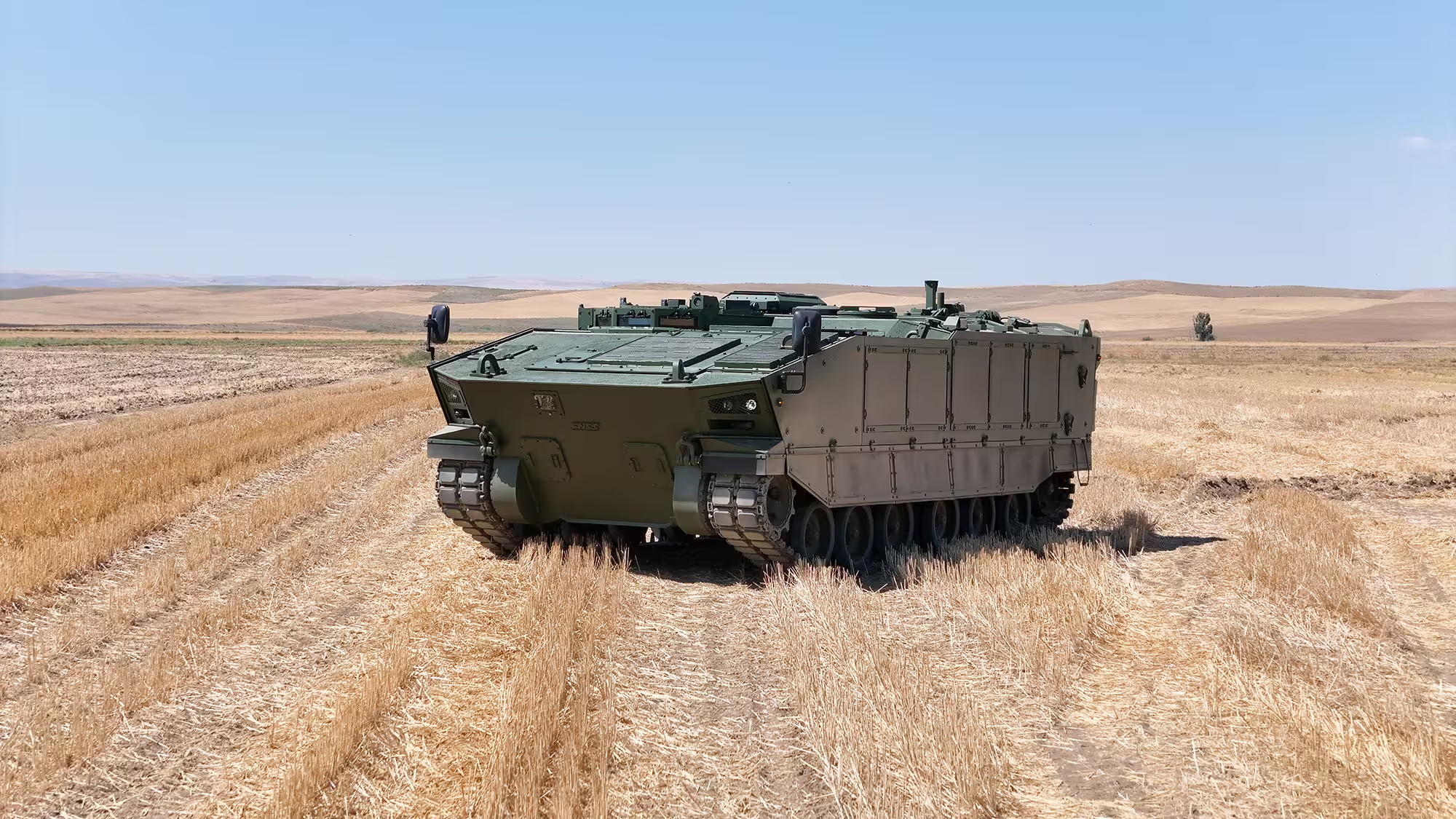
The KAPLAN Armoured Personnel Carrier is approaching full production. It differs from KAPLAN MT in its structural design: it will accommodate a crew of 13 personnel, including the driver, commander and a gunner. Since it’s a modular vehicle, we’ve designed it with possible integration options for both manned and unmanned turret systems, armed with light and medium calibres, as well as 120mm mortars and ATGM turrets and weapon systems.
We introduced the CFL-120 KARPAT Medium Tank on the same Kaplan MT hull, integrating Leonardo’s HITFACT MkII turret with a 120 mm NATO-standard cannon. It delivers main battle tank-level firepower while retaining KAPLAN’s mobility, air-transportability and reduced logistic footprint. That positions it as a cost-effective alternative to full-weight MBT fleets: you get that firepower without the procurement and through-life sustainment costs that come with them.
The KAPLAN family spans a wide and versatile range of missions, mission modules and firepower levels. It’s really a scalable platform family, built to respond to the emerging requirements of modern warfare.
FNSS has been developing hybrid and optionally-manned platforms, including the ALKA-KAPLAN HYBRID system integrating ROKETSAN’s directed-energy technology. What operational requirements are driving this shift toward hybrid propulsion and autonomy in armored vehicles?
The threat picture is evolving very fast, and that’s really what’s driving this. Ground units are facing new challenges, especially from the drone and loitering munition threat, and that’s pushing armies toward layered, mobile, close-in air defense. This is the operational need behind ALKA-KAPLAN HYBRID, which we developed jointly with ROKETSAN on the KAPLAN hybrid platform: a two-layer counter-UAS capability, with soft-kill electromagnetic jamming on one side and a hard-kill laser weapon on the other, so you can neutralize mini and micro UAVs and loitering munitions while preserving your missiles and ammunition for higher-value targets.
We’ve always placed great importance on indigenous design: developing our own new-generation drive systems, suspension systems, gearboxes and powertrains, in line with the development and adaptation of new-generation technologies for armoured combat vehicles.
With the integration of ALKA DEWS, developed by ROKETSAN, into FNSS’ KAPLAN HYBRID platform, and enhanced further with autonomous capabilities, we now have what we call ALKA-KAPLAN HYBRID-AUTONOMOUS. It stands out with its high manoeuvrability, silent driving, extended mission duration, and its ability to support optionally manned, autonomous and high-energy mission systems. Thanks to the hybrid powerpack, both mobility and mission-system requirements can be met without needing to transport an additional power unit. The hybrid powerpack is also capable of providing energy to distant locations and operational centers, such as command posts and mobile HQs.
Recently we also released U-MAV, our Multi-Purpose Modular Unmanned Amphibious Vehicle: a next-generation unmanned manoeuvre element designed to operate in close coordination with Marine units equipped with the MAV/ZAHA amphibious assault vehicle. Its primary mission is to establish initial engagement with enemy coastal defences ahead of the manned MAV/ZAHA elements, neutralise mines and obstacles according to its configured payload, prepare the beach for the manned MAV/ZAHA approach and landing, and then provide support throughout all the subsequent phases of the operation.
Our R&D more broadly focuses on sustainable innovation, domestic localization, and next-generation armoured vehicles; we’re working on autonomy, hybrid propulsion, AI integration, C-UAS systems and MUM-T technologies. Our target is clear: within five years, we want more than 50% of FNSS’s revenue to come from products that aren’t even in our current portfolio yet. These targets are aligned with less dependence to other countries for Turkiye, and FNSS presents this aspect to friendly countries as technology and capability transfer.
As battlefields shift toward distributed, multi-domain operations, how is FNSS adapting vehicle design, including protection, mobility, and sensor and weapons integration, to meet these evolving requirements?
If you look at the lessons from recent conflicts, one thing really stands out: single, isolated platforms get neutralized very quickly. Area dominance today favors vehicles that are more cost-effective and faster to produce, rather than simply maximizing armor. This is why we see the priority shifting toward 6×6 armoured vehicles and light tracked platforms, with mobility increasingly being prioritized over armor thickness.
At the same time, we’re building in layered self-protection (soft-kill and hard-kill counter-drone capability) that can scale across all of our platforms, , focus on Self-Defense of platforms and platoon level formations.
You can see this shift very clearly in the design of PARS ALPHA 8×8, for example, with its enhanced mine protection and mobility. Honestly, if you look across the board (U-MAV, KAPLAN HYBRID, KAPLAN FSRV) you can see that FNSS’s entire development strategy has shifted accordingly.
FNSS recently signed a framework agreement with CSG Defence to establish a new European land systems partnership anchored by the CFL-120 KARPAT. What does this venture signal about FNSS’s broader European market strategy?
We signed a framework agreement with CSG Defence to establish Danube Defence Systems, and the anchor platform for that venture is the CFL-120 KARPAT Medium Tank, though the scope of it is actually broader than just one vehicle.
In this partnership, CSG Defence will lead marketing and manufacturing, initially through MSM Land Systems’ facility in Trenčín, Slovakia, while FNSS provides the technology transfer, engineering know-how and platform licences needed for local European production.
Beyond the KARPAT Medium Tank, we’re planning to extend the venture to the wider KARPAT family (APC and armoured combat vehicle configurations), as well as additional FNSS wheeled and tracked platforms and our full turret portfolio.
What this really signals is a genuine in-region industrial partnership, one that’s positioned to address Europe’s growing preference for locally produced capability, including SAFE-related and nationally funded programs.
- With cooperation agreements in place with PT Pindad in Indonesia and SAMI LAND in Saudi Arabia, how central is localization and in-country production becoming to FNSS’s export strategy?
FNSS already has a proven record when it comes to localization and technology transfer with various countries. Our ongoing project with PT Pindad is a good example — we cooperate with this local, competent partner to co-design and co-manufacture an advanced family of vehicles together. Kaplan MT, which is already in the Indonesian Army’s inventory, has proven itself not only on the ground, but also within the production line we’ve established in Indonesia.
We also have a long history with KSA: a three-phase modernization of the M113 platform, covering more than 990 vehicles over an extended period. Right now, we’re planning to team up with SAMI Land to help KSA reach its Vision 2030 goal, by transferring our state-of-the-art wheeled platform technology to the maximum possible level. The detailed study is still ongoing, but our ultimate goal is for SAMI Land to be able to attain the whole manufacturing process of PARS vehicles in KSA.
Between the Next Generation Vehicle Project for the Turkish Land Forces and growing export interest in PARS ALPHA, how does FNSS balance domestic delivery commitments with international demand?
PARS ALPHA 8×8 has been selected for the Turkish Land Forces’ Next Generation Vehicle Project, and that selection also happens to be our strongest export reference — several countries are following the programme closely and expressing direct interest.
In fact, requirement-driven design adaptations for PARS ALPHA are already underway for friendly and allied nations. To support both tracks at once, FNSS is doubling its vehicle production capacity, and we’re shifting our whole production approach: from a model led mainly by cost-effectiveness with limited schedule pressure, to one where delivery schedule is now the most critical planning factor.
Looking ahead five to ten years, how does FNSS see the role of armored land systems evolving alongside autonomy, directed-energy weapons, and networked, multi-domain warfare?
Looking five to ten years out, we expect cost-effective, highly mobile platforms with integrated self-protection to take priority over maximum-armor solutions. That’s where we see concentrated demand — on 6×6 armoured vehicles and light tracked platforms.
Very high protection levels are becoming less decisive, because mobility combined with dispersed firepower can achieve area dominance more efficiently. The drone threat is reinforcing that shift even further, pushing everyone toward layered (one- to two-tier) self-protection that’s integrated directly into the platform.
Hybrid propulsion, autonomous and optionally-manned systems, and self-protection are all moving from demonstrators into fielded, platform-level capability. We guide all of this through a systematic R&D and technology roadmap process, which lets us identify the technologies we’ll need early, collaborate with start-ups and SMEs, and stay in continuous engagement with end users so we can shape the most effective solutions.
What message would you like international defense stakeholders and prospective partners to take away about FNSS’s direction going forward?
If I had to sum it up, I’d put it the way our CEO does: “We work with the awareness that we must continuously and proactively sense the threat portfolio and create the solution to respond quickly and effectively.” That’s how FNSS operates today, and we’re positioning ourselves to anticipate battlefield requirements, not just keep pace with them.
For our international stakeholders and prospective partners, the message is this: we bring proven platforms, deep technology-transfer experience and a clear product roadmap, and we’re ready to support partner nations in building their own local production, sustainment and export capability.