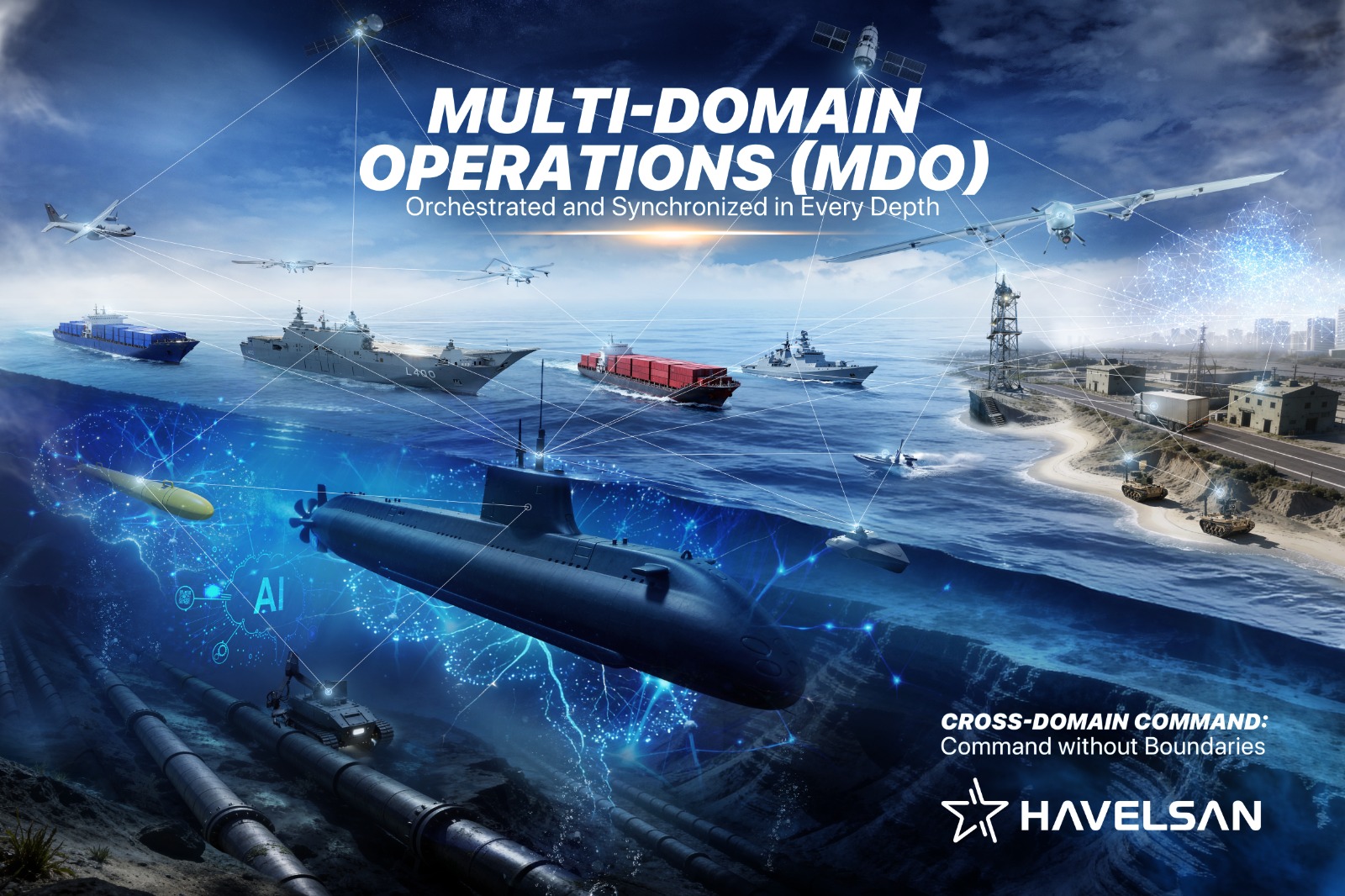

HAVELSAN is expanding its command-and-control expertise into a multi-domain operational architecture designed to connect military, civilian, industrial, academic, and commercial capabilities within a unified decision-making framework.
The Turkish defense technology company’s approach is based on integrating existing systems rather than replacing them. It combines artificial intelligence, big data analytics, interoperable command systems, cyber resilience, and a “system of systems” architecture to help commanders coordinate operations across land, maritime, air, cyber, and space domains.
Table of Contents
ToggleHAVELSAN Builds on More Than 25 Years of C2 Experience
Modern military operations increasingly depend on the ability to coordinate forces across multiple domains at the same time.
Traditional joint operations focused primarily on cooperation among land, air, and naval forces. Multi-domain operations extend that requirement into cyber and space while also incorporating civilian institutions, industry, academia, logistics providers, and commercial partners.
HAVELSAN’s concept builds on more than 25 years of experience in command-and-control and combat management systems. Rather than proposing an entirely new command structure, the company is seeking to connect existing capabilities through a common operational architecture.
The objective is to improve the speed and quality of decision-making without forcing armed forces to discard systems that are already performing effectively.
AI-Driven Cross-Domain Command Concept
A central element of HAVELSAN’s approach is its AI-driven Cross-Domain Command Concept.
Traditional command structures often involve several layers of information processing and approval. While these procedures can support control and accountability, they may also slow the movement of information between sensors, commanders, and operational units.
HAVELSAN’s concept is intended to reduce the time between detection, assessment, decision, and action.
By combining artificial intelligence with big data analytics, the architecture can process information from multiple domains and support commanders during short operational decision windows.
This does not necessarily remove human command authority. Instead, AI is used to organize information, identify patterns, assess developments, and propose possible courses of action.
Such support can be especially valuable during fast-moving operations involving unmanned platforms, electronic warfare, cyber activity, missile threats, air defense, and dispersed forces.
System of Systems Architecture Preserves Existing Capabilities
HAVELSAN’s multi-domain architecture is based on a System of Systems approach.
Under this model, individual command, combat-management, logistics, and operational systems continue to function independently while exchanging data through a wider digital framework.
The company identifies systems such as ADVENT, AICCS, DOOB, MATRA, and civilian logistics platforms as elements that can remain operationally distinct while contributing to a shared mission environment.
This approach offers several potential advantages.
Armed forces do not need to replace every legacy platform at the same time. Existing investments can remain in service, while interoperability is introduced through common interfaces, standards, and data exchange mechanisms.
A System of Systems architecture can also reduce the risk associated with creating a single, monolithic command platform.
Each component can retain its own development path, technical role, and upgrade cycle while contributing information to a wider operational picture.
Operation Intelligence Supports Predictive Decision-Making
At the center of HAVELSAN’s concept is a decision-support capability known as Operation Intelligence.
The system is intended to process heterogeneous data from military and civilian networks in real time.
This could include information from sensors, command systems, logistics networks, intelligence sources, communications infrastructure, civilian agencies, and operational platforms.
Operation Intelligence continuously evaluates changes across the operational environment and provides decision-makers with predictive support and recommended Courses of Action.
Rather than requiring personnel to manually analyze every available data stream, the system uses machine-speed processing to identify relevant changes, compare possible responses, and present actionable options.
This can help commanders assess the consequences of different decisions before committing forces.
For crewed platforms and headquarters, the capability strengthens human decision-making.
For uncrewed systems, it could provide part of the command-and-control foundation required for higher levels of autonomy.
Integrating Crewed and Uncrewed Systems
Multi-domain operations increasingly depend on cooperation between crewed and uncrewed platforms.
A modern force may need to coordinate fighter aircraft, warships, armored vehicles, drones, unmanned ground systems, cyber units, satellites, and electronic warfare assets within the same operational framework.
The challenge is not simply to connect these systems technically. Commanders must also understand their status, assign missions, manage communications, resolve competing priorities, and adapt to disrupted networks.
HAVELSAN’s architecture is designed to support this interaction by maintaining continuous data exchange across participating systems.
For uncrewed platforms, the availability of machine-readable operational data and AI-supported decision logic may allow more autonomous behavior within commander-defined constraints.
This could include route adjustment, target prioritization, sensor tasking, logistics support, surveillance, and coordinated operations involving multiple unmanned assets.
Interoperability Through FMN, MIP, and OCTOPUS
HAVELSAN’s multi-domain approach is also supported by its experience with military interoperability protocols.
The company identifies Federated Mission Networking, the Multilateral Interoperability Programme, and OCTOPUS among the standards and frameworks supporting its architecture.
These protocols are important because multinational and multi-agency operations often involve systems developed by different organizations and countries.
Without common standards, units may be unable to exchange data, share a recognized operational picture, or coordinate actions effectively.
Interoperability frameworks help define how systems format, transmit, receive, and interpret operational information.
This is particularly important for Türkiye’s national requirements and for operations involving NATO or partner forces.
Cyber Resilience Forms a Critical Layer
A connected operational architecture creates major advantages, but it also increases exposure to cyberattack, data manipulation, network disruption, and electronic warfare.
HAVELSAN therefore positions cyber resilience as a core element of its multi-domain concept.
The company’s portfolio includes technologies ranging from data diodes to the Turkish Armed Forces Cloud Computing Infrastructure.
Data diodes are used to control the direction in which information can move between networks, reducing the risk that sensitive systems will be compromised through reverse access.
Cloud infrastructure can provide scalable computing, data storage, software services, and distributed access across military organizations.
However, military cloud systems must be designed for secure operation, redundancy, survivability, and degraded communications environments.
The effectiveness of a multi-domain architecture will depend not only on connectivity, but also on its ability to continue operating when networks are contested.
HAVELSAN Positions Itself as Prime Digital Integrator
HAVELSAN’s objective is to serve as a prime integrator for the strategic digital backbone connecting military and civilian organizations.
This role extends beyond the supply of a single command system.
A prime digital integrator must coordinate software, communications, cybersecurity, data standards, legacy-system interfaces, cloud infrastructure, artificial intelligence, operational workflows, and user requirements.
The company’s proposed architecture is intended to connect separate organizations without eliminating their independent roles.
This is particularly relevant in operations requiring coordination among armed forces, emergency services, government ministries, logistics organizations, infrastructure operators, and private industry.
Applications Beyond Conventional Warfare
Although the concept is designed for defense, HAVELSAN also presents it as applicable to peacetime missions, natural disasters, and crisis response.
The same operational requirements frequently appear in both military and civil emergencies.
Authorities need to collect information from different sources, establish a common operational picture, allocate resources, coordinate organizations, and make decisions under time pressure.
During an earthquake, flood, wildfire, or major infrastructure failure, the architecture could theoretically connect military units, emergency services, hospitals, transportation networks, logistics providers, and local authorities.
This broader application could increase the value of the system by supporting national resilience as well as military operations.
Strategic Significance
HAVELSAN’s multi-domain operations concept reflects a broader shift in modern defense planning.
Operational advantage increasingly depends less on the performance of a single platform and more on the ability to connect sensors, decision-makers, weapons, logistics, and support organizations.
A highly capable aircraft, ship, or missile system may have limited effect if it cannot exchange information quickly or operate as part of a wider network.
By focusing on integration, AI-supported decision-making, interoperability, and cyber resilience, HAVELSAN is addressing the digital infrastructure required to coordinate complex operations.
The central challenge will be implementation.
Connecting legacy systems from different services and organizations requires common data standards, secure interfaces, reliable communications, and extensive testing.
AI-generated recommendations must also remain transparent, auditable, and aligned with command responsibility.
If these challenges are addressed, HAVELSAN’s architecture could provide Türkiye and international customers with a framework for combining existing systems into a more responsive multi-domain force.
What to Watch Next
Key developments will include demonstrations involving multiple operational domains, integration with additional legacy systems, deployment of Operation Intelligence, and evidence of how the architecture performs under contested communications conditions.
Further details will also be important regarding the level of autonomy available to uncrewed systems, the governance of AI-generated Courses of Action, and the integration of allied or civilian networks.
HAVELSAN’s progress will be closely watched as armed forces increasingly seek command architectures capable of coordinating dispersed, networked, and autonomous capabilities across a complex operational environment.