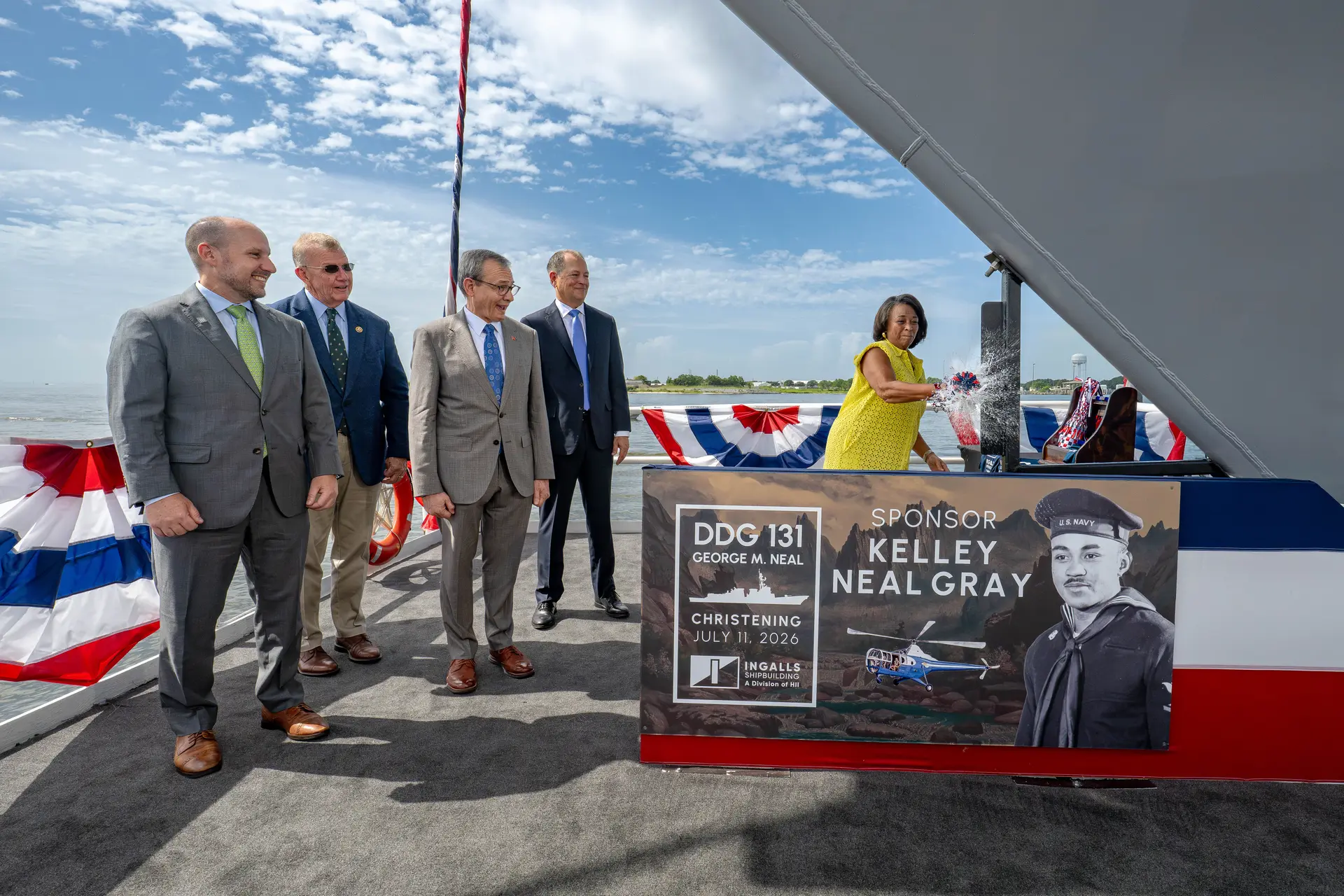

HII has christened the future USS George M. Neal (DDG 131), marking another milestone in the U.S. Navy’s expansion of its Flight III Arleigh Burke-class guided-missile destroyer fleet.
The christening ceremony took place on July 11, 2026, at HII’s Ingalls Shipbuilding division in Pascagoula, Mississippi. DDG 131 is the fourth Flight III Arleigh Burke-class destroyer being built by Ingalls and will eventually join the Navy’s surface fleet with upgraded air and missile defense capabilities.
The vessel is named in honor of Aviation Machinist’s Mate Third Class George M. Neal, a Korean War veteran and Navy Cross recipient recognized for his conduct following a helicopter crash during a rescue mission in North Korea.
Table of Contents
ToggleDestroyer Honors Korean War Veteran George M. Neal
Neal was serving aboard a helicopter conducting a rescue attempt in mountainous terrain when the aircraft crashed in 1951. He reportedly evaded opposing forces for nine days before being captured and held as a prisoner of war for approximately two and a half years.
The Navy named DDG 131 in recognition of Neal’s service, endurance, and actions during the conflict.
Kelley Neal Gray, Neal’s daughter and the ship’s sponsor, conducted the traditional bottle-breaking ceremony against the vessel’s bow.
Gray said the ship would preserve her father’s legacy while serving as a future component of the U.S. Navy’s surface combatant force.
William Toti, performing the duties of under secretary of the Navy, said the christening represented another step toward building the fleet required to address emerging national security challenges.
He described Flight III destroyers as an important part of the Navy’s future force structure and highlighted the role of the Ingalls workforce in delivering the ships.
Flight III Destroyer Brings Enhanced Air and Missile Defense
The Flight III configuration represents the most capable version of the Arleigh Burke class currently entering U.S. Navy service.
Its principal upgrade is the AN/SPY-6(V)1 Air and Missile Defense Radar, a new-generation radar designed to provide greater sensitivity, improved discrimination, and expanded tracking capacity against advanced aerial and ballistic missile threats.
DDG 131 will also incorporate the Aegis Baseline 10 combat system, integrating the ship’s sensors, command-and-control architecture, and weapons into a combined air and missile defense capability.
AN/SPY-6 Radar Expands Threat Detection Capacity
The AN/SPY-6(V)1 radar is intended to improve the Navy’s ability to detect and track ballistic missiles, cruise missiles, aircraft, and other complex threats at greater ranges and with higher accuracy than earlier radar configurations.
The radar is built around modular radar assemblies, allowing the technology to be adapted for several classes of U.S. Navy surface ships.
For Flight III destroyers, the system is supported by substantial changes to the Arleigh Burke design, including upgraded electrical generation, cooling capacity, and shipboard infrastructure.
These modifications allow the destroyers to operate more demanding sensors and combat systems while retaining the established weapons, propulsion, and survivability characteristics of the Arleigh Burke class.
Aegis Baseline 10 Supports Integrated Defense
Aegis Baseline 10 is designed to combine air and missile defense functions within a common combat-system architecture.
The configuration will support operations against increasingly diverse threats, including low-observable cruise missiles, ballistic missile systems, unmanned aircraft, and coordinated saturation attacks.
The ship is also expected to retain the Arleigh Burke class’s broader mission set, including anti-submarine warfare, anti-surface warfare, land attack, maritime security, and strike-group escort operations.
Once commissioned, the future USS George M. Neal will be capable of operating independently or as part of a carrier strike group, amphibious force, or integrated naval task group.
Ingalls Expands Arleigh Burke Flight III Production
Ingalls Shipbuilding has delivered 36 Arleigh Burke-class destroyers to the U.S. Navy, including USS Jack H. Lucas (DDG 125), the first operational Flight III destroyer.
The shipbuilder has also delivered Ted Stevens (DDG 128), while several additional Flight III vessels remain under construction.
Current Ingalls destroyer construction includes Jeremiah Denton (DDG 129), George M. Neal (DDG 131), Sam Nunn (DDG 133), Thad Cochran (DDG 135), and John F. Lehman (DDG 137).
Additional ships in pre-planning include Telesforo Trinidad (DDG 139), Ernest E. Evans (DDG 141), Charles French (DDG 142), Richard J. Danzig (DDG 143), Intrepid (DDG 145), Robert Kerrey (DDG 146), and Ray Mabus (DDG 147).
HII President and CEO Chris Kastner described DDG 131 as a highly capable future surface combatant and emphasized the contribution of the Ingalls workforce to the Navy’s shipbuilding program.
Why DDG 131 Matters for the U.S. Navy
The christening comes as the U.S. Navy seeks to strengthen fleet air defense against increasingly sophisticated missile, drone, and aircraft threats.
Flight III destroyers are expected to serve as central air and missile defense platforms within carrier strike groups and other deployed naval formations. Their enhanced radar capacity will be particularly important in environments involving long-range anti-ship missiles, ballistic weapons, electronic warfare, and large numbers of unmanned systems.
The class also provides the Navy with a relatively mature production pathway while development continues on future large surface combatants.
For the U.S. shipbuilding industrial base, continued Arleigh Burke construction sustains skilled employment and preserves experience in complex surface combatant production. It also helps maintain fleet numbers as older cruisers and destroyers approach retirement.
Following christening, DDG 131 will continue outfitting, systems integration, testing, and sea trials before delivery to the U.S. Navy. Its eventual commissioning will add another SPY-6-equipped warship to the Navy’s expanding Flight III fleet.