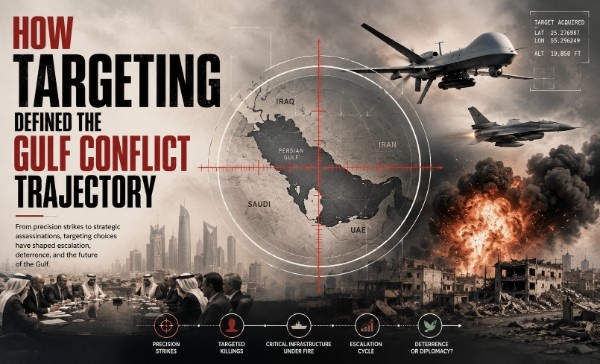

On February 28, 2026, the US and Israel launched a large-scale joint operation against Iran. Codenamed Operation Epic Fury, the campaign targeted Iran’s top leadership, military infrastructure, and conventional assets, and aimed at weakening the regime’s legitimacy, paving the way for the rival factions to replace it. The strikes resulted in the death of Supreme Leader Ayatollah Ali Khamenei, key commanders of the Islamic Revolutionary Guard Corps (IRGC), and the destruction of Iran’s military-grade infrastructure. In response, Iran retaliated with a barrage of drones and missiles, striking the military installations, radar sites, regional energy facilities, and data centres of countries housing US assets.
At the outset of the campaign, the US administration laid out an expansive list of politico-military objectives. It involved ending Iran’s nuclear program, dismantling its missile capabilities, ending Iran’s support for the proxy networks, and toppling the Iranian regime. Iran, on its part, focused on regime survival, protecting its nuclear program and military capabilities, and preserving its ideological commitment to proxy networks. Based on these distinct objectives, both sides pursued a unique targeting strategy grounded in their military capabilities and understanding of the conflict paradigm.
Due to continuously shifting politico-military objectives, the US and Israeli targeting strategy remained in a continuous flux. Initially, the US and Israel’s air forces targeted the IRGC’s command and control (C2) nodes, air defence grid, surface-to-air missile (SAM) sites, and naval assets to achieve local air superiority. The targeting also focused at the systematic degradation of Iran’s defence industrial base, such as missile production sites, dual-use research facilities, and surface-to-surface missile (SSM) siloes, to degrade Iran’s operational tempo and capacity to rebuild the lost assets.
However, the airstrikes fell short of achieving the stated objectives. Iran’s nuclear program, missile infrastructure, and underground facilities survived the sustained bombing. In response, the US Air Force shifted its targeting to oil facilities around the Kharg Island, the South Pars gas field, and Tehran’s storage facilities to add another layer of pressure. Besides military targeting, damage was inflicted on a range of civilian sites and urban centres. Notably, besides numerous archaeological sites and universities the US bombed Shajareh Tayyebeh girls’ elementary school in Minab, resulting in the casualties of 150 people, including children.
On the other hand, Israel conducted multi-theatre strikes comprised of ground offensive against Hezbollah strongholds to reduce Iran’s regional leverage, combined with air strikes against Iran’s desalination plants and fuel depots to increase water insecurity and exacerbate environmental challenges. Nonetheless, Israel’s ground offensive met with an ironclad response by Hezbollah’s rocket and drone barrages that limited the operational impunity of the Israel Defence Forces (IDF).
Iran, on its part, focused on the regime’s endurance and survival. To inflict maximum pressure, Iran struck mainland Israel, US bases in the Gulf, the Gulf’s energy infrastructure, and data centres. Instead of confronting the conventional military superiority of the US and Israel, Iran adopted a distinct mode of ‘mosaic defence.’ With its layered ballistic missile capabilities, long-range drones, and a mix of proxy groups in the region, Iran launched a targeted campaign against mainland Israel and the US bases in neighbouring countries. Iranian missiles successfully hit a wide array of US-linked facilities in Bahrain, Kuwait, Qatar, Saudi Arabia, and the United Arab Emirates. Similarly, the One Way Attack (OWA) drones, such as Shahed-136 and Arash-2, were launched to saturate air defences and hit airport, energy, and port infrastructure.
Simultaneously, Iran exacted an economic cost of the conflict by disrupting the shipping in the Strait of Hormuz with its anti-access/area-denial (A2/AD) capabilities. The disruption resulted in fuel price hike along with the suspension of shipments. Concurrently, AI infrastructure, particularly the data centres, also became a legitimate target in the conflict. Iranian Shahed drones struck two Amazon Web Services data centres, resulting in a banking outage across the region of 50 million people. The targeting of AI infrastructure compelled the tech firms to reevaluate their posture around the national defence considerations.
Despite the proclaimed effective targeting, the success of any force is measured by the political objectives it achieves. The sustained aerial strikes inflicted sustained blows to Iran’s conventional military infrastructure. However, the US and Israel were unable to translate tactical gains into a broader strategic success. Contrariwise, Iran demonstrated a resilient response not only by ensuring the regime’s survival but also by sustaining its operational tempo and matching escalation by continuously striking the targets in the Middle East. The conflict demonstrated that brute force alone cannot secure victory, as firepower means little without clear political objectives and legitimacy.

Shaheer Ahmad is a Research Assistant at the Centre for Aerospace & Security Studies, Islamabad. He can be reached at cassthinkers@casstt.com