
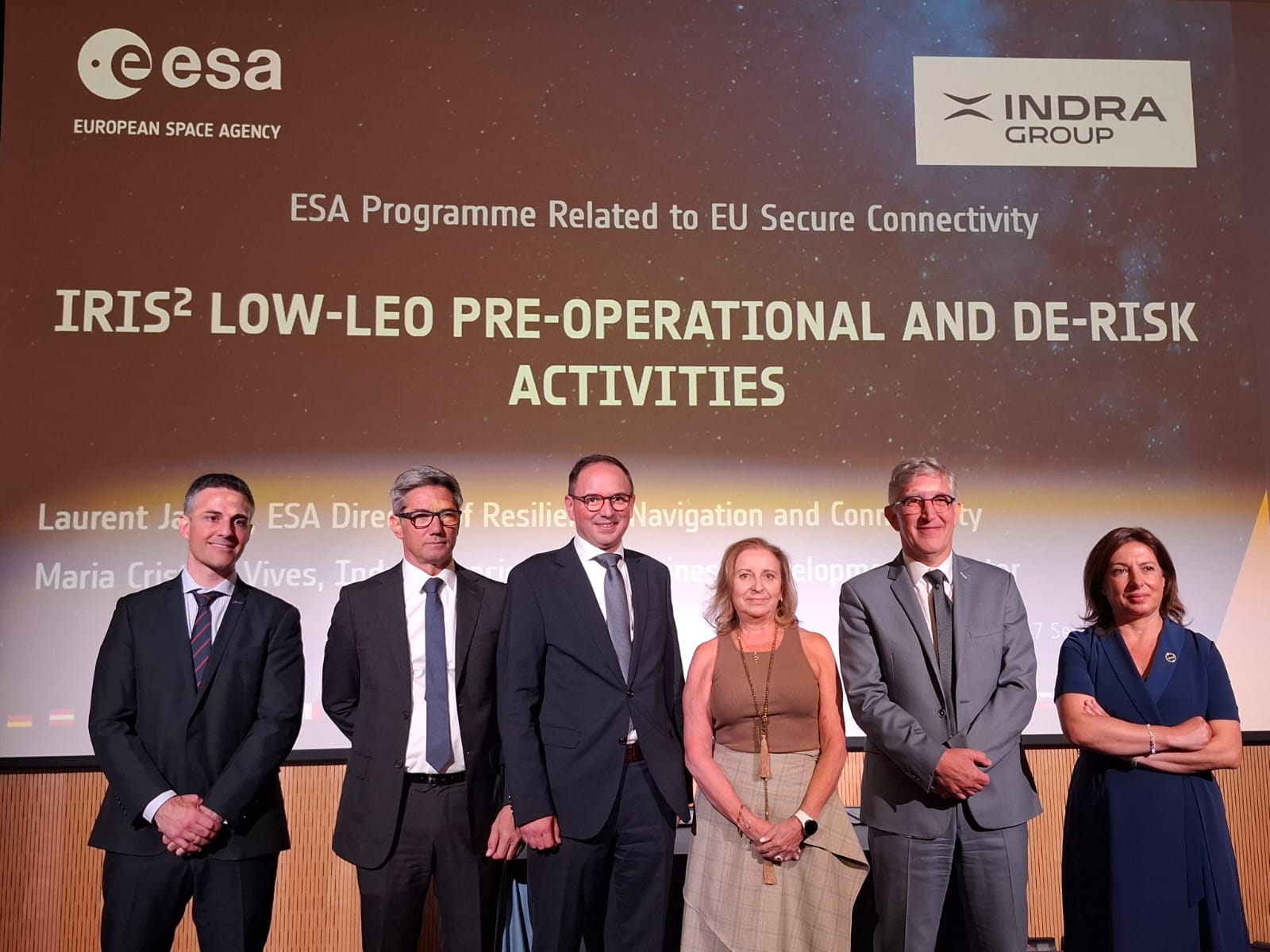

Indra Space will lead two European Space Agency projects focused on space-based air traffic management and 5G direct-to-device connectivity as Europe develops future governmental services for the Low-LEO layer of the IRIS² secure satellite communications system.
The European Space Agency (ESA) has selected two projects led by Indra Space, ATLAS and SELENE, to advance into the consolidation phase of the IRIS² Low-LEO Pre-Operational and De-Risk Activities initiative.
The projects are designed to mature technologies and mission concepts that could support future governmental services under the European Union’s IRIS² secure connectivity program.
According to Indra Group, ESA will oversee both projects during an initial competitive consolidation phase lasting approximately four months. The work will focus on reducing technological risks and refining the respective mission concepts.
Following this stage, ESA is expected to initiate a subsequent procurement process. A limited number of mission demonstrators will then be selected for implementation, including development, deployment and in-orbit validation.
Demonstration missions are expected to reach orbit toward the end of the decade.
Table of Contents
ToggleATLAS Targets Space-Based Air Traffic Management
The ATLAS project will focus on validating satellite-based communications and surveillance capabilities for air traffic management.
The project builds on experience gained through Startical, a joint venture established by Spanish air navigation service provider ENAIRE and Indra. Startical is developing satellite-based communications and surveillance services intended to support air traffic management operations.
ATLAS aims to conduct an IRIS²-compatible in-orbit validation of technologies designed to support global air navigation services.
The project will examine how communications and surveillance functions traditionally supported through terrestrial infrastructure can be complemented by satellite-based systems.
Indra Space is leading a consortium that also includes Aerospacelab, Sener Aeroespacial, Stellar Project, DHV Tecnología Espacial Avanzada Malagueña, EOSOL Engineering Consulting, CITD Engineering Technologies and Startical.
The participating companies will contribute expertise in satellite platforms, payloads, communications systems, power technologies, spacecraft structures and the operational design of space-based air traffic management services.
SELENE to Explore 5G NTN Connectivity
The second project, SELENE, will assess a space infrastructure based on 5G Non-Terrestrial Network technology, commonly known as 5G NTN.
Its objective is to demonstrate the feasibility of providing governmental services and next-generation direct-to-device communications through satellite infrastructure.
The proposed architecture is intended to support government and defense users, allowing compatible terminals to communicate through space-based networks.
Direct-to-device satellite connectivity has become an increasingly important area of development across the global space and telecommunications industries. The technology could enable users to maintain communications beyond the coverage of conventional terrestrial networks.
The SELENE consortium includes Celeste, Druid Software, Aerospacelab, Thales Alenia Space España, Sener Aeroespacial, Stellar Project, Hisdesat and i2CAT.
The organizations will contribute capabilities involving 5G technology, satellite platforms, advanced antennas, optical inter-satellite links and space-system operations.
Supporting Future IRIS² Government Services
ATLAS and SELENE form part of ESA’s wider work to examine technologies that could eventually contribute to the Low-LEO component of IRIS².
The Infrastructure for Resilience, Interconnectivity and Security by Satellite, or IRIS², is the European Union’s planned secure multi-orbit satellite communications system.
The program is intended to provide resilient connectivity for both governmental and commercial applications while strengthening Europe’s secure communications infrastructure.
IRIS² is being developed through cooperation between the European Commission and ESA, alongside a private-sector consortium involving European satellite operators Hispasat, Eutelsat and SES.
Total planned investment in the multi-orbit system exceeds €15.6 billion, according to Indra. Initial IRIS² satellite launches are expected to begin in 2029 under the current program schedule.
Low-LEO Layer to Host New Mission Concepts
One component of IRIS² will be its Low-LEO layer, designed to operate below an altitude of 750 kilometers.
The layer is intended to support some of the program’s more innovative technologies and mission concepts. It is also expected to provide opportunities for European startups and small and medium-sized enterprises developing emerging space capabilities.
ESA’s Low-LEO Pre-Operational and De-Risk Activities are designed to provide a mechanism for testing potential governmental services and related mission concepts in orbit before decisions are made on their possible integration into the operational IRIS² architecture.
Projects that mature successfully through the program could progress from technology development to demonstration and pre-operational validation.
However, selection for the current consolidation phase does not automatically mean that ATLAS or SELENE will become part of the final operational IRIS² system. Further procurement, technical validation and program-level decisions will determine whether individual concepts proceed.
ESA’s Role in IRIS² Development
Under the broader EU Secure Connectivity Programme, the European Commission retains overall responsibility for IRIS², while ESA supports the qualification and validation of its governmental infrastructure.
ESA manages development and validation contracts for elements of the initial space and ground segments. It also verifies system, service and security performance against requirements established by the European Commission.
The Low-LEO activities are intended to allow new technologies and government-focused services to be tested repeatedly as the wider IRIS² architecture develops.
For Indra Space, the selection of ATLAS and SELENE gives the company a role in two areas expected to become increasingly important for European satellite infrastructure: space-based air traffic management and secure 5G-enabled satellite communications.
The consolidation phase will now determine whether the two concepts are sufficiently mature to compete for the later demonstration stage and eventual in-orbit validation.












