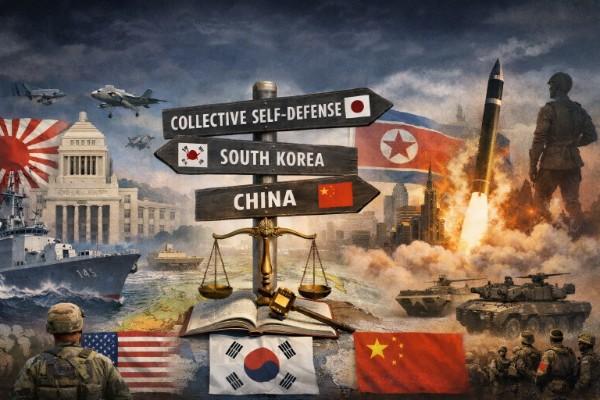

If war were to break out again on the Korean Peninsula, Japan’s expanded legal framework for collective defense could collide with South Korea’s sensitivities as well as constitutional constraints, resulting in friction within the US–Japan–ROK trilateral cooperation structure. Although Japan’s changing security posture, anchored in the reinterpretation of Article 9, the 2015 security legislation, and the revised US–Japan Defense Guidelines, is largely perceived by Washington and Tokyo as a necessary adaptation to the regional security environment, such shifts continue to be viewed with caution in Seoul.
From the perspective of South Korea, Japan’s expanded legal discretion has not been uniformly interpreted as “progress.” Instead, the issue has amplified concerns over the possibility of unilateral Japanese military action, ambiguity regarding the scope of collective self-defense, and unresolved historical problems. As a result, operational coordination between Japan and South Korea in the event of a Korean contingency remains constrained by legal, political, and strategic frictions, despite notable institutional advances in the US–Japan alliance.
Japan’s Expanding Legal Framework for Collective Defense
Japan’s pacifist identity—codified in Article 9—has long restricted the use of force abroad and effectively prevented the Japan Self-Defense Forces (JSDF) from exercising collective defense in support of its closest ally. During the Cold War period, Japan’s role in regional contingencies was strictly confined to territorial defense and non-combatant support functions.
This posture began to change in the late 1990s with the enactment of the 1999 Law Concerning Measures to Ensure the Peace and Security of Japan in Situations in Areas Surrounding Japan (SIASJ). That legislation enabled Japan to conduct rear-area and logistical support—albeit limited—for US forces operating in contingencies that could affect Japan’s security, including those on the Korean Peninsula.
However, the most noteworthy shift occurred with the July 1, 2014 cabinet decision that reinterpreted Article 9 to permit collective defense under specific circumstances. This reinterpretation was institutionalized through the 2015 Legislation for Peace and Security, which entered into force in 2016. Under this legal framework, the JSDF may use force—if there are no other appropriate means and only under the condition that the use of force is kept to the minimum necessary level—when an armed attack against a foreign country threatens Japan’s survival and poses a clear danger to fundamentally overturning the lives and rights of its people.
Meanwhile, the 2015 US–Japan Defense Guidelines were revised in line with this legal evolution. They were designed to facilitate alliance coordination across a diverse range of scenarios, including regional contingencies, by expanding Japan’s scope of support while remaining formally consistent with Japan’s constitutional interpretation.
Japan’s Role in a Korean Contingency: Historical and Legal Sensitivities
For the past several decades, Japan has assumed the possibility of indirect involvement in contingencies on the Korean Peninsula, primarily through rear-area and logistical support roles. Since the early Cold War period, US–Japan security planning has been based on the assumption that Japan’s geography would make it indispensable—as a hub for force projection, training, and medical support—if another major war were to break out on the Korean Peninsula. Unsurprisingly, subsequent contingency plans have consistently emphasized missions such as base protection, maritime surveillance, minesweeping, logistical support, and medical treatment, rather than direct military engagement on the Korean Peninsula itself.
Nonetheless, the JSDF’s potential activities in and around the Korean Peninsula remain politically and legally sensitive matters. Even under the post-2015 legal framework, the use of force is contingent upon a situation being classified as either an “Important Influence Situation” or a “Survival-Threatening Situation,” and such classification requires case-by-case political judgment and oversight by the Diet. This ambiguity leaves considerable room for divergent interpretations among allies during rapidly evolving crisis situations.
Legal Frictions with South Korea in a Korean Contingency
South Korea has consistently expressed concerns regarding Japan’s possible military involvement, citing both historical experience and sovereignty issues. Although US–Japan alliance planning assumes a certain degree of interoperability and mutual support, South Korea has maintained the position that JSDF operations in or around South Korean territory without the prior consent of the South Korean government would not be permitted.
Such a stance could generate legal and operational friction across multiple plausible contingency scenarios. One such area of concern is missile defense. If North Korea were to launch missiles against US Forces Japan (USFJ) or US military installations within Japan, Tokyo could legally respond under its right of collective self-defense. However, if missile interception or tracking operations were conducted near or over the Korean Peninsula—particularly when prior consultation is insufficient or politically contested—questions regarding sovereignty, coordination, and the scope of Japan’s authority could arise.
A second sensitive issue concerns minesweeping operations. In a large-scale military conflict, securing sea lines of communication (SLOCs) would be an essential task enabling US naval operations and potential amphibious actions. Historical precedent highlights the sensitivity of this mission. During the early phase of the Korean War, in October 1950, US naval authorities requested that the Japanese Maritime Safety Agency (MSA) dispatch minesweepers to clear mines off Wonsan. The operation was conducted secretly under severe political constraints—Japan remained under US occupation until 1952, and the minesweeping mission itself carried extreme sensitivity. In today’s transparent media environment, combined with contemporary public sentiment in both countries, a similar operation would undoubtedly trigger public and political controversy.
Japan’s recent decision to acquire enemy base strike capabilities further complicates the legal environment. Although Tokyo emphasizes that these newly introduced capabilities are intended strictly for self-defense purposes and remain constrained by constitutional interpretation and alliance coordination, their potential use during a Korean contingency—particularly in scenarios involving preemptive strikes against missile launchers deep within North Korean territory or retaliatory strikes—could prove politically destabilizing if not carefully coordinated with Seoul.
An additional friction point concerns refugee evacuation and rear-area security operations. In a major conflict, Japan could face large-scale refugee flows, raising issues related to maritime interception, screening procedures, and JSDF activities in international waters or near Korean ports. Likewise, legal ambiguities may arise regarding whether local governments and civilian medical institutions have a legal obligation to support allied operations when wounded US military personnel must be evacuated to and treated within Japan.
Toward Trilateral Legal Interoperability
To mitigate legal and political friction in a Korean contingency, deliberate pre-conflict coordination is necessary. First, the United States, Japan, and South Korea should establish a standing trilateral legal consultation mechanism to align interpretations of collective self-defense, rear-area support, and sovereignty issues. Second, bilateral or trilateral memoranda of understanding should be negotiated in advance to clarify the conditions under which the JSDF may conduct specific support missions in or around the Korean Peninsula.
Third, prior notification and agreement procedures should be institutionalized to ensure transparency and political legitimacy for sensitive operations such as missile defense and intelligence, surveillance, and reconnaissance activities. Fourth, joint military exercises should incorporate legal and political tabletop exercises—alongside operational training—allowing policymakers and military commanders to identify and resolve legal friction points before an actual crisis occurs. Finally, rules of engagement among the three countries should be harmonized to ensure that tactical activities remain consistent with strategic intentions.
Preventing Legal Paralysis in a Crisis
Within the US–Japan alliance, Japan has taken notable steps to expand its legal capacity for regional security cooperation. However, coordination with South Korea remains constrained by historical memory, legal ambiguity, and political distrust. A second Korean War would place unprecedented strain on the boundaries of collective defense, rear-area support, and, most critically, trust within the trilateral framework.
If legal alignment and procedural clarity are not secured in advance, even well-intended military actions could generate diplomatic repercussions and operational paralysis. Only sustained legal diplomacy, institutionalized trilateral mechanisms, and trust-building measures can ensure that the US–Japan–ROK framework functions as a facilitator—rather than a legal obstacle—during a future military conflict on the Korean Peninsula.

Dr. Ju Hyung Kim
Dr. Ju Hyung Kim serves as President of the Security Management Institute, a defense-focused think tank affiliated with South Korea’s National Assembly. He has contributed to numerous defense initiatives and has advised key institutions, including the Republic of Korea Joint Chiefs of Staff.