
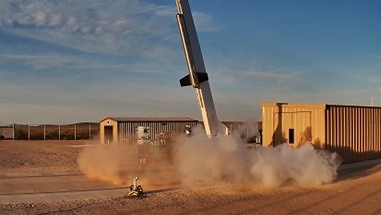

Lockheed Martin and Venus Aerospace have signed a joint technology development agreement to evaluate Rotating Detonation Rocket Engine technology for future long-range precision-strike systems.
Announced on July 21, the collaboration will combine Venus Aerospace’s propulsion technology with Lockheed Martin’s missile integration, manufacturing and defense-system development capabilities.
The companies will assess whether the emerging propulsion architecture can support future precision-fires systems requiring greater range, higher speed and improved operational flexibility.
Table of Contents
TogglePartnership Targets Next-Generation Precision Fires
Under the agreement, Lockheed Martin and Venus Aerospace will evaluate the potential integration of Rotating Detonation Rocket Engine, or RDRE, technology into future missile and precision-fires applications.
The work is intended to move the propulsion concept beyond subsystem and flight-demonstration activities toward military systems designed around operational requirements.
Lockheed Martin said the partnership would allow it to examine the technology alongside established launch systems, guidance technologies, manufacturing processes and weapon-system architectures.
The companies did not disclose the financial value, development timeline or specific missile programs covered by the agreement.
Tim Cahill, president of Lockheed Martin Missiles and Fire Control, said the collaboration would help determine how the technology could be incorporated into future precision-fires solutions.
“Lockheed Martin is focused on rapidly delivering advanced capabilities that strengthen deterrence and provide decisive advantages for the warfighter,” Cahill said.
“Our collaboration with Venus Aerospace allows us to evaluate a promising propulsion technology and determine how it can be integrated into future precision fires solutions.”
How Rotating Detonation Rocket Engines Work
Conventional rocket engines generally rely on deflagration, a combustion process in which a flame front travels through a fuel-and-oxidizer mixture at subsonic speed.
Rotating detonation engines instead use one or more continuously traveling detonation waves inside an annular combustion chamber. These waves move around the chamber while rapidly compressing and burning the propellant mixture.
Because detonation-based combustion occurs at higher pressure and can extract energy more efficiently, RDRE technology could potentially improve propulsion performance compared with conventional rocket-engine designs.
The technology may also reduce the number or complexity of some engine components, although its practical military value will depend on factors including reliability, thermal management, materials, manufacturing costs and integration with existing weapon systems.
For long-range precision fires, improved propulsion efficiency could allow future missiles to travel farther, reach targets faster or carry additional payload without requiring proportionate increases in weapon size.
Potential Benefits for Long-Range Missile Systems
Lockheed Martin and Venus Aerospace believe rotating detonation propulsion could support missile systems requiring greater speed and range while remaining affordable and suitable for large-scale production.
The companies will evaluate whether the technology can meet military requirements for manufacturability, reliability and operational deployment.
For the U.S. military, future precision-strike systems are expected to operate across increasingly contested environments where forces may need to engage mobile, hardened or time-sensitive targets from greater distances.
Longer-range weapons can also allow launch platforms and ground units to operate farther from enemy air defenses, missile batteries and surveillance systems.
However, converting experimental propulsion technology into a fielded missile system involves more than demonstrating engine performance. Developers must also address storage, handling, guidance, launch compatibility, thermal loads, structural stresses and repeatable production.
Lockheed Martin’s role is expected to focus on assessing these broader weapon-system requirements and determining how the propulsion system could be integrated into deployable precision-fires platforms.
Venus Aerospace Expands Defense Propulsion Work
Venus Aerospace has been developing high-speed propulsion technologies, including rotating detonation engines intended for aerospace and defense applications.
The company describes its RDRE approach as a propulsion architecture capable of providing substantial performance improvements without relying solely on incremental upgrades to conventional rocket engines.
Sassie Duggleby, co-founder and chief executive officer of Venus Aerospace, said defense customers were seeking greater improvements in range and speed.
“Defense customers are asking for more than incremental gains from legacy propulsion,” Duggleby said.
“Our RDRE technology offers a different propulsion architecture for systems that need more range, more speed and a realistic path to production.”
Duggleby added that the agreement with Lockheed Martin would move the technology closer to practical precision-fires applications.
From Demonstration to Operational Capability
The agreement reflects growing defense-industry interest in advanced propulsion technologies that could improve the performance of future missiles, interceptors and high-speed aircraft.
Rotating detonation engines have been studied for decades, but advances in materials, computational modeling, sensors and additive manufacturing have increased the possibility of developing more reliable and scalable systems.
The next phase will likely focus on evaluating whether Venus Aerospace’s propulsion technology can meet the environmental, mechanical and production requirements associated with operational weapons.
Lockheed Martin said partnerships with emerging U.S. technology companies could help accelerate development while strengthening the domestic defense industrial base.
No prototype missile, flight-test schedule or operational deployment date was announced.
The collaboration remains a technology-development and evaluation effort, and any transition into a specific military program would depend on testing results, customer requirements and future procurement decisions.












