
One year ago today, the skies over Pathankot, Udhampur, and Adampur felt the impact of Pakistan’s calm but lethal response to the Indian provocation. But at the same time, towards a distant south, another battle was being fought, not in the skies and not on the Line of Control, but in the North Arabian Sea. It was a contest of will, of doctrine, and of positioning. And it was a battle Pakistan won with its Navy never having to fire a shot at sea. The deterrent threat is often more important than the blow struck.
On the night of 7-8 May 2025, India initiated Operation Sindoor. Pakistan’s response on 10 May was given a name from the Holy Quran, Bunyan-um-Marsoos: a cemented, fortified, impenetrable wall. The 19-day-long clash, overall dubbed Marka-e-Haq, the Battle of Truth, was the severest clash seen by the world between the two nuclear-armed adversaries.
The air and missile aspects of Operation Bunyan-um-Marsoos are well chronicled. Pakistan attacked two dozen Indian military targets, airbases (Pathankot, Halwara, Ambala, Srinagar, Udhampur, Adampur); storage of BrahMos missiles at Beas and Nagrota; two S-400 air defence systems; brigade headquarters; supply depots. JF-17 Thunder fighters, armed with precision weapons, hit their targets with unflinching accuracy, dispelling the complacent Indian belief in its strategic depth. Drones buzzed over New Delhi, signaling capability.
But the maritime aspect, less flamboyant, less publicized, no less significant, has its story to tell.
India had deployed a potent naval force with the intention of intimidation in the North Arabian Sea. The Indian carrier battle group, centred around INS Vikrant, India’s first indigenous-built aircraft carrier, the pride of a decade-long naval modernisation drive and a showcase of Indian naval aspirations, included Kolkata-class destroyers, Talwar-class frigates, and Kalvari-class submarines. It had P-8I Poseidon maritime patrol and MQ-9B Sea Guardian drones to provide continuous surveillance of Pakistani waters. INS Vikrant had ventured 400 nautical miles into Pakistan’s waters before withdrawing into the safety of its ports.
It did so because it had to.
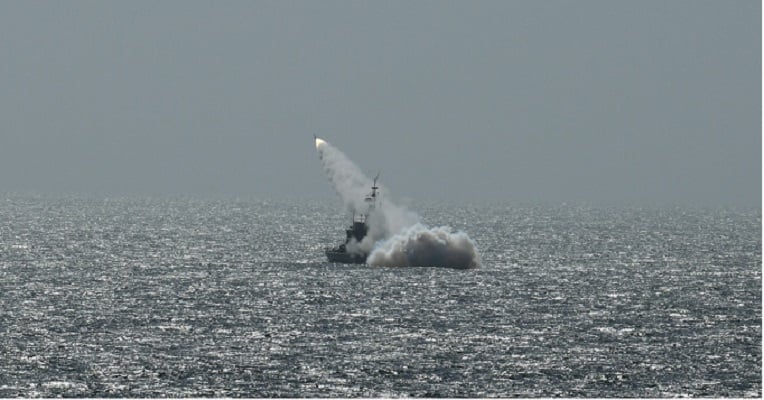
The Pakistan Navy had, professionally, raised its readiness from peacetime to wartime. Agosta-90B submarines, armed with SM-39 Exocet anti-ship missiles and fitted with air-independent propulsion systems to allow longer covert patrols, were positioned in the Arabian Sea to provide a credible, second-strike, maritime deterrent platform that a carrier group commander could not ignore. Zulfiqar-class frigates with C-802A anti-ship cruise missiles patrolled further to the west from Karachi and Gwadar. P-3C Orion maritime surveillance aircraft provided an unblinking watch over Pakistan’s 240,000 square kilometer Exclusive Economic Zone. Azmat-class fast attack craft, some of the fastest and best-armed missile boats in the region, were patrolling the coast. Jinnah Naval Base at Ormara, with its reinforced facilities strategically located to make it more difficult for an enemy to target, was placed on a high state of readiness.
The result was decisive. Indian Navy’s aircraft carrier and its escorts were stuck in their own waters and never dared any southward voyage. The multi-layered area denial and anti-access capabilities, submarines, surface warships, coastal anti-ship batteries, and naval air support neutralized the Indian Navy. The Chief of Naval Staff at the inducting ceremony of PNS Khaibar on 4 Apr 26 also informed that Pakistan Navy elements were on the prowl to land a decisive blow on the Indian carrier, compelling it to turn back.
Further, the Navy’s resolute posture, operational dexterity, and effective deterrent response were also evident through the protection of its sea lines of communication (SLOCs) through which Pakistan’s critical trade and energy pass. Pakistan Navy thus provided a “layered and assured seaward defence”. The SLOCs held. Karachi port functioned. Gwadar remained open. Pakistan’s seaborne commerce, the lifeblood of the country, flowed through the waters that an Indian aircraft carrier battle group had sought to intimidate.
This was no accident. It was a doctrine applied with precision.
Those men and women of the Pakistan Navy who took their submarines into their forward battle stations in the darkness, who flew their night maritime patrols over a congested and contested sea, who stood ready at their action stations in those ships and aircraft that the world underestimated, they knew what they were about and why. As Pakistan’s naval forces did in Operation Dwarka in 1965, when they raided to the very heart of India, they knew that the measure of a naval force is not its numbers, but its professionalism and its coolness in action.
Marka-e-Haq was indeed, as ISPR has correctly pointed out, a fine example of synergy between the elements of national power. But the maritime realm lent a strategic dimension to that synergy that has, as yet, not been fully appreciated. In a war in which India brought its biggest naval asset to the fore in a show of coercive muscle, the Pakistan Navy secured the maritime flank, the economic lifeblood, and took away the escalation option it was looking for.
Pakistan Navy thus enabled the continuous flow of Sea Lines of Communication (SLOCs) during the May 2025 conflict, ensuring the uninterrupted supply of fuel and logistics to support operations of Pakistan Air Force and Army. This vital maritime guarantee ensured the overall war-fighting capability, reconfirming the adage that “Logistics is vital in War”. As Winston Churchill once urged in the context of Allied cooperation during the Second World War, “Give us the tools, and we will finish the job”. Similarly, the guarantee of unbroken SLOCs ensured the means through which Pakistan’s armed forces could push through their operational plans with persistence and determination.
A year on, the nation’s salute to the Pakistan Navy, the quiet service that guarded the seas, kept the lifeblood of national resilience flowing, and remained the impenetrable sea wall of national defence.Anee
Table of Contents
ToggleCommander Anees Muhammad Khan (Retd)
The writer is a retired Commander of the Pakistan Navy and a Senior Maritime Fellow at the National Institute of Maritime Affairs (NIMA), Bahria University, Islamabad