
It was April 2025, one of those exhausting stretches where work just wouldn’t let go. Days melted into nights, and I could feel that heavy, quiet tiredness settling into my bones. I needed to get out, even if only for a little while. So, one day I slipped away, drove up the Murree Expressway, and finally breathed again. The hills opened wide under the sky, and as the sun sank low, everything slowed down. Just what I needed. Evening descended gently. The horizon burned in shades of amber and gold as the last light of day folded into the mountains. I sat there with a cup of coffee warming my hands, its aroma mingling with the cool air. It was the kind of moment that asks for nothing—only your presence, and perhaps the comfort of good company.
But serenity is often fragile. While scrolling through my mobile a breaking news was shaping up quickly. A horrific attack in Pahalgam, in Indian- Illegally Occupied Kashmir. Innocent people gone, just like that—cut down in another senseless act of terror. No place, no people, deserve that kind of pain. Terror never picks sides; it only ever claims the innocent. However, this didn’t feel like it would stay only a tragedy. There was something else underneath it—an uneasy sense that it might become a pretext, a convenient opening for old rivalries to boil over again, a way to settle scores that have been festering since Operation Swift Retort.
I had somehow forgot that I was in the middle of the conversation with a friend when I got silent after the developing situation. When I finally looked at her — the same one who’d been with me on the drive, sharing coffee and that rare quiet — and said, almost without thinking, “You should head back to the UK. Things might get unpleasant here… very soon.” However, she was optimistic that its just a drama, and nothing will go wrong. By then the coffee and sandwiches were finished. The sunset we’d been watching had slipped away into full darkness. What started as a much-needed escape now felt swallowed by that old, familiar unease — the sense that in this part of the world, peace is always temporary, always carrying the shadow of what might come next.
When I got home that night, the calm of the hills already felt like something from another lifetime. The brief sense of relief I’d found on the Murree Expressway had faded, replaced by the heavier feeling I knew too well. The airwaves were ablaze.
I managed to reach just before the 9 pm news was starting which confirmed my fears. As if on cue, the machinery kicked into gear. Segments of the Indian media, backed by voices inside the Government of India, shifted into high gear. Accusations flew. Insinuations multiplied. A relentless wave of rhetoric flooded the airwaves. This wasn’t measured reporting. It was something else — a narrative being built in real time, loud, urgent, and leaving almost no room for questions, for doubt, or for restraint.
Night after night, the usual voices took center stage: Arnab Goswami’s thunderous delivery, Major General G. D. Bakshi’s intense military framing, and Gaurav Arya’s sharp, unflinching commentary. Their words didn’t just fill television studios — they spilled out across the country, shaping emotions, feeding speculation, and hardening public sentiment. Nuance was the first casualty.
And that is where the real danger lies.
South Asia has always been a delicate region — layered with history, memory, and pain. Two nuclear-armed nations living side by side. In moments like these, when grief is still fresh, the power of amplified narratives matters. They shrink the space for dialogue. They drown out diplomacy. They risk transforming sorrow into something far more volatile. Because tragedies of this kind demand something difficult but essential: clarity, responsibility, and cooperation. Not the rush to score points. Not the temptation to turn pain into political momentum. In this part of the world, sparks have a way of finding dry grass. And once the fire starts, containing it is never as easy as lighting it.
GENERAL PERCEPTION
Pakistan, at that time, was only just finding its footing again. The shadow of economic strain had not fully lifted; it lingered in everyday conversations, in market prices, in the quiet calculations families made before every purchase. The state, both in its political corridors and military ranks, was under intense scrutiny—much of it driven by a restless public, especially supporters of the opposition party, who questioned decisions, direction, and intent with growing impatience, which created polarization in an already depressive environment.
At our homes, the struggles were far more immediate, far more personal. Inflation had tightened its grip, especially on those who could least afford it. Even beyond borders, in parts of the Middle East where many Pakistanis sought opportunities, there was a growing sense of unease—an unspoken hesitation in how they were received. For someone like me—an ordinary civilian trying to navigate an increasingly uncertain world—the priorities were simple, almost survivalist: save what little you can, pay your bills, meet your obligations, and hold onto dignity. Investment, growth, ambition—those felt like distant luxuries, reserved for a different time, a different reality.
This was the time; India was benefiting from a growing economy and a relatively stable political system. In contrast, Pakistan was grappling with economic challenges and political instability. Its western borders remained volatile, with the military actively engaged in counterinsurgency operations against militant groups such as the Balochistan Liberation Army (BLA) and Tehrik-i-Taliban Pakistan (TTP). Under such strained conditions, the prospect of another conflict with India was not only undesirable but potentially catastrophic for Pakistan. And in the midst of all this, the thought of conflict—of another confrontation with India—felt not just unwelcome, but unthinkable.
Across the border, the balance of power looked unmistakably tilted in India’s favor—at least on paper. Their air force had grown into a serious, layered machine. The Dassault Rafale stood out as the star: armed with the deadly long-range Meteor missile and shielded by the sophisticated SPECTRA electronic warfare system, it was routinely called a game-changer, built not just to fight but to own the skies through superior information, precision, and survivability. Supporting it was a deep fleet of proven jets—the heavy Su-30MKI, nimble MiG-29UPG, battle-hardened Mirage 2000, and the homegrown HAL Tejas—backed by high-end munitions from Israel and France known for their accuracy and reliability. On the ground, the formidable S-400 air defense system added another layer of protection, weaving into their existing missile network to track and strike threats at long distances, often described as the crown jewel of their defenses.
All of this, in my mind, seemed to cast a long shadow over the memory of February 2019. The very combination that had once tilted the scales—the F-16 Fighting Falcon armed with AIM-120 AMRAAM, working in concert with the Dassault Falcon 20 and Saab-2000 Erieye—now felt less like a decisive edge and more like a chapter the adversary had already studied in detail.
Back then, during Operation Swift Retort, that synergy of reach, coordination, and electronic deception had managed to outmaneuver expectations. It was a moment defined not just by platforms, but by execution—timing, discipline, and a clear understanding of the battlespace. But time changes equations. What once worked brilliantly rarely remains a guaranteed advantage. Against an opponent that has observed, analyzed, and adapted, the same playbook risks becoming predictable. The element of surprise fades, and with it, a certain margin of comfort. And that realization carried its own quiet weight—that in any future encounter, relying solely on past success would not be enough. The game had moved on. India had already witnessed the Pakistan Air Force’s swift and calibrated response. And any prudent adversary learns. They adapt, reassess, and refine. It was only logical to assume that lessons had been drawn, gaps had been studied, and strategies had evolved. Which meant that if history were to repeat itself, it would not do so in the same way. It would be sharper. Faster. And perhaps far less forgiving.
INITIAL OBSERVATIONS
While life carried on in its usual rhythm for most of us—work, bills, snatched moments of rest—the atmosphere around us had quietly shifted. The news no longer felt routine; every bulletin carried a sharper edge, a sense of inevitability. Across the border, India’s tone had changed. The language was no longer measured—it had grown aggressive and deliberate, filled with talk of “teaching a lesson,” words that landed heavily on this side and sounded unmistakably like preparations for confrontation.
It started, as expected, with immediate accusations. Pakistan was blamed for the Pahalgam attack without hesitation. What followed was a swift unravelling of diplomatic ties: envoys were expelled, missions scaled down, visas suspended, and borders sealed. Most alarming was the talk of revisiting the Indus Waters Treaty, a fragile foundation of cooperation for decades, now suddenly under threat in the heat of the moment.
Islamabad denied any involvement and called for an independent international investigation, a plea that New Delhi flatly rejected. In response, Pakistan imposed trade restrictions, closed its airspace, and suspended cooperation under the Shimla Agreement. The diplomatic chill quickly spread into the military sphere. Between late April and early May, the Line of Control grew restless again—sporadic exchanges of fire and artillery bursts, nothing entirely new, yet each incident felt heavier with implication, like steps along a familiar and dangerous path.
All the while, the Indian media grew louder and more confident. The Rafale was hailed as a decisive weapon, the S-400 as an impenetrable shield, and the BrahMos as a precision strike that could change everything in a single blow. At sea, the movement of INS Vikrant was presented with dramatic historical parallels, as if the stage was already being set.
Yet, in that very assertiveness lay a paradox.
The constant posturing, the loud signaling, and the endless rhetoric had one unintended effect: they were stripping away the single biggest advantage in any conflict — the element of surprise. Pakistan took careful note. Quietly but with clear purpose, the country shifted into a higher state of readiness. A “Code Red” posture was quietly enforced. Assets were mobilized, dispersed, and positioned according to wartime plans. The Pakistan Air Force adjusted its deployments with particular attention to the advanced air defence systems waiting across the border. Unlike the more visible concentrations of 2019, this time everything was subtler — no obvious forward movements that could be easily tracked. Instead, there were reports of a more dispersed and concealed posture, with key assets tucked away in undisclosed locations, staying alert just out of sight.
On the ground, the Pakistan Army moved in step with the same quiet resolve. At sea, the Pakistan Navy made its position unmistakably clear through a series of live missile drills conducted from air, surface, and subsurface platforms — a deliberate message that Pakistan’s maritime flanks would not be left vulnerable. The movement of INS Vikrant and its accompanying group suggested the possibility of a blockade—a strategy steeped in historical precedent. But this time, the response came swiftly. Pakistan’s naval signaling, backed by visible preparedness, appeared to complicate that calculus. The waters, much like the skies and borders, had become contested in intent if not yet in full engagement.
And so, what unfolded was a tense equilibrium—two nations watching, preparing, and signaling in equal measure. For those of us living through it, it was not strategy or doctrine that defined the moment, but the quiet, persistent awareness that events were moving along a fragile edge—one where even a small misstep could carry consequences far beyond control.
I reached out to a few friends in uniform — people who live much closer to the edge of uncertainty than the rest of us. Their replies were calm and measured, each word chosen carefully, as if they had already thought them through many times. Yes, the situation was tense, they said. And yes, if India decided to act, it would likely come at a time and place of its own choosing.
Yet beneath that caution lay a quiet, steady confidence. They didn’t boast or speak with bravado; they simply spoke with clarity. All the loud signaling, the aggressive rhetoric, and the very public preparations from the other side hadn’t been wasted on them. In fact, it had given them precious time to prepare, to reposition, and to anticipate. If a strike came, they told me, it would not go unanswered. The response would be firm and decisive — clear enough to send its own message. When the call ended, I sat in silence for a long time, letting the weight of their words settle in.
There was nothing more for me to do. No role to play in strategies or decisions that shape nations. Like millions of others in Pakistan, I returned to the only thing within my control—hope. Quiet, unspoken, almost instinctive. And so, I did what civilians often do in times like these. I kept my fingers crossed and prayed for our boys to dominate and win.
THE FIRST ENCOUNTER
The night of April 29th blurred into the early hours of the 30th in that exhausting way only certain days do. I had just left a formal dinner with the Ambassador of Uzbekistan when my phone rang—sharp and urgent. An onshore bidding round was looming, the deadlines were brutal, and my presence was required. No excuses. By the time I finally got home it was nearly 2 a.m. I managed a few hours of sleep before dragging myself up again. At 8:30 sharp I was back in office, deep in meetings, spreadsheets, and high-stakes decisions. For a few hours, the outside world faded into the background. Work has that merciful ability sometimes.
But reality has a habit of breaking through.
Later that morning, I was drafting the usual post-bidding summary when my phone started buzzing. The messages came in fragments at first, then in a rush. Reports claimed Indian Air Force jets—Dassault Rafales among them—had tried to cross the border, only to be pushed back by alert Pakistan Air Force patrols and electronic warfare support. At that moment it all felt like noise, just another wave in an already tense atmosphere. What struck me most was how some Pakistani media outlets were spinning the story. The same Rafales that were constantly praised as game-changers were suddenly being portrayed as almost useless relics. The narrative felt too neat, too lopsided, and it didn’t sit right with me.
But as the day wore on and the evening settled in, the tone began to shift. Discussions among veterans and seasoned analysts carried a different weight—less noise, more nuance. They didn’t confirm everything, but they didn’t dismiss it either. Instead, there was an acknowledgment, subtle but unmistakable, that something had indeed transpired. Perhaps not on the scale being reported, perhaps not in the way it was being dramatized—but enough to suggest that the line between rhetoric and reality was beginning to blur. And that realization carried its own quiet tension. Because once that line is crossed—even slightly—the situation is no longer just about words, narratives, or speculation. It becomes something far more immediate, far more real.
As I pieced things together from conversations, fragments, and informed voices, a picture began to form—one that felt far more structured than the noise on television. According to what I gathered, the night of April 29–30 was not about an outright strike, but a calculated probe. The Indian Air Force had reportedly launched a tactical reconnaissance mission near the Line of Control, deploying a small package of Dassault Rafale jets from Ambala Air Force Station. The objective, it seemed, was not escalation—but information: to test responses, map reactions, and gather signals in a live environment. But across the border, the system was already awake. The Pakistan Air Force, operating within its integrated air defence framework, appeared to have detected the movement early. From there, the response unfolded not in chaos, but in coordination. Command-and-control nodes tracked the aircraft in real time, decisions flowing quickly, almost seamlessly—from detection to reaction. Fighters were scrambled. Ground-based electronic warfare measures were brought online. What followed, as described, was less about dogfights and more about the invisible contest—the electromagnetic spectrum. As the Rafales approached sensitive thresholds, they were reportedly met with targeted electronic interference. Radar picture degradation, communication disruption, cockpit-level confusion—the kind of pressure that doesn’t destroy aircraft, but challenges pilots in ways that force caution. At the same time, Pakistani interceptors and surface-based systems achieved tracking solutions—enough to signal intent, enough to complicate the mission. It wasn’t about pulling the trigger; it was about making the other side reconsider. And reconsider they did. The Rafales, as the account goes, disengaged—dropping altitude, accelerating away, and recovered at Srinagar Air Force Station instead of Ambala, their home base. The mission ended not in confrontation, but in withdrawal—its purpose, perhaps, partially fulfilled, but its risks made clear. If true, it was a quiet exchange—no explosions, no headlines worthy of confirmation—but significant nonetheless. A test met with a response. A signal answered with another. In such moments, nothing is officially declared, yet everything is understood.
The incident had immediate operational and psychological repercussions. IAF pilots reportedly expressed concerns over PAF’s EW dominance, with some drawing parallels to the post-Balakot air operations in 2019. Internal assessments within the IAF highlighted the risks of conducting deep penetrations against Pakistan’s modernized air defences. Notably, then-Vice Chief of Air Staff Air Marshal SP Dharkar reportedly cautioned against further high-risk missions, emphasizing PAF’s upgraded capabilities. His warnings, however, clashed with the political leadership’s insistence on leveraging the Rafale as a strategic deterrent. The fallout extended to institutional tensions. Air Marshal Dharkar was replaced within seven months of assuming office, with Air Marshal Narmdeshwar Tiwari appointed as the new Vice Chief. This reshuffle followed earlier changes to India’s Northern Command leadership after the Pahalgam incident, underscoring a pattern of friction between military pragmatism and political objectives. While official statements cited routine rotations, analysts interpreted the moves as symptomatic of broader civil-military discord under the current administration.
The engagement carried significant strategic implications. Pakistan Air Force showcased its electronic warfare and network-centric warfare capabilities, demonstrating an operational effectiveness that rivaled even advanced platforms such as the Rafale. This parity in technology and tactical execution suggests a narrowing capability gap between the two air forces. Moreover, Pakistan’s deployment of a layered air defence umbrella presents a credible deterrent, potentially restricting the Indian Air Force’s operational freedom along the Line of Control. Compounding these military challenges, the Indian military leadership faces mounting political pressure, which risks undermining long-term force readiness and strategic decision-making.
Following these incidents, the Indian military convened to reassess its strategy, having gained a clearer understanding of the challenges it might face in a potential future confrontation. Despite having received authorization from the Indian government to take punitive action against Pakistan, more than ten days had passed without any significant escalation.
Meanwhile, the Indian media adopted an aggressive posture, outpacing official statements in its rhetoric. Outlets portrayed the Indian Armed Forces as preparing for a decisive conflict that would “end Pakistan once and for all.” They claimed that the advanced Rafale jets were ready to dominate the skies, while the S-400 missile systems would neutralize Pakistani aircraft shortly after take-off. The INS Vikrant was touted as capable of striking Karachi, and the Indian Army was projected to swiftly overrun Pakistan within 12 hours. The narrative propagated by the media suggested that Pakistan—armed with what was described as inferior Chinese-made weaponry—would capitulate within hours. One analyst in his over enthusiasm stated that ‘’Pakistan ki aukaat nahen ke wo Rafale gira sakey.’’
Buoyed by this messaging, the Indian public, aligning with both government and media narratives, was swept up in a wave of triumphalism. There was a widespread belief in the inevitability of a swift and decisive victory. However, as days passed without military action, frustration grew over the perceived delay in retaliating against Pakistan.
INDIAN AIR PROVOCATION – NIGHT OF 6/7 MAY 2025
The evening of May 6 felt strangely ordinary, the way tense times often do right before everything changes. On the surface, life continued as usual—headlines kept coming, people debated, speculation swirled—but nothing had visibly broken yet. It was that heavy kind of stillness, the sort that hides how much is quietly moving underneath. Across the border in India, the Indian Premier League was in full flow. Stadiums glowed under bright lights, packed with cheering crowds losing themselves in cricket, as if the gathering storm didn’t exist. Here in Pakistan, the Pakistan Super League carried on with the same determined energy. Both sides, in their own worlds, clinging to these small pockets of normal joy, even as the weight of uncertainty pressed down around us.
I followed my own routine that night. Nothing suggested disruption was imminent. No unusual alerts, no dramatic shift in tone—just the familiar hum of news cycles that had, over the past weeks, become almost constant background noise. At around 10:30 p.m., I went to bed. There was no reason to think the night would be any different from the ones before it. No indication that the balance—tense but intact—was about to be tested in a way that would pull everything suddenly into focus. And yet, as it often happens in such periods, the quiet is rarely what it seems.
I woke up at 4:30 a.m. for Fajr, the house still wrapped in that heavy pre-dawn silence that only breaks reluctantly. Almost instinctively, I reached for my phone—habit more than expectation—to scan through notifications. What I saw jolted me fully awake. Messages were pouring in from multiple directions—something unfolding at speed I could describe it as the best ever feeling since my existence. There were multiple reports of shoot downs of multiple Indian Rafales, MiG-29, Mirage-2000H, Su-30MKI. For a moment, it didn’t feel real. It felt like watching an arcade scoreboard flicker uncontrollably—numbers, labels, outcomes flashing faster than meaning could settle.
However, the time for Jamaat was very close, so I quickly set the phone aside, performed ablution, and stepped out toward the mosque which just a minute’s walk away. The streets were quiet, almost indifferent to whatever was unfolding elsewhere. Inside, the familiar rhythm of Fajr prayers brought a different kind of grounding—structured, calm, unaffected by the noise outside. Yet even there, the world seemed to seep in. Between the stillness of prayer, distant sounds—uncertain, indistinct—caught my attention. It could have been anything: aircraft at altitude, a surface to air missile, or simply imagination sharpening every sensation under tension. In moments like these, perception itself becomes unreliable. As soon as the prayers ended, I joined my brother who was already there and told him about the developing situation.
Together we went to wake my father. Within minutes, the three of us were in the TV room, switching between news channels. The screens were already saturated with breaking updates—statements, counter-statements, analysts trying to stitch coherence out of fragments. Reports of strikes and responses were being aired alongside images whose origins made it clear. The wreckage of IAF jets was literally littered across Kashmir till Bhatinda and was clearly identifiable. Like everyone else, I found myself doing what people do in such moments: refreshing, saving, comparing, trying to separate what was real from what was being amplified. Hours passed in that loop—between broadcasts, social media, and constant updates—while the line between verified events and circulating claims remained blurred.
By morning, one thing was certain, even if details were not: something significant had happened. But the full shape of it, as always in such moments, would only become clear much later—after the noise settled, and the first layer of narratives gave way to facts. By the evening, things were becoming clear. PAF had indeed shot down IAF jets and Rafale was amongst one of the confirmed jets downed. Along with Rafale (Bhatinda), Mirage-2000 (Pampore), Su-30MKI (Akhnoor), MiG-29 (Ramban) and an IAI Heron were also confirmed, at least one type each with their crashed locations. It was also confirmed that all except one were downed by PL-15 and at least one downed by HQ-9B surface to air missile system. Rafale was identified by its nose cone, missile launchers, engine and vertical stabilizer. Su-30MKI was identified by its twin tails, twin engines, ejection seats and parachutes. Mirage-2000 was identified by its sheared fuel tanks and nose cone. MiG-29 was identified from its engines and ejection seat. Heron was identified by its broken wings. IAF was so stunned it never claimed any PAF jet even fired upon.
However, situation on the ground was grim. At least 26 civilians lost their lives at that time and more than 70 others sustained injuries as a result of unprovoked attacks carried out by the Indian Armed Forces on Pakistani territory that night, according to a statement released by the Inter-Services Public Relations (ISPR). In its official press release, DG ISPR strongly condemned what it described as “barbaric strikes,” highlighting that among the victims were women and children, further underscoring the human cost of the aggression. The military’s media wing emphasized the tragic consequences of the hostilities, noting that the attacks were unprovoked and targeted civilian populations, in clear violation of international humanitarian laws.
To make matters worse Indians started beating the bush that they had targeted terrorists under the guise of ‘Operation Sindoor’. A Muslim and a Sikh female military spokesperson were appointed who gave the details of this operation, excluding the details when their own aircraft were hunted down in response. The words of General Asim Munir in support of two nations theory were still weighing hard on their minds. Even if one believes that terrorists were targeted, terrorists are never that naive that they will stay in their suspected hideouts knowing that they will be attacked and eliminated. The hype created by the Indian Government and Indian Media was so much that India was compelled to attack, and Pakistan was ready for it.
There was also discussion in analytical circles and among defence commentators—including references attributed to voices like Pravin Sawhney—suggesting possibilities ranging from electronic warfare disruptions to even friendly-fire scenarios. But even these remained speculative in nature, part of a broader attempt to interpret rapidly unfolding and still-unverified developments. What was clear, however, was the psychological effect of it all.
Pakistani Prime Minister Shahbaz Sharif convened an emergency meeting of the National Security Council (NSC) to deliberate on retaliatory measures. The NSC issued a statement asserting that Pakistan “reserves the right to respond in self-defence at a time, place, and manner of its choosing.” According to The Guardian, Sharif authorized Chief of Army Staff General Asim Munir and the Pakistani military to determine an appropriate counterstrike.
DRONE WARS – 8/9 MAY 2025
I had been expecting a Pakistani response the following day, but what actually happened left me stunned. Instead of retaliation from our side, it was Indian IAI Harop and Harpy drones that began pouring across the border, violating Pakistani airspace in multiple areas. The shock deepened when reports came in that one of these drones had struck in Walton, Lahore. An Army officer and two of his men were injured. The war, which had felt distant and abstract until then, had suddenly crossed into our cities.
The weather in Islamabad was terrible that day — heavy, pouring rain with low, gloomy clouds. But it did nothing to stop the Indian drones. They kept coming anyway. One was shot down over Saddar, while another crashed into a restaurant near Rawalpindi Stadium. For a while, panic spread through wild rumours: Faisal Mosque had been hit and a local holiday had been declared. It all turned out to be fake news, just another hoax swirling in the chaos.
During a break, I stepped out with a couple of friends to see what was really happening. We drove around a bit, then stopped for lunch at Savour Foods in the Blue Area. Surprisingly, the city looked almost normal on the surface — people were still moving about, shops were open. But the frustration was palpable. Everyone was talking about the same thing: how so many Indian drones were managing to enter Pakistani airspace so easily, and why our forces weren’t bringing them down with missiles. The anger and confusion in people’s voices were hard to miss.
It later emerged that soft-kill measures were employed to neutralize the drones, as the use of hard-kill systems risked exposing the locations of deployed air defence assets. However, countering such drones proved far from straightforward and highlighted a key challenge for any future conflict: effectively neutralizing unmanned threats without compromising the positions of AD units. By evening, according to ISPR, more than 80 drones had been confirmed destroyed, while no significant damage was reported to the Pakistan Armed Forces.
Indian media channels were in overdrive, projecting an image of an all-out war and an overwhelming Indian military offensive. Studio screens flashed dramatic headlines claiming that any potential Pakistani response had already been crushed by fierce resistance from the Indian Armed Forces. According to the frenzy on television, a full-scale blitzkrieg was underway — by midnight, half of Pakistan had supposedly fallen, major cities were under threat, and the Indian Navy had allegedly destroyed the “sea ports” of Karachi, Lahore, and Faisalabad. Reports of PAF aircraft being shot down and pilots captured inside India were circulated with absolute certainty and theatrical intensity.
Yet beyond the noise of the television studios and social media hysteria, the reality on the ground painted a very different picture. There was no sweeping offensive, no collapsing frontlines, and no dramatic territorial gains. In fact, the silence itself was striking. The contrast between the media narrative and the actual situation highlighted how modern information warfare can often become as intense — and at times as detached from reality — as the conflict it claims to cover.
India did launch a number of missiles from Adampur Air Force Station targeting aerial assets deep inside Pakistani airspace; however, according to the information circulating at the time, they failed to inflict any significant damage on high-value targets.
As civilians, much of what we followed came through the rapidly growing OSINT communities on social media, which had become extremely active throughout the crisis. Flight tracking data, satellite imagery, radio intercept discussions, NOTAMs, and eyewitness reports were being analyzed in real time by enthusiasts and analysts across the world. In many ways, these online communities became an alternative information space, piecing together developments long before official statements were released.
The next day began like any other clear morning, but the atmosphere across Pakistan was anything but ordinary. Social media had turned into a meme fest, with Pakistanis mocking the exaggerated and often theatrical coverage aired by the Indian media the previous night. Claims of decisive victories and dramatic battlefield scenarios dominated their broadcasts, while on our side there was an unusual calmness — a silence that suggested the real response had yet to come.
I was at the office that day, but my attention was divided. On one of my dual screens, I had FlightRadar24 open, closely monitoring airspace closures and tracking special flights originating from Saudi Arabia and Iran. Everyone knew Pakistan’s response was inevitable; the only uncertainty was when and how it would unfold.
By evening, anticipation had reached its peak as a Tri-Services briefing was announced. I waited impatiently for it to begin. During the briefing, the DG ISPR openly criticized sections of the Indian media for broadcasting what he described as childish and irresponsible content, remarking that they needed to “grow up.” His message was direct and unmistakable: when Pakistan chose to respond, the impact would be felt far beyond the region.
The Pakistan Air Force then presented details of the air battle fought during the night of 6–7 May 2025, including the coordinates where Indian Air Force aircraft had reportedly been engaged. Among the most striking revelations was the radio transmission of a member of the Rafale formation — callsign “Godzilla,” ironically the name of my favorite kaiju — confirming the loss of one of his teammates during the engagement. For many observers, that transmission became one of the strongest indicators supporting the claims of a Rafale shootdown.
That night, I went to sleep with a deep sense of satisfaction and pride. Once again, the Pakistan Air Force had demonstrated the professionalism, skill, and resolve that had long defined its legacy, living up to the standards set by the generations before them.
OPERATION BUNYAN-UM-MARSOOS
It was around 2:15 am when a sudden thud jolted me awake. Instinctively, I rushed upstairs to the rooftop to understand what had happened. Living within a five-kilometer radius of PAF Base Nur Khan, any unusual sound immediately triggers concern during times of tension.
What I witnessed moments later froze me in place. In the distance, I saw two impacts in the vicinity of the base. The entire scene felt surreal. Under the pale light of the waxing moon, the night looked more like something out of a horror film than reality. For a few moments, I simply stood there, unable to move. My mind wanted to react, but my legs refused to cooperate. It took nearly ten minutes before I could gather myself enough to come back downstairs.
That night taught me something important: in times of war, everyone imagines themselves brave until danger comes close enough to shake the ground beneath their feet. A missile strike in your vicinity is enough to test every ounce of that bravado.
Soon after, messages began circulating that Nur Khan had been hit and that a Lockheed C-130 Hercules had been destroyed. Anxiety spread rapidly. Later, however, acquantance associated with the base clarified that the angle of the circulating footage had created a misleading impression. The aircraft remained safe, and there had been no loss of life or critical equipment. The first thud that woke me, it was later understood, had actually been the successful interception of a BrahMos missile.
As the night progressed, reports emerged of strikes or attempted strikes near Rahim Yar Khan, Sukkur, Shorkot, and Murid. Sleep became impossible after that. The sense of uncertainty and tension only deepened.
At the same time, the DG ISPR, who was already addressing the media regarding missile launches originating from Adampur Air Force Station, continued receiving updates as the situation evolved in real time. By around 3:30 am, his tone had noticeably hardened, and he openly warned that Pakistan’s response would come shortly.
As a civilian watching these developments unfold through the night, I remember feeling increasingly frustrated and restless. Drone incursions and missile strikes were taking place, yet there appeared to be no immediate visible response from our side. The silence felt heavy — the kind that builds anticipation before something much larger unfolds.
At the time of Fajar prayers, I joined my father and brother, and naturally the entire conversation revolved around the rapidly evolving situation. All of us were visibly disturbed and frustrated by the events of the night, yet there was also an understanding that military operations are not driven by emotion or impulsive reactions. Modern warfare follows carefully defined strategies, not the old-school notion of a cavalry charge that many civilians instinctively imagine in moments of crisis.
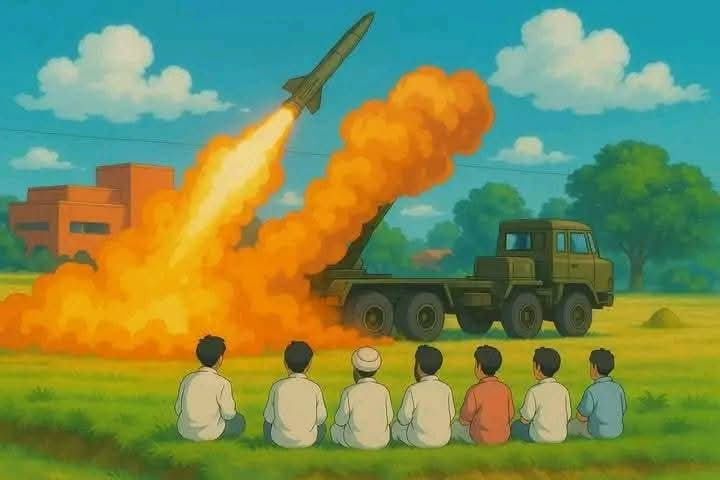
Shortly after returning home, I came across the first official video announcing the commencement of Operation Bunyan-um-Marsoos. The footage showed Pakistan launching the first wave of Fatah-1 guided rockets toward Indian targets. The moment I saw it, I immediately rushed downstairs and informed my father that the response had finally begun. It was morale boosting, tears came in my eyes, I wanted to be out there alongside them, but again was a spectator, not a participant.
As I switched on the news channels, the entire atmosphere changed dramatically. It felt like witnessing history unfold in real time — the kind of moment one expects to see only once in a lifetime. Reports indicated that the Pakistan Army was engaging targets using the Fatah-1 and SH-15 long-range artillery systems. Simultaneously, the Pakistan Air Force was reportedly striking targets across the border using JF-17 Thunder fighter aircraft. There were also reports of large formations taking off for follow-on strike missions inside India. In every sense, Pakistan’s response was now fully underway.
As the news spread, I began receiving calls and messages from friends living abroad. Many of them sounded genuinely worried, fearing that the conflict could spiral into something much larger — perhaps even resembling the prolonged and devastating nature of the Russo-Ukrainian War. To be honest, I shared some of those fears myself. The uncertainty of where events might lead weighed heavily on everyone watching.
Around dawn, I went back to the rooftop hoping to observe some visible sign of the ongoing operations. Yet between 5:00 am and 6:00 am, the scene was unexpectedly calm. The only visible activity was a Lockheed C-130 Hercules circling around the vicinity of PAF Base Nur Khan. There were no flames, no smoke columns, and no visible evidence of the earlier attack — a quiet but reassuring indication that the damage feared during the night had not materialized. The Indian claims that the base had been “wiped off the face of the earth” quickly proved to be nothing more than wartime propaganda and misinformation. As the day progressed, normal operational activity continued at PAF Base Nur Khan, with transport aircraft visibly operating from the base throughout the day.
For those of us living nearby, that activity itself became the clearest indication that the situation on the ground was far different from the dramatic narratives circulating online and on certain television channels. In times of conflict, information warfare often runs parallel to actual military operations, and that day was a stark reminder of how exaggerated claims can spread rapidly before facts emerge.
As the morning progressed, the television coverage became increasingly repetitive. Despite the tension in the air, no major developments unfolded until around 7:00 am. Realizing that electricity disruptions could become a possibility in the event of further attacks, I decided to charge my mobile phone fully and try to get some sleep. My thinking was simple: if another major escalation occurred, it would be better to be rested and prepared, with at least a charged phone to stay informed and connected.
But sleep never truly came. The uncertainty of the situation weighed too heavily on the mind. I remained restless for hours, drifting between brief moments of silence and constantly checking for updates until nearly midday. The only morale boosting videos were of Fatah-1 engaging Indian positions, and the JF-17 Thunders loaded with hypersonic missiles, taking off for follow up strikes against Indian S-400 air defence systems. At least 26 Indian targets were hit which was a big relief after what they did in the initial hours of the day.
Shortly before Zuhr, disturbing reports began circulating that in another wave of attacks, the Indian Air Force had allegedly managed to strike PAF Base Mushaf, PAF Base Shahbaz, and PAF Base Bholari, with fears of casualties emerging from Bholari. At that point, the reality of the situation became impossible to ignore — this was no longer limited to rhetoric, media narratives, or symbolic shows of force. It was a shooting war, and in war, casualties are always a painful possibility.
The precise details of those reported attacks remained unclear and heavily contested, as conflicting claims and counterclaims continued to dominate the information space. Yet even amid the uncertainty, there was a growing sense that international pressure was rapidly building to prevent the conflict from spiraling further.
Then, around 4:00 pm, discussions of a ceasefire suddenly began appearing across the media. The first public indication came from Donald Trump, who announced that a ceasefire understanding had been reached. About thirty minutes later, Pakistan’s Ministry of Foreign Affairs formally confirmed the ceasefire, followed shortly afterward by a similar announcement from the Indian Ministry of External Affairs at approximately 5:00 pm.
What only hours earlier had appeared to be the beginning of a prolonged and dangerous conflict unexpectedly came to an abrupt halt. The speed with which the crisis escalated — and then suddenly de-escalated — left many of us stunned. One moment, the region seemed to be standing on the edge of a major war; the next, an uneasy silence had returned.
Social media was abuzz with claims that the ceasefire remained fragile, while sections of the Indian media appeared visibly frustrated that Pakistan had once again escaped the kind of punishment they had confidently predicted. The same media houses that had spent days projecting overwhelming Indian dominance suddenly shifted tone, trying to justify the outcome rather than celebrate it.
The following day, during the Indian Tri-Services briefing, the officials appeared composed but noticeably restrained, maintaining what looked more like a poker face than the confidence seen earlier in the conflict. They insisted that India had achieved its objectives during the initial strikes of 6–7 May and focused heavily on showcasing attacks on PAF bases, alleged radar sites, and civilian airports, supported by satellite imagery.
Yes, there were visible impacts. Some installations had clearly been struck. But from all available indications, the only targets of real operational significance appeared to be a hangar at Shahbaz and another at Bholari. Beyond that, most of the damage seemed to carry little tactical consequence and did not meaningfully hamper the Pakistan Air Force’s operational capability or wartime response. PAF continued to operate, respond, and maintain pressure throughout the crisis.
What stood out even more during the briefing was the response regarding aircraft losses and competing claims. Instead of confidently dismissing Pakistan’s assertions, the Indian side avoided giving a direct answer. Their spokesperson merely stated that “losses are part of combat,” emphasized that political objectives had been achieved, and added that all pilots were accounted for. It was a carefully worded response, but hardly the reaction expected from a side claiming overwhelming superiority.
As a civilian observer, I could not help but ask myself a simple question: if India truly held such an unchallenged advantage, why did it not press forward and decisively dismantle Pakistan’s military capability? Why halt when the rhetoric beforehand had suggested total dominance?
The answer, perhaps, lay in the reality that emerged once the shooting started. The situation had not unfolded according to expectations. The resistance encountered, the losses suffered, and the uncertainty of escalation appeared to shock decision-makers on the other side. In the end, rather than escalating further into an unpredictable and costly conflict, India seemed eager to step away from a crisis that had become far more complicated than anticipated.
The ISPR Tri-Services briefing was delayed because the Indian Tri-Services media conference was still underway. But when the Pakistani briefing finally began, the contrast in atmosphere was impossible to ignore. The faces of the Pakistani officers seemed to tell their own story — calm, composed, confident, almost carrying the demeanor of men satisfied with the outcome of the confrontation. There were smiles, light jokes, occasional smirks; the environment appeared remarkably relaxed for people who had just come through one of the most dangerous military stand-offs in recent years.
DG ISPR then presented a detailed, almost blow-by-blow account of the operations. The PAF spokesperson elaborated extensively on the SEAD/DEAD missions carried out against Indian air defence assets, particularly the S-400 units. Detailed radar imagery of incoming Indian missile strikes was shown during the briefing. According to the PAF, several incoming missiles had been intercepted, while some did manage to hit their intended locations. However, the spokesperson firmly maintained that all key aerial assets of the Pakistan Air Force remained safe, operational, and fully combat capable.
The Naval spokesperson also made an interesting revelation. He stated that the Indian aircraft carrier Vikrant had been one of Pakistan Navy’s highest-priority targets during the confrontation. According to him, had the carrier crossed a certain operational threshold, it would have been engaged and targeted well beyond the firing range of its BrahMos missiles. The statement was delivered calmly, but its strategic implications were significant.
Pakistan also presented satellite imagery to support its claims, though the visuals were not as sharp or commercially polished as those shown by the Indian side. Yet, oddly enough, that restraint itself seemed meaningful. The overall tone of the Pakistani briefing appeared measured — assertive, but not triumphalist. It almost gave the impression that Islamabad was intentionally avoiding humiliating India publicly to a degree that could force New Delhi into escalating again simply to recover domestic prestige.
In many ways, it felt as though Pakistan had already provided India an opportunity to step back gracefully on the night of 6–7 May. And during this briefing too, another opening seemed to be offered — a chance to preserve face before its own public. Because had the full scale of the setback been openly acknowledged and amplified, the political fallout for Modi and his government could have become extremely difficult to contain domestically.
CONCLUSION
Within a matter of days, Pakistan’s prestige and strategic standing appeared to rise dramatically across the region. Countries in the Middle East that had initially cautioned Islamabad against responding forcefully to India — warning of severe consequences and possible escalation — now seemed far more interested in Pakistan’s military capabilities and operational experience. Conversations reportedly shifted from restraint to cooperation, with several states openly expressing interest in closer defence ties and military coordination with Pakistan.
The United States too, which at first appeared relatively detached from the crisis, suddenly showed renewed interest in engaging Pakistan’s military leadership. At the same time, Pakistan received visible diplomatic and political support from countries such as China, Turkey, Azerbaijan, and Bangladesh. The reaction within parts of Indian social media was intense enough that unofficial calls began circulating to boycott tourism to Turkey and Azerbaijan.
Another narrative quickly emerged within Indian discourse: that India had not truly fought Pakistan alone, but had effectively confronted Chinese military technology and support structures. For many Indians struggling to process the outcome, attributing Pakistan’s battlefield performance to Chinese systems became easier than accepting that Pakistan itself had fought effectively. Attention especially focused on the performance of Chinese-origin platforms against Western systems. The reputation of the Dassault Rafale appeared to suffer reputational damage in public debate, while China’s Chengdu J-10C gained enormous attention. Reports and speculation about future export orders, especially for the JF-17 Thunder, dominated defence circles.
Delegations and military officials from countries such as Indonesia, Singapore, Thailand, and Malaysia reportedly visited Pakistan in the aftermath of the conflict, publicly acknowledging the professionalism demonstrated during the crisis. Pakistan also pushed aggressively to market its defence industry, particularly the JF-17, with reports of major defence agreements and interest from countries including Azerbaijan, Sudan, Iraq, and Libya.
Meanwhile, India faced growing international and domestic pressures. Economic tensions with the United States reportedly intensified, with trade disputes and tariff-related disagreements adding to New Delhi’s challenges. Setbacks and embarrassing incidents at international defence exhibitions further fed criticism within Indian media and opposition circles. During the later tensions involving the United States, Iran, and Israel, India’s perceived alignment with Israel reportedly strained its relations with Iran, while Pakistan increasingly positioned itself as a regional mediator and stabilizing actor attempting to prevent wider escalation.
Pakistan’s strategic ties with Saudi Arabia deepened further through new defence agreements and military cooperation, with Pakistani forces maintaining an enhanced presence in the Kingdom. Qatar also moved toward closer defence coordination. Domestically, General Syed Asim Munir was elevated to the rank of Field Marshal and appointed Chief of Defence Staff, while the Chief of Air Staff reportedly received an extension focused on modernizing and preparing the Pakistan Air Force for any future confrontation with India.
India, meanwhile, increasingly appeared to rely on a closer strategic alignment with the United Arab Emirates and Israel, creating what many analysts described as a new regional axis shaped by shared security and geopolitical interests.
A week after the conflict, PAF fighter jets roared over the skies of Islamabad, releasing flares in a symbolic display of confidence and dominance after what had been a limited but extremely dangerous military confrontation. The contrast between the atmospheres in the two countries felt stark. In Pakistan, there was celebration, pride, and renewed confidence. In India, there appeared to be frustration, political infighting, and a growing debate over the purpose and outcome of the confrontation. Opposition parties questioned the government relentlessly, while parts of the Indian media and military establishment continued advancing delayed or exaggerated claims months after the conflict. At the same time, many ordinary and sober-minded Indians openly questioned the strategic utility of what they saw as a costly and avoidable misadventure.
Yet beneath the celebrations and rhetoric, one realization lingered strongly on both sides of the border: this conflict may have ended, but the rivalry had not. Almost everyone understood that another confrontation between India and Pakistan remained not a question of if, but when.
Copyright 2026 Sarmad Hassan Sharif. All Rights Reserved. Reproduction in whole or in part in any form or medium without express written permission of author is prohibited.