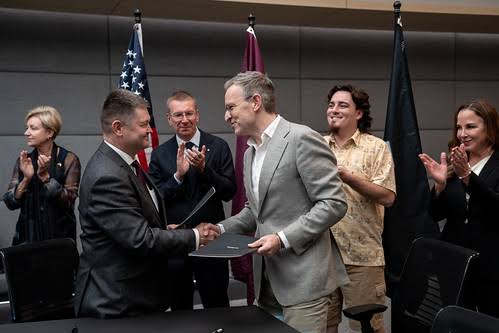

Latvian defense technology company ORIGIN and U.S.-based Anduril Industries have signed a memorandum of understanding to explore the integration of ORIGIN’s BLAZE autonomous counter-drone interceptor with Anduril’s Lattice command-and-control platform.
The companies announced the agreement on September 25, 2026, saying the collaboration will focus on developing and testing a layered counter-unmanned aerial system capability that could support Latvia and other NATO countries along the alliance’s eastern flank.
The MoU includes plans for joint testing, demonstrations, and validation activities in Latvia. The companies will also work on concept-of-operations development, data sharing, and assessments of mission effectiveness for counter-UAS operations.
The agreement is exploratory and does not represent a procurement contract.
Table of Contents
ToggleBLAZE to Be Tested With Anduril Lattice
Under the MoU, ORIGIN and Anduril will examine how BLAZE can connect with the Lattice software platform alongside radars and other sensors deployed within an air defense architecture.
Lattice is Anduril’s software platform designed to combine data from different sensors, networks, and unmanned systems into a common operating layer.
The platform is intended to provide operators with real-time situational awareness while allowing connected systems, including sensors and autonomous vehicles, to be tasked through a shared command-and-control environment.
By integrating BLAZE with Lattice, the companies aim to assess whether the interceptor can operate as part of a broader networked counter-UAS architecture rather than as a stand-alone system.
According to ORIGIN, such an approach could allow sensor data to be passed more rapidly to an interceptor, helping operators respond to incoming drone threats within a coordinated air defense network.
Joint Counter-UAS Testing Planned in Latvia
ORIGIN and Anduril plan to conduct testing and demonstrations in Latvia as part of the cooperation agreement.
The work will include developing operational concepts, sharing technical data, and evaluating how the combined systems perform against different counter-UAS mission profiles.
The collaboration reflects a broader shift toward connecting individual sensors, effectors, and command systems within integrated air defense networks.
For counter-drone operations, this can involve linking detection systems such as radar with command-and-control software and interceptors capable of engaging the identified target.
“Integrating BLAZE with Anduril’s Lattice platform means our interceptors operate as part of a connected system, giving allied forces better visibility and faster response against evolving drone threats,” said Martins Marenis, Commercial Director of ORIGIN.
“That is what modern air defense requires, and it is what smaller nations along NATO’s eastern flank need to defend their own airspace effectively,” he added.
What Is ORIGIN’s BLAZE Interceptor?
BLAZE is an autonomous interceptor drone developed by ORIGIN for counter-UAS operations.
According to the company, the system receives targeting information from radar and uses the data to guide its onboard autopilot toward an aerial threat. It can then acquire and track the target before conducting an intercept under operator supervision.
ORIGIN says the system is designed to engage drones and loitering munitions.
The company also describes BLAZE as NATO-codified and says it incorporates a STANAG-compliant warhead module.
ORIGIN states that Latvia was the first European customer to order and receive BLAZE, followed by Estonia, Belgium, and France.
Anduril Lattice Provides Common Command Layer
Anduril describes Lattice as an open, sensor-agnostic software platform designed to integrate information from distributed sensors, systems, and networks.
The platform applies artificial intelligence, machine learning, and data-processing tools to organize information and present relevant data to operators.
Connected assets can then be tasked from within the platform.
Anduril says Lattice is already used to integrate legacy and autonomous systems for several government customers, including U.S. Customs and Border Protection, U.S. Special Operations Command, and the UK Home Office.
For the ORIGIN collaboration, the key objective will be determining how BLAZE can operate within that wider command-and-control environment.
Agreement Signed During Latvian Trade Mission to United States
The MoU was signed during a Latvian business trade mission to the United States organized by the Investment and Development Agency of Latvia (LIAA).
The mission coincides with Latvian President Edgars Rinkēvičs’ official visit to the United States and runs through September 27, with activities in New York, Los Angeles, and San Diego.
Ieva Jāgere, Director of LIAA, described the agreement as an important result of the mission and said Latvia is seeking to develop joint projects between Latvian technology companies and U.S. partners.
“The cooperation memorandum between ORIGIN and Anduril is a significant outcome of this trade mission,” Jāgere said.
She added that LIAA aims to help Latvian companies establish partnerships, secure orders, and attract investment in the United States.
Analysis: Networked Counter-UAS Systems Gain Importance
The ORIGIN-Anduril agreement is notable less for the individual technologies involved than for the operational model the two companies intend to test.
Modern counter-UAS operations increasingly depend on connecting detection, decision-making, and interception systems within a common network.
A radar may detect a drone, but the effectiveness of the wider defense architecture depends on how quickly that information can reach command systems and how efficiently the appropriate interceptor or other effector can be assigned to the target.
Integrating BLAZE with Lattice could allow ORIGIN’s interceptor to function as one component within a broader sensor-to-effector chain.
This approach could be particularly relevant for NATO members on the alliance’s eastern flank, where governments are investing in additional capabilities to detect and counter unmanned aerial threats.
The planned testing in Latvia will therefore be important. Demonstrations can help determine how effectively the two systems exchange targeting data, how rapidly operators can respond, and whether the combination can work alongside other sensors and air defense systems already in service.
Another important factor is interoperability.
Counter-UAS systems are increasingly expected to connect with platforms from multiple manufacturers. Anduril’s description of Lattice as sensor- and system-agnostic is intended to address that requirement, although the practical effectiveness of the BLAZE integration will need to be demonstrated through testing.
The agreement should also be viewed in its proper context. The companies have signed an MoU to explore integration and testing; they have not announced a new operational deployment or procurement contract resulting from the partnership.
The next significant milestone will therefore be the joint demonstrations in Latvia and whether those trials lead to a validated operational configuration or subsequent procurement opportunities.