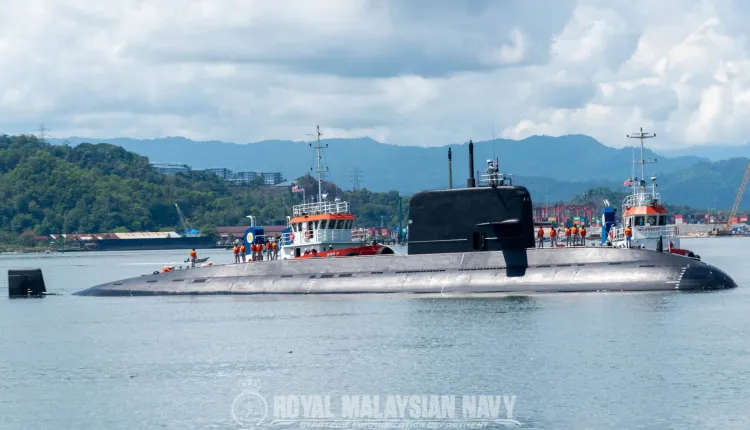

Beneath the surface of the Arabian Sea, a strategic shift is quietly unfolding. With an eight-submarine deal worth $5 billion concluded with China, and the first batch expected to enter service in 2026, Pakistan is making a decisive bid to redefine its role in regional naval competition. Three Hangor-class submarines are currently undergoing sea trials; the fourth, PNS Ghazi, was launched at a Chinese shipyard in Wuhan on December 17, 2025, while the remaining four are being integrated at Karachi Shipyard and Engineering Works (KSEW). To fully appreciate what this means for South Asian naval dynamics, it is essential to understand the capabilities that make the Hangor-class a game-changer.
The Hangor-class is a diesel-electric attack submarine distinguished by its advanced stealth, sensor suite, endurance, and firepower. At the heart of its design is Air Independent Propulsion (AIP), powered by a Stirling engine, which allows the submarine to conduct submerged patrols for two to three weeks without surfacing, and without generating the acoustic signature that traditional diesel submarines produce. Its SONAR (Sound Navigation and Ranging) systems provide sophisticated detection and targeting capabilities against both surface and subsurface threats. Embedded intelligence, surveillance, and reconnaissance (ISR) systems further enable Pakistan to monitor adversarial activity and protect its maritime interests. Perhaps most critically, the Hangor-class’s 533mm torpedo tubes can launch long-range sea-skimming anti-ship missiles, making them significantly harder to detect on enemy radar. Together, these systems transform the submarine from a passive deterrent into a potent offensive platform.
Before the Hangor-class, Pakistan’s naval posture was largely reactive. The fleet relied on aging Khalid-class and Hashmat-class submarines, both approaching the end of their operational lives, while India extended its blue-water reach across the Indian Ocean with a fleet of over 150 warships, including two aircraft carriers and a mix of nuclear and conventional submarines. India’s recent investments in anti-submarine warfare (ASW) capabilities have further reinforced its power-projection ambitions. Against this backdrop, the Hangor-class introduces a meaningful asymmetric counterweight. Its raft-mounted vibration-dampening technology reduces acoustic emissions to a minimum, making the submarine extraordinarily difficult to track. Its low acoustic signature makes it especially valuable for intelligence-gathering missions during peacetime and periods of heightened tension alike. Operationally, the Hangor-class poses a credible challenge to India’s ASW systems: its ability to launch torpedoes or anti-ship missiles threatens large naval platforms, including carrier battle groups, which would require significantly greater resource allocation for protection. While India retains decisive numerical superiority, the Hangor-class directly complicates its maritime dominance.
The name itself carries historical weight. The original PNS Hangor became a symbol of Pakistan’s naval capability when, during the 1971 Indo-Pakistan War, it sank the Indian frigate INS Khukri, the first submarine kill in the post-World War II era in Asia. That legacy of underwater warfare continues to reverberate. Stung by lessons drawn from that conflict, India has long sought to modernize its own submarine fleet. Under Project-75I, New Delhi is attempting to procure six advanced conventional submarines equipped with AIP technology from Germany, at an estimated cost of $8 billion. Yet Project-75I has been plagued by decades of delays: its origins trace to the late 1990s, negotiations remain ongoing, and construction has not yet begun. The likelihood of an Indian submarine entering service before the early 2030s remains slim. This procurement lag risks leaving India in a strategically vulnerable position in the Arabian Sea precisely as Pakistan’s new underwater capabilities come online.
The broader regional implications of the Hangor-class extend well beyond bilateral rivalry. In the Indian Ocean Region (IOR), the submarine enhances Pakistan’s anti-access and area-denial (A2/AD) capabilities, strengthening its ability to challenge Indian naval operations and protect critical sea lanes, particularly those connected to Gwadar port and the China-Pakistan Economic Corridor (CPEC). For India, the China-Pakistan maritime partnership is increasingly perceived as a strategic threat, adding cost and complexity to its naval calculus in the Arabian Sea and the wider Indian Ocean.
From Pakistan’s perspective, the Hangor-class submarines are a vital defensive upgrade. They close key gaps in underwater surveillance and sea denial, strengthening the country’s ability to deter aggression and protect its sea lanes. Far from seeking dominance, this capability simply ensures a more balanced and stable maritime environment in South Asia by raising the cost of any conflict and safeguarding national sovereignty.