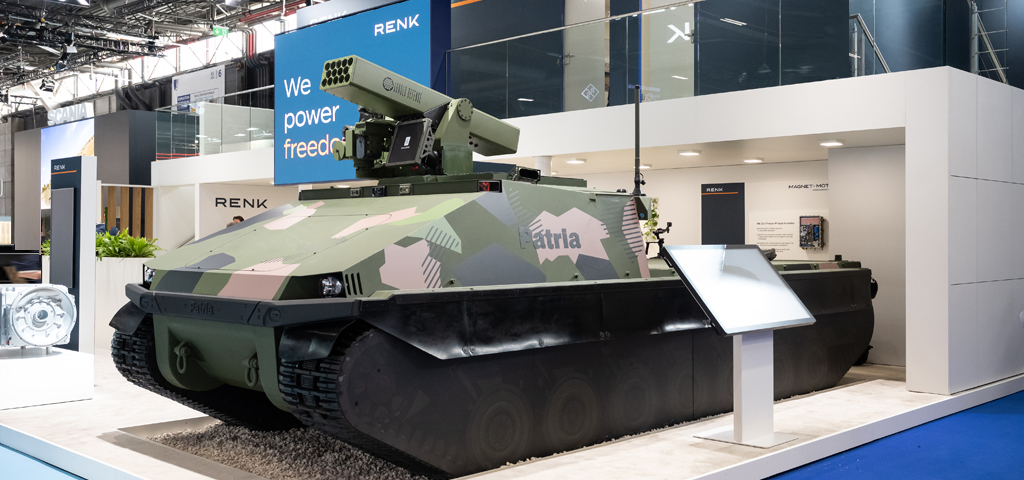

Finnish defense company Patria and Germany’s RENK Group AG have unveiled a next-generation heavy unmanned ground vehicle (UGV) concept at Eurosatory 2026, highlighting Europe’s growing emphasis on autonomous land warfare capabilities.
Displayed at RENK’s stand (J280, Hall 6) from 15–19 June, the concept combines Patria’s modular TRACKX tracked vehicle platform with RENK’s HSWL 076 transmission and drive-by-wire mobility architecture. The collaboration aims to demonstrate how existing combat vehicle technologies can be adapted to support remotely operated and future autonomous missions.
The unveiling comes amid increasing interest among NATO members in fielding unmanned systems capable of operating in high-threat environments while reducing risks to military personnel.
Table of Contents
ToggleCombining Mobility and Autonomy
According to the companies, the UGV concept integrates Patria’s expertise in tracked vehicle design with RENK’s advanced drivetrain technologies to create a scalable platform suitable for future operational requirements.
“Patria TRACKX is an exceptional all-terrain armored tracked vehicle, offering an optimal solution for various applications that demand high mobility standards for military units,” said Panu Routila, President and CEO of Patria.
He noted that lessons emerging from the war in Ukraine continue to shape defense procurement priorities.
“The war in Ukraine shows what modern and future warfare looks like. Today, unmanned systems are essential and are a battlefield necessity. Patria provides the platform expertise, and RENK digitalized transmission HSWL 076 with drive-by-wire capability, bringing greater commonality between Patria’s uncrewed and crewed vehicles for end users.”
The HSWL 076 transmission, paired with drive-by-wire technology, enables remote vehicle control and provides a foundation for progressively higher levels of autonomy.
European Cooperation for Future Land Systems
RENK emphasized that the initiative represents a broader trend towards digitally enabled military platforms capable of adapting to evolving operational requirements.
“The future of land operations will depend on digitally enabled, and scalable vehicle architectures,” said Dr. Alexander Sagel, CEO of RENK Group AG. “Together with Patria, we are demonstrating how European defense cooperation can rapidly translate innovation into scalable and future-ready unmanned ground capabilities.”
The collaboration reflects growing efforts across Europe to strengthen indigenous defense capabilities while enhancing interoperability among allied forces.
Lessons from Ukraine Drive Demand for UGVs
The emergence of unmanned systems as a defining feature of contemporary conflicts has accelerated interest in ground-based robotic platforms.
Recent conflicts, particularly the Russia–Ukraine war, have demonstrated the operational value of reducing crew exposure during high-risk missions such as reconnaissance, logistics support, casualty evacuation, breaching operations, and direct combat support.
As a result, defence ministries across NATO are increasingly pursuing optionally manned and fully unmanned solutions capable of operating in contested environments without compromising mobility or mission effectiveness.
The Patria–RENK concept directly addresses these requirements by leveraging mature technologies already employed in crewed combat vehicles.
Analysis: Europe’s UGV Race Is Accelerating
The unveiling of the Patria–RENK concept highlights a broader shift in the European defene landscape.
Rather than developing entirely new vehicle families from scratch, manufacturers are increasingly focusing on modularity, digitalization, and commonality. By integrating autonomous functions into proven platforms, armed forces can potentially reduce acquisition risks, simplify maintenance, and streamline operator training.
The use of drive-by-wire architecture is particularly significant, as it serves as a critical enabling technology for future autonomous capabilities. Such systems allow vehicles to transition gradually from remote operation towards greater levels of artificial intelligence-assisted decision-making.
Moreover, the collaboration underscores Europe’s determination to strengthen its defense industrial base amid rising geopolitical tensions. Joint programmes between European companies may become increasingly common as governments seek rapid capability enhancements while promoting strategic autonomy.
While the showcased platform remains a concept demonstrator, its debut at Eurosatory 2026 signals that unmanned ground systems are moving from experimental programmes towards mainstream military planning.
As defense planners reassess battlefield requirements in light of evolving threats, heavy UGVs are likely to play an expanding role within future land force structures.