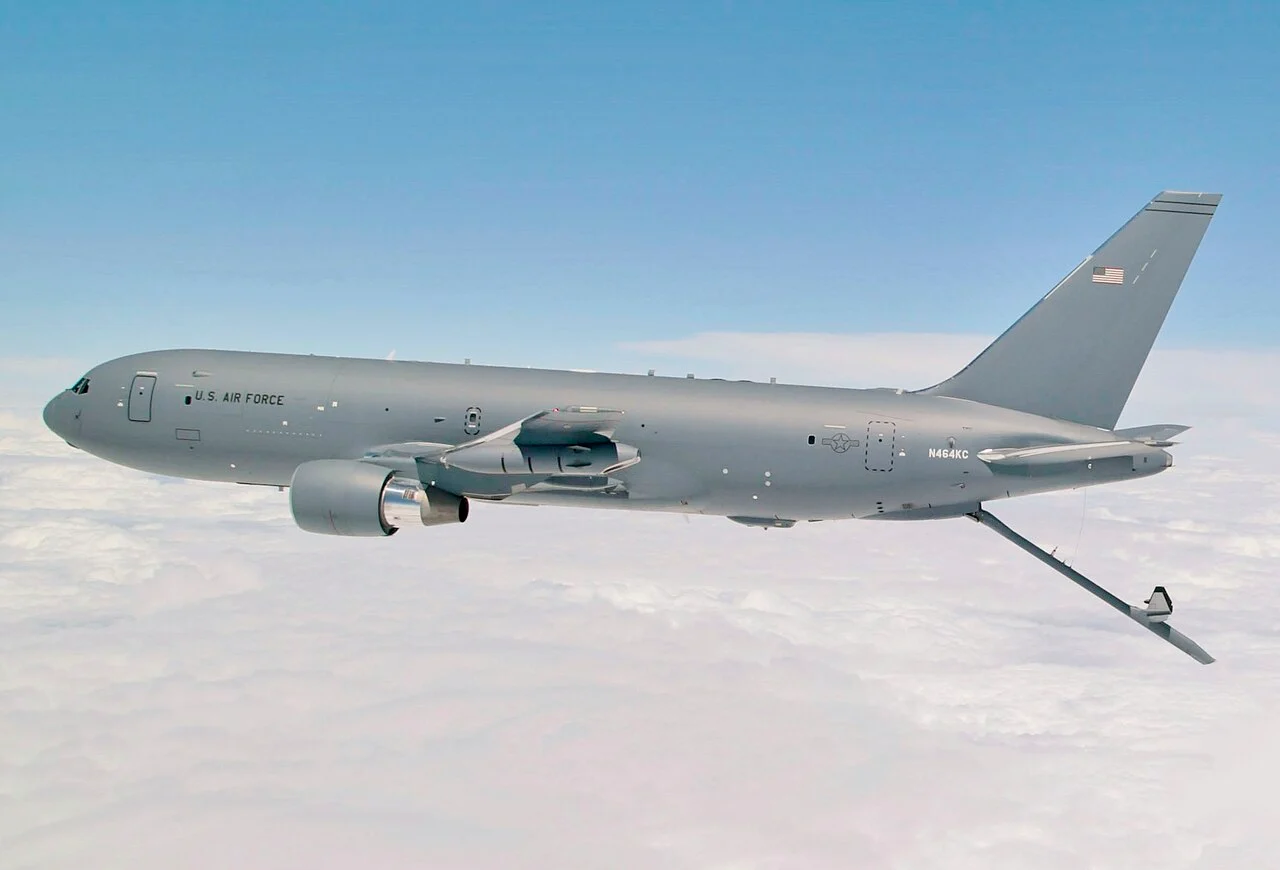

The U.S. Department of State has approved a possible $4.5 billion Foreign Military Sale (FMS) to Qatar involving up to four Boeing KC-46A aerial refueling aircraft, along with associated engines, defensive systems, training, logistics, and support equipment.
The proposed sale was detailed in Congressional Notification Transmittal No. 26-80, dated August 20, 2026, and represents a potentially significant enhancement to Qatar’s airpower and long-range operational capabilities.
According to the notification, the Government of Qatar has requested the purchase of up to four KC-46A aircraft and a comprehensive package of mission systems and support equipment.
The proposed package includes eight Pratt & Whitney PW4062 turbofan engines, ten AN/ALR-69A radar warning receivers, fifteen Guardian Laser Transmitter Assemblies (GTLA) for the Large Aircraft Infrared Countermeasure, or LAIRCM, system, and eight LAIRCM processor replacements.
Additional equipment would include missile warning sensors, Identification Friend or Foe systems, cryptographic equipment, precision navigation capabilities, electronic warfare database support, aircraft components and spare parts, maintenance equipment, training systems, technical documentation, software, transportation support, infrastructure assistance, and U.S. government and contractor technical services.
KC-46A to Strengthen Qatar’s Air Refueling Capability
The Boeing KC-46A Pegasus is a 767-derived multirole aerial refueling aircraft designed to support the in-flight refueling of military aircraft while also providing cargo, passenger, and aeromedical transportation capabilities.
For Qatar, acquisition of the KC-46A would provide an important force-multiplier capability by allowing combat aircraft to remain airborne for longer periods and operate at greater distances.
Aerial refueling can significantly increase the operational reach and endurance of fighter aircraft while reducing dependence on intermediate airfields. It can also improve Qatar’s ability to participate in multinational and coalition air operations.
The U.S. State Department said the proposed sale would improve Qatar’s ability to address current and future threats while enhancing interoperability with U.S. and allied forces.
“The proposed sale will increase Qatar’s capability to meet current and future threats by enhancing its defense capabilities and interoperability with U.S. and allied forces and reinforcing Qatar’s strategic role in regional security,” the State Department said.
Washington also stated that Qatar would have no difficulty absorbing the proposed aircraft and associated systems into its armed forces.
Advanced Defensive Systems Included
Beyond the aircraft themselves, the proposed KC-46A package contains an extensive suite of defensive and electronic warfare equipment intended to improve aircraft survivability.
Among the systems listed are the AN/ALR-69A radar warning receiver, missile warning sensors, and components of the LAIRCM system.
LAIRCM is designed to help protect large military aircraft against infrared-guided missile threats by detecting missile launches and using directed infrared countermeasures to disrupt incoming missile seekers.
The inclusion of electronic warfare database support, cryptographic equipment, secure identification systems, and mission-related software indicates that the proposed acquisition encompasses considerably more than the delivery of the four aircraft.
The package also covers long-term elements necessary for operating and sustaining the fleet, including maintenance, spare parts, repair and return support, technical assistance, personnel training, facilities support, transportation, and aircraft fuel.
Boeing Named Principal KC-46A Contractor
Boeing, headquartered in Arlington, Virginia, will serve as one of the principal contractors for the proposed sale.
Other major contractors identified in the congressional notification include Pratt & Whitney Military Engines, RTX Corporation, and Northrop Grumman Corporation.
Pratt & Whitney produces the PW4062 engines associated with the aircraft, while the broader package includes electronic warfare, warning, countermeasure, and mission-support systems from U.S. defense suppliers.
The U.S. government said it is currently unaware of any offset agreement associated with the potential sale. Any future offset arrangements would be determined through negotiations between Qatar and the relevant contractors.
According to the notification, implementation of the proposed sale would not require additional U.S. government or contractor representatives to be permanently assigned to Qatar.
The State Department also assessed that the sale would not alter the basic military balance in the region and would have no adverse effect on U.S. defense readiness.
Qatar-US Defense Cooperation
The proposed tanker acquisition comes within the framework of close defense and security relations between Qatar and the United States.
In its notification, Washington described Qatar as a strategic regional partner and said strengthening the country’s defense capabilities supports U.S. foreign policy and national security objectives in the Middle East.
If the acquisition proceeds, the KC-46A would give the Qatar Emiri Air Force a sophisticated aerial refueling platform capable of supporting extended air operations and improving interoperability during combined missions involving U.S. and allied aircraft.
The $4.5 billion figure represents the estimated maximum value of the proposed Foreign Military Sale package. Congressional notification does not constitute the signing of a final procurement contract, and the eventual value, aircraft configuration, equipment quantities, and delivery arrangements could change during subsequent negotiations.
The proposed sale must proceed through the remaining U.S. Foreign Military Sales process before a final agreement and aircraft deliveries can take place.