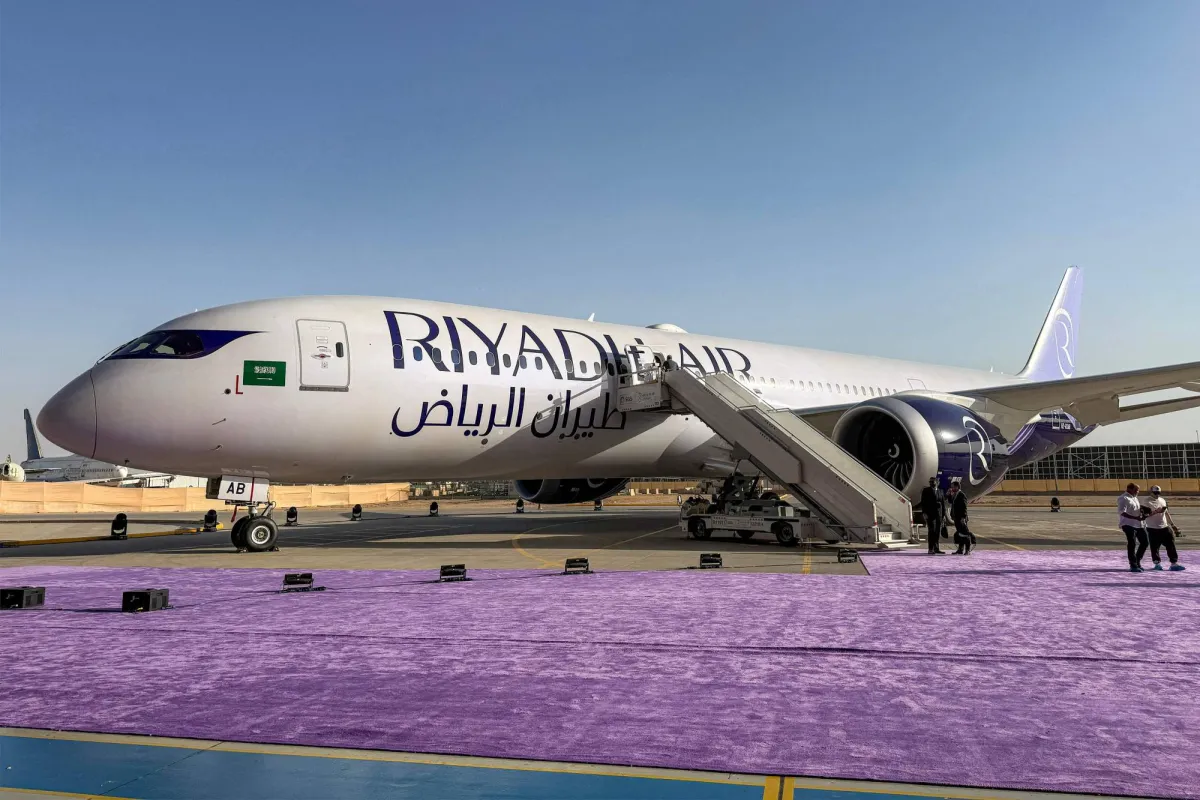

Riyadh Air has committed to acquire 28 additional Boeing 787 Dreamliners, adding the larger 787-10 variant to its future fleet as the Saudi carrier expands toward more than 100 international destinations by 2030.
The agreement, announced at the Farnborough International Airshow on July 20, 2026, involves the exercise of options linked to Riyadh Air’s original 2023 Boeing order. The airline will convert 20 of the aircraft to the higher-capacity 787-10, while the remaining eight will retain the 787-9 configuration unless subsequently revised.
Eleven aircraft are covered by a previously unidentified purchase. Boeing said the remaining 17 will require finalization before Riyadh Air’s firm order total reaches 67 Dreamliners.
Table of Contents
ToggleRiyadh Air Adds 787-10 to Future Widebody Fleet
The latest commitment introduces the Boeing 787-10 to Riyadh Air’s fleet plan for the first time.
The carrier currently operates six 787-9 aircraft and serves six cities. Adding the larger 787-10 will give Riyadh Air greater flexibility to match aircraft capacity with passenger and cargo demand across different routes.
The 787-9 offers greater range, making it suitable for longer intercontinental services. The 787-10 has a shorter range but provides more passenger capacity and lower operating cost per seat on high-demand medium- and long-haul routes.
Riyadh Air said the larger variant will provide approximately 50 more seats than the 787-9, depending on the airline’s final cabin configuration.
Operating both versions will allow the carrier to deploy the 787-9 on longer or thinner routes while assigning the 787-10 to markets where higher traffic volumes justify additional capacity.
Commitment Builds on Riyadh Air’s 2023 Boeing Order
The 28-aircraft commitment forms part of the options included in Riyadh Air’s original Boeing 787 agreement announced in 2023.
The latest transaction includes 11 aircraft that had previously been listed by Boeing under an unidentified customer. The remaining 17 are expected to be added to Boeing’s firm backlog after contractual finalization.
This distinction is important. Although Riyadh Air has committed to all 28 aircraft, Boeing has stated that only part of the transaction is currently reflected as a finalized purchase.
Once the remaining aircraft are confirmed, Riyadh Air’s firm order count will increase to 67 Boeing 787 Dreamliners.
The expanded order demonstrates the airline’s intention to build a sizeable, standardized widebody fleet rather than operate the Dreamliner as a limited subfleet.
Fleet Commonality to Reduce Training and Maintenance Complexity
Operating the 787-9 and 787-10 together will provide Riyadh Air with significant fleet commonality.
Both variants share flight-deck systems, pilot type ratings, maintenance procedures, spare-parts requirements, and much of the same technical support infrastructure.
This can reduce crew-training costs and simplify aircraft scheduling. Pilots trained on one variant can operate the other with limited additional preparation, while maintenance teams can support both aircraft using largely common tools, procedures, and technical knowledge.
Fleet commonality can also improve operational resilience. Aircraft can be reassigned between routes more easily when demand changes or when maintenance disrupts scheduled operations.
For a new airline expanding rapidly, such standardization is particularly important because introducing multiple unrelated widebody types can increase technical, training, and supply-chain complexity.
Boeing 787-10 to Increase Passenger and Cargo Capacity
The 787-10 is the largest member of Boeing’s Dreamliner family.
Its higher seating capacity will allow Riyadh Air to accommodate increasing passenger demand on major regional and international routes while also carrying additional belly cargo.
The aircraft is expected to be particularly useful on dense routes linking Riyadh with major destinations in Europe, Asia, the Middle East, and potentially Africa.
Tony Douglas, chief executive officer of Riyadh Air, said the commitment marked another step toward the airline’s plan to serve more than 100 international destinations by 2030.
“The addition of the 787-10 strengthens our ability to accommodate growing passenger and cargo demand while providing the operational flexibility required to support our ambitious network plans,” Douglas said.
The carrier has not disclosed the final seating configuration, cabin-class distribution, engine selection, or delivery schedule for the additional aircraft.
Riyadh Air Expands Following Launch of Commercial Operations
The order follows Riyadh Air’s launch of full commercial operations.
According to Boeing, the airline has taken delivery of six 787-9 aircraft and currently serves six cities.
The expansion from an initial operating network to more than 100 destinations within four years will require a rapid increase in aircraft deliveries, trained personnel, maintenance capacity, airport infrastructure, and international traffic rights.
The new Dreamliner commitment provides part of the widebody capacity required to support that expansion.
However, network growth will also depend on passenger demand, airport slots, route approvals, competitive conditions, and the airline’s ability to integrate new aircraft without compromising operational reliability.
Order Supports Saudi Vision 2030 Aviation Strategy
Riyadh Air is wholly owned by Saudi Arabia’s Public Investment Fund and forms a central part of the Kingdom’s aviation and tourism strategy under Vision 2030.
Saudi Arabia is seeking to establish Riyadh as a major international aviation hub while increasing tourism, business travel, investment, and non-oil economic activity.
The airline aims to connect the Saudi capital directly with more global markets, reducing reliance on transit through established hubs elsewhere in the Gulf and wider region.
Riyadh Air expects its expansion to support more than 200,000 direct and indirect jobs and contribute over $20 billion, equivalent to approximately SAR 75 billion, to non-oil gross domestic product by 2030.
These figures are company projections and will depend on the scale and pace of the airline’s network, fleet, employment, and associated economic activity.
Boeing Highlights Fuel Efficiency and Passenger Experience
Boeing states that the 787-10 uses approximately 25 percent less fuel and produces 25 percent fewer emissions than the aircraft types it typically replaces.
The efficiency gains are attributed to the aircraft’s composite structure, advanced aerodynamics, modern engines, and integrated systems.
Actual fuel performance will depend on route length, payload, cabin density, weather, and operating procedures.
The Dreamliner also includes passenger-focused features such as large electronically dimmable windows, higher cabin humidity, lower cabin altitude, and turbulence-sensing technology.
Riyadh Air has positioned itself as a premium international carrier, making cabin design and passenger experience important elements of its brand strategy.
The airline has not yet revealed how the 787-10 cabin will differ from its 787-9 product.
Strategic Importance of the 787-10 Selection
The addition of the 787-10 indicates that Riyadh Air expects substantial demand on some parts of its future network.
The larger aircraft is most effective where passenger volumes are high enough to support additional seating but where the extreme range of the 787-9 is not required.
Using both variants could allow the airline to avoid deploying excessive capacity on thinner routes while still maximizing seat economics on major city pairs.
The order also strengthens Boeing’s position in Saudi Arabia’s rapidly expanding commercial aviation market.
Riyadh Air’s growing Dreamliner fleet will operate alongside widebody expansion by other Saudi carriers as the Kingdom seeks to increase international connectivity and compete for global passenger traffic.
What to Watch Next
The next major milestone will be the finalization of the remaining 17 aircraft.
Further details will be needed on delivery dates, financing, engine selection, cabin configuration, and the division between 787-9 and 787-10 operations.
It will also be important to monitor how quickly Riyadh Air expands beyond its initial six destinations and which routes receive the higher-capacity 787-10.
Once finalized, the expanded order will give Riyadh Air a firm commitment for 67 Dreamliners and provide the widebody foundation for one of the world’s most ambitious airline growth programs.