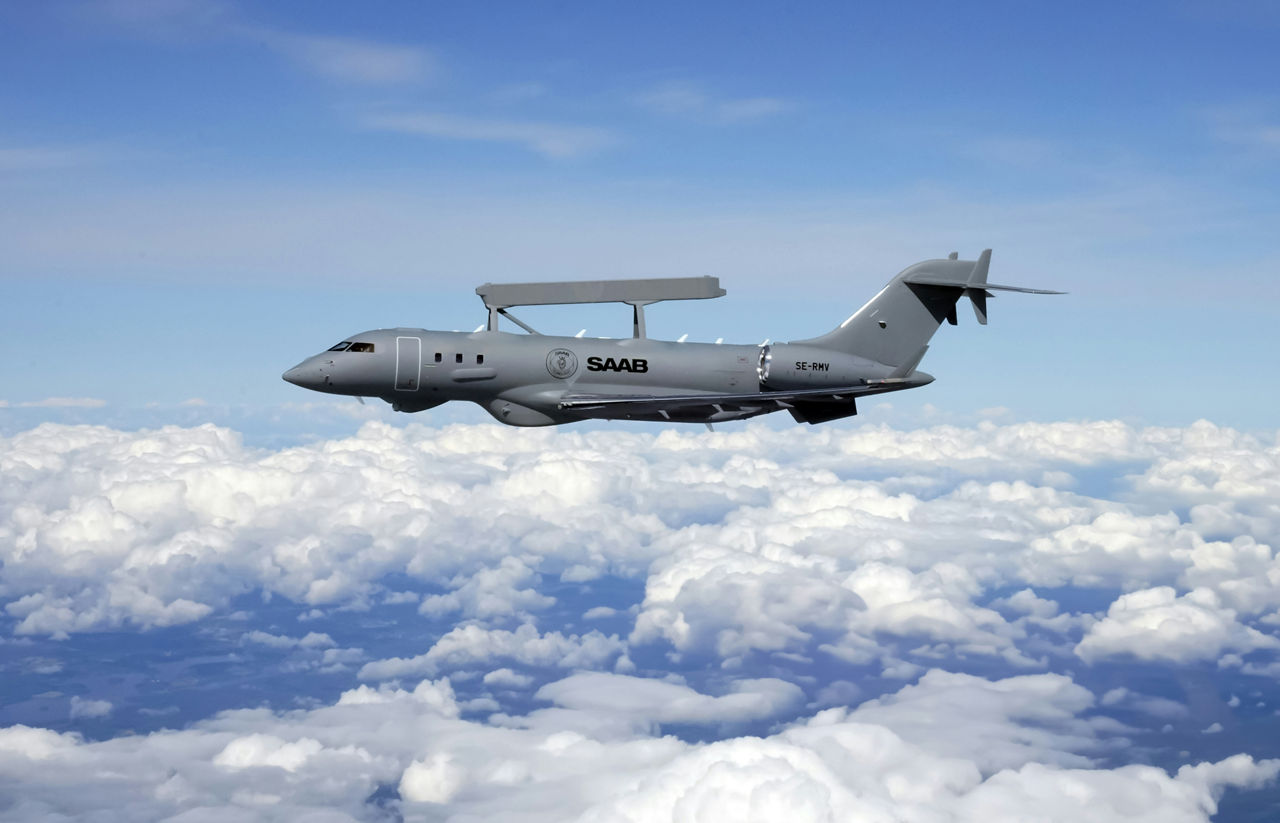

NATO’s reported move toward a joint procurement of Saab GlobalEye aircraft could mark a major change in the airborne early-warning and control market. For decades, airborne surveillance was defined by large platforms such as the E-3 Sentry: expensive, crew-intensive aircraft serving as flying command posts. GlobalEye represents a different model. It combines long-range airborne warning, maritime surveillance and selected ground-monitoring functions on a business-jet platform designed for high availability and lower operating demands.
The key question is not whether GlobalEye can reproduce every feature of an E-3-class aircraft. It is whether NATO still needs to organize surveillance around a limited number of very large platforms. In an era of distributed sensors, satellites, unmanned systems and long-range weapons, the future may favor aircraft operating as nodes inside a wider combat network.
GlobalEye Versus the Traditional AWACS Model
Traditional airborne warning and control system, or AWACS, fleets were built around endurance, radar coverage, onboard command capacity and the ability to manage complex air battles from a single aircraft. The E-3 Sentry became the clearest expression of that concept, carrying a large mission crew, extensive communications equipment and a rotating radar system.
GlobalEye approaches the mission differently. Saab combines the Erieye Extended Range active electronically scanned array radar with additional sensors and a modern mission-management architecture. Its business-jet base offers greater fuel efficiency and deployment flexibility than older four-engine AWACS aircraft. It can also support air, maritime and ground-surveillance tasks from the same platform.
That does not make GlobalEye a one-for-one replacement for every E-3 function. A larger aircraft may still offer advantages in crew capacity and battle-management workload. GlobalEye’s strength lies in networking, multi-domain awareness, sensor performance and operating efficiency rather than in recreating the scale of a traditional flying headquarters.
Can GlobalEye Assume E-3-Class Missions?
GlobalEye can perform many missions historically associated with the E-3, including long-range air surveillance, tracking low-flying targets, identification support, maritime monitoring and distributing a recognized operational picture.
It could be especially valuable over NATO’s northern and eastern approaches, the Baltic Sea, the Arctic and critical maritime corridors. These operating environments require persistent monitoring of aircraft, cruise missiles, drones, naval vessels and other targets across large areas.
However, replacing the E-3 is not only a radar question. NATO’s airborne command-and-control model also depends on doctrine, secure communications, staffing and the number of operators required to manage a high-intensity air campaign. In a major conflict, the alliance may still want a larger platform such as the E-7 Wedgetail to serve as a theater-level battle-management node.
A mixed fleet is therefore more plausible than complete substitution. E-7 aircraft could provide high-capacity command and control, while GlobalEye delivers persistent surveillance, maritime awareness, regional coverage and rapid reinforcement.
Will NATO Operate GlobalEye and E-7 Together?
A mixed GlobalEye and E-7 fleet would reflect NATO’s movement toward a more distributed military architecture. Rather than using one aircraft type for every mission, the alliance could assign platforms according to operational demand.
The E-7 is based on a larger commercial airliner and optimized for airborne warning and battle management. GlobalEye is smaller, easier to deploy and designed for multi-domain surveillance. NATO could reserve the E-7 for demanding command missions while using GlobalEye for routine patrols, national air-defense reinforcement, maritime surveillance and operations from smaller bases.
Mixed fleets would increase training, maintenance and logistics requirements. Yet NATO may conclude that common data links, mission standards and interoperable command systems matter more than operating a single airframe.
In future coalition warfare, standardization may increasingly occur at the software, communications and network level. An E-7 and a GlobalEye would not need identical airframes if they could exchange sensor tracks, targeting information and command instructions through a common NATO architecture.
Why Operating Cost Matters More Than Aircraft Size
The economics of airborne surveillance are becoming strategically important. Large AWACS aircraft require extensive maintenance, specialized crews, major infrastructure and substantial long-term support budgets. Smaller European air forces may struggle to fund independent fleets or sustain enough flying hours to maintain continuous readiness.
A business-jet-based system can potentially provide more flight hours per budget cycle, faster deployment and lower support requirements. An airborne warning aircraft creates operational value only when it is available. A larger platform that flies less frequently may provide less practical coverage than a smaller aircraft with higher readiness.
Lower operating costs could also allow users to acquire more aircraft, disperse them across several bases and maintain continuous coverage during maintenance cycles. Dispersal would become particularly important during a conflict in which enemy forces could target established air bases and high-value support aircraft.
The emerging trend may therefore be toward smaller platforms operating in more distributed and survivable fleets, rather than simply replacing large AWACS aircraft with fewer business jets.
A Standardization Effect Across Europe
A NATO-backed GlobalEye acquisition would give Saab a powerful reference customer and could reshape procurement decisions across Europe. Smaller air forces unable to operate large AWACS fleets independently may see a joint fleet or multinational operating model as a practical route to advanced surveillance.
Northern and Eastern European states are likely to value the aircraft’s ability to monitor air and maritime activity in contested environments. Its business-jet design may also appeal to countries seeking advanced capability without the infrastructure burden associated with large airliner-based platforms.
Several countries could pool aircraft, training, maintenance facilities and mission crews under a NATO or regional framework. Such an arrangement would allow smaller members to access airborne surveillance capabilities that would otherwise be financially or operationally beyond their reach.
The most important standardization effect may consequently come through joint procurement and shared operations rather than through individual national acquisitions.
Implications for the Middle Eastern Market
The Middle East could become another important market for GlobalEye. The United Arab Emirates has already demonstrated the platform’s relevance for integrated air and maritime awareness.
Gulf states face overlapping threats from ballistic missiles, cruise missiles, drones, combat aircraft and maritime activity. They must monitor both congested civilian airspace and increasingly complex military operating environments. A platform contributing to several surveillance missions at once is therefore commercially and operationally attractive.
Business-jet-based aircraft are also well suited to countries that require long-range surveillance but do not need the larger onboard battle-management capacity of an E-7-class platform.
If NATO adopts GlobalEye at scale, Middle Eastern customers may view it not only as a sensor aircraft but also as an entry point into a broader Western command-and-control ecosystem. NATO adoption could strengthen confidence in its interoperability, long-term support network and future upgrade potential.
Integration With Space and Unmanned Systems
GlobalEye’s long-term importance will depend on how effectively it connects with external sensors. Future surveillance aircraft will receive and distribute data from satellites, ground-based radars, naval vessels, fighters and unmanned systems.
Space-based sensors can provide missile warning, electronic intelligence and wide-area monitoring. Unmanned maritime aircraft can remain on station for long periods and inspect areas beyond surface-sensor coverage. GlobalEye could help fuse these inputs, identify surveillance gaps and direct other assets toward emerging threats.
The aircraft could also receive targeting or warning data before its own sensors detect a threat. It could then reposition, investigate the contact or pass the information to fighters, surface-to-air missile units and naval forces.
This networked role may ultimately matter more than radar range alone. Future airborne early-warning platforms will be judged by how quickly they convert multiple data streams into operational decisions and how securely they share information across NATO networks.
GlobalEye Is the Next Evolution of AWACS
GlobalEye is unlikely to make large AWACS aircraft immediately obsolete. High-capacity platforms will remain important in major coalition operations. However, relying on a few expensive and centralized aircraft is increasingly challenged by budget pressure, maintenance demands and long-range threats.
NATO’s reported interest in GlobalEye suggests a more flexible architecture built around distributed sensors, mixed fleets and networked command systems. If the procurement advances, it could establish GlobalEye as a preferred platform for states seeking advanced surveillance without the cost and infrastructure of a traditional AWACS fleet.
The most important change is not simply the replacement of one aircraft by another. It is the transition from AWACS as a self-contained command center to airborne surveillance as one highly connected node in a multi-domain battlespace.
In that model, GlobalEye has a strong chance of becoming one of NATO’s defining surveillance systems.

Umair Aslam is the Founder and Chief Executive Officer (CEO) of Global Defense Insight. He has worked as a defense journalist reporting on military modernization programs, defense industry, arms procurement, and emerging technologies.