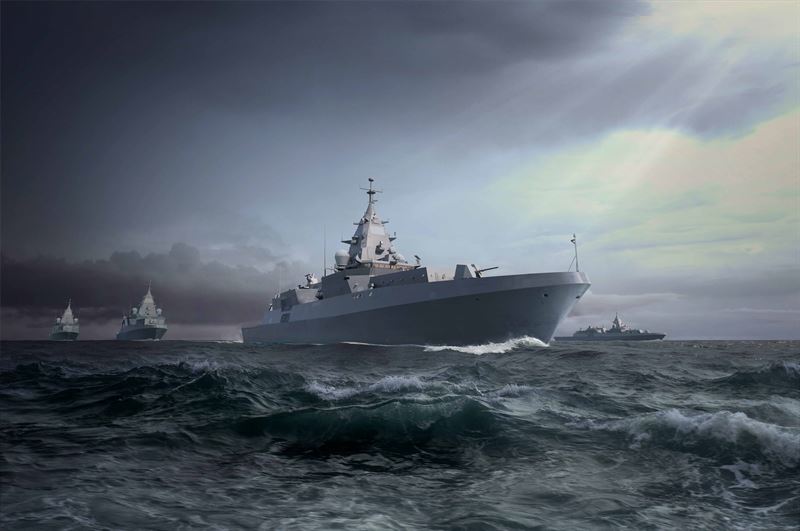

Saab has received an order valued at approximately SEK 8.7 billion from German naval shipbuilder TKMS to deliver and integrate combat systems, sensors, and composite structures for four new German Navy frigates.
The vessels will be based on the MEKO A-200 DEU design and constructed in Germany, with TKMS serving as the prime contractor. Saab’s deliveries are scheduled to take place between 2029 and 2032.
The contract also includes an option covering the integration and equipment of additional frigates, potentially expanding Saab’s role in the German naval modernization program.
The order represents a significant European naval systems contract and strengthens the longstanding industrial relationship between Saab, TKMS, and Germany’s armed forces.
Table of Contents
ToggleContract Covers Combat Systems, Radars, and Superstructures
Saab’s scope of work includes the delivery and integration of several major systems that will form the frigates’ combat and sensor architecture.
The package includes:
- 9LV Combat Management System
- 9LV Fire Control System
- Sea Giraffe 4A Fixed Face long-range surveillance radar
- Sea Giraffe 1X lightweight multi-mission radar
- Passive sensor systems
- Composite superstructures
- System integration and engineering support
Together, these systems are intended to support the frigates’ anti-air warfare, anti-submarine warfare, and anti-surface warfare missions.
Saab will be responsible not only for supplying equipment but also for integrating the systems into the vessels, making its role central to the ships’ operational configuration.
9LV to Form the Core of the Frigates’ Combat System
The 9LV system will provide the command-and-control framework through which operators can collect, process, and distribute information from the frigates’ sensors and weapons.
A combat management system serves as the operational center of a modern warship. It combines radar, electronic-support, communications, navigation, identification, and weapon data into a common tactical picture.
The system assists operators in identifying threats, prioritizing targets, assigning weapons, and coordinating engagements across multiple warfare areas.
Saab’s 9LV architecture is designed to integrate different sensors and effectors within a modular framework. This allows ship operators to update or replace individual subsystems without redesigning the entire combat system.
The associated fire-control system will support the tracking and engagement of airborne, surface, and potentially asymmetric threats, depending on the final weapon configuration selected for the vessels.
Sea Giraffe 4A Fixed Face to Provide Long-Range Surveillance
The Sea Giraffe 4A Fixed Face radar will provide the principal long-range surveillance capability for the new frigates.
The system uses fixed radar arrays rather than a mechanically rotating antenna. This configuration allows continuous coverage, faster update rates, and improved tracking of multiple targets approaching from different directions.
The radar is designed to detect and track a wide range of threats, including:
- Combat aircraft
- Helicopters
- Unmanned aerial vehicles
- Anti-ship missiles
- Surface vessels
- Low-altitude and high-speed targets
Its inclusion indicates that air surveillance and missile-defense support will be important elements of the MEKO A-200 DEU mission set.
The fixed-face configuration should also improve reaction time by allowing the system to monitor the surrounding airspace without waiting for a rotating antenna to revisit a particular sector.
Sea Giraffe 1X Adds Close-Range Multi-Mission Coverage
The frigates will also receive the smaller Sea Giraffe 1X radar.
The lightweight system is designed for short- and medium-range surveillance and can complement the larger Sea Giraffe 4A by improving detection and tracking of small or low-observable targets.
These may include small drones, helicopters, fast attack craft, and other threats operating close to the sea surface or ship.
Using two radar types can provide layered surveillance. The long-range system contributes wide-area detection, while the smaller radar can support close-range situational awareness, target confirmation, and coverage in complex coastal environments.
The combination is particularly relevant as naval forces face increasing threats from unmanned systems, sea-skimming missiles, and coordinated attacks involving multiple target types.
Composite Superstructures to Reduce Weight and Radar Signature
Saab will also supply composite superstructures for the four frigates.
Composite materials can provide several advantages over conventional steel structures, including reduced weight, lower maintenance requirements, resistance to corrosion, and greater design flexibility.
In naval applications, composites may also help reduce radar reflections when incorporated into carefully shaped superstructures.
Lower topside weight can improve ship stability and create additional allowance for sensors, communications equipment, weapons, and future upgrades.
The use of composite structures is therefore relevant both to the ships’ physical design and their long-term capacity to accommodate new systems.
Order Supports German Naval Modernization
The contract forms part of Germany’s broader effort to modernize its surface fleet and strengthen naval readiness.
The new frigates are expected to provide multi-mission capabilities across air defense, surface warfare, anti-submarine operations, maritime security, and allied task-group operations.
Germany’s navy operates within both national and NATO frameworks, requiring vessels that can exchange data and operate alongside allied ships, aircraft, and command networks.
The integration of modern radar and combat-management systems will be important to achieving that interoperability.
Micael Johansson, president and chief executive officer of Saab, said the order would strengthen both the German Navy and the company’s longstanding relationship with Germany.
“These deliveries will significantly enhance the Navy’s anti-air-, anti-submarine- and anti-surface warfare capabilities,” Johansson said.
Industrial Cooperation With TKMS
TKMS will lead construction of the frigates in Germany and retain overall responsibility as prime contractor.
Saab’s role will center on the combat system, surveillance architecture, passive sensors, fire control, composite structures, and associated integration work.
The arrangement combines TKMS’s shipbuilding capabilities with Saab’s experience in naval sensors and command systems.
Successful integration will require close coordination across vessel design, power generation, cooling, cabling, electromagnetic compatibility, software development, testing, and combat-system certification.
Because deliveries are scheduled between 2029 and 2032, the program will involve several years of engineering, production, software integration, installation, and sea trials.
Strategic Significance of the Order
The SEK 8.7 billion order strengthens Saab’s position in the European naval systems market at a time when many NATO members are expanding maritime investment.
European navies are seeking improved air surveillance, anti-submarine capabilities, electronic warfare, missile defense, and resilience against unmanned threats.
The German contract also demonstrates the continuing importance of open and modular combat-system architectures. Modern frigates are expected to remain operational for several decades, during which sensors, weapons, software, and communications systems may require repeated upgrades.
A modular architecture can reduce the cost and technical risk of those future modifications.
The option for additional frigates also provides Saab with the possibility of securing follow-on work if Germany expands the class.
What to Watch Next
Important milestones will include completion of the detailed ship design, finalization of the weapon and sensor configuration, production of the composite superstructures, combat-system integration, and the start of shipboard testing.
Further details will also be required regarding the number of optional vessels, the frigates’ final armament, and how the MEKO A-200 DEU class will fit within Germany’s wider fleet structure.
With Saab deliveries planned from 2029, the program will become an important indicator of Germany’s naval modernization pace and Europe’s ability to deliver complex surface combatants through multinational industrial cooperation.