
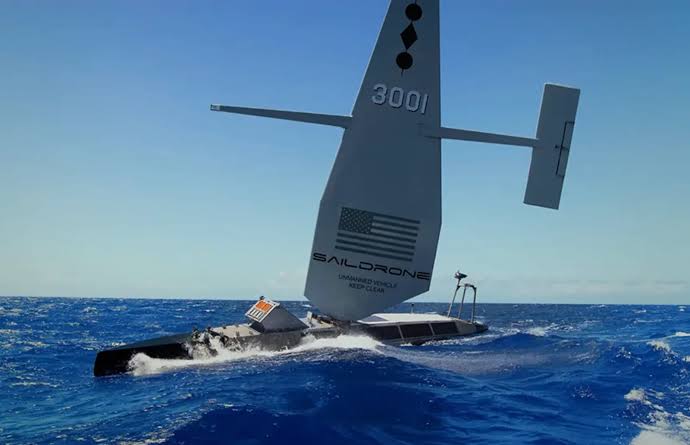

Saildrone and Lockheed Martin have demonstrated a new armed unmanned surface vessel capability after successfully launching Joint Air-to-Ground Missiles from a Saildrone Surveyor during the US Navy’s Rim of the Pacific exercise.
Saildrone and Lockheed Martin have successfully integrated and fired the Joint Air-to-Ground Missile (JAGM) from a Saildrone Surveyor unmanned surface vessel (USV) during the US Navy’s Rim of the Pacific (RIMPAC) exercise, marking the first missile launch from a Saildrone platform.
The demonstration, conducted off Hawaii under the US Navy’s Fleet Experimentation Program (FLEX), involved two JAGM launches from the 20-meter Surveyor USV. The companies said the test demonstrated how commercially developed autonomous maritime platforms can be rapidly integrated with operational weapon systems for naval missions.
The armed Surveyor operated in coordination with the USS Theodore Roosevelt (CVN-71) Carrier Strike Group and used targeting information provided through the Navy’s Adjunct Remote Engagement System (ARES), a remotely operated combat system.
During the demonstration, the USV acted on targeting data associated with a surrogate high-speed surface craft, demonstrating the ability to connect an autonomous surface platform with a broader naval sensor and command network.
Table of Contents
ToggleJAGM Adds Kinetic Capability to Saildrone Surveyor
Lockheed Martin integrated a dual JAGM launcher onto the bow of the Saildrone Surveyor.
JAGM is a precision-guided missile developed by Lockheed Martin for use against a range of stationary and moving targets. Integrating the weapon with an unmanned surface vessel expands the potential employment of the missile beyond its established airborne applications.
According to Saildrone, the RIMPAC demonstration followed approximately six months of joint development between the two companies after they established a strategic partnership in October 2025.
The live-fire event is particularly significant as the US Navy examines ways to increase the number and distribution of weapons available across its fleet. Armed USVs could supplement crewed warships by carrying additional effectors while allowing commanders to distribute sensors and weapons across a larger operating area.
Such platforms could also provide persistent presence in contested maritime environments without requiring personnel to remain aboard the vessel.
Surveyor Demonstrates Electronic Warfare Capability
The RIMPAC activity extended beyond the JAGM firing.
Saildrone said the Surveyor was also equipped with a passive electronic warfare sensor that detected, classified and identified a surrogate threat radar while operating in conjunction with an MH-60 helicopter.
The demonstration highlighted the Surveyor’s potential to perform multiple missions, including intelligence, surveillance and reconnaissance (ISR), electronic support, targeting and kinetic operations.
The 20-meter (66-foot) Surveyor has been designed for extended autonomous missions and can remain deployed for months. Its sensor suite can incorporate radar, electro-optical/infrared systems, passive acoustic sensors, Automatic Identification System data and machine-learning-based detection capabilities.
The addition of a missile launcher introduces a kinetic element to a platform originally developed primarily around persistent maritime sensing and ocean-mapping missions.
Saildrone Plans Larger Armed Spectre USV
The companies are now looking toward integrating heavier weapon and sensor packages aboard Saildrone Spectre, a substantially larger autonomous vessel currently under development.
The 52-meter (170-foot) Spectre is expected to displace approximately 300 tonnes at full payload and reach speeds of up to 30 knots.
Its concealed mission deck is designed to accommodate as many as five 20-foot containers or two 40-foot containers, allowing different payload configurations depending on operational requirements.
One planned capability is integration of Lockheed Martin’s Mk 70 launcher, which could provide the larger USV with significantly greater missile capacity than the JAGM-equipped Surveyor. Towed arrays are also being considered for anti-submarine warfare missions.
Saildrone plans two configurations of the Spectre. One would incorporate the company’s wing technology for efficient and comparatively quiet long-duration operations, while another would use a lower-profile configuration optimized for higher-speed missions.
Armed USVs Could Expand Distributed Naval Firepower
The Saildrone-Lockheed Martin demonstration reflects growing US Navy interest in combining autonomous vessels with distributed sensors, command networks and weapons.
Rather than relying exclusively on large crewed combatants to carry missiles, armed USVs could potentially disperse additional weapons across a carrier strike group or other naval formation. This could increase the number of available firing platforms while complicating an adversary’s targeting problem.
The concept nevertheless depends on reliable communications, command-and-control architecture, autonomous navigation, target identification and strict human control over weapons employment.
For Saildrone and Lockheed Martin, the successful JAGM launches represent an important step toward demonstrating that autonomous surface platforms can move beyond surveillance and reconnaissance roles into operational combat applications.
Future integration of larger launch systems aboard the Spectre could further expand the role of unmanned surface vessels in anti-surface warfare, counter-unmanned aircraft missions, electronic warfare and distributed maritime operations.












