
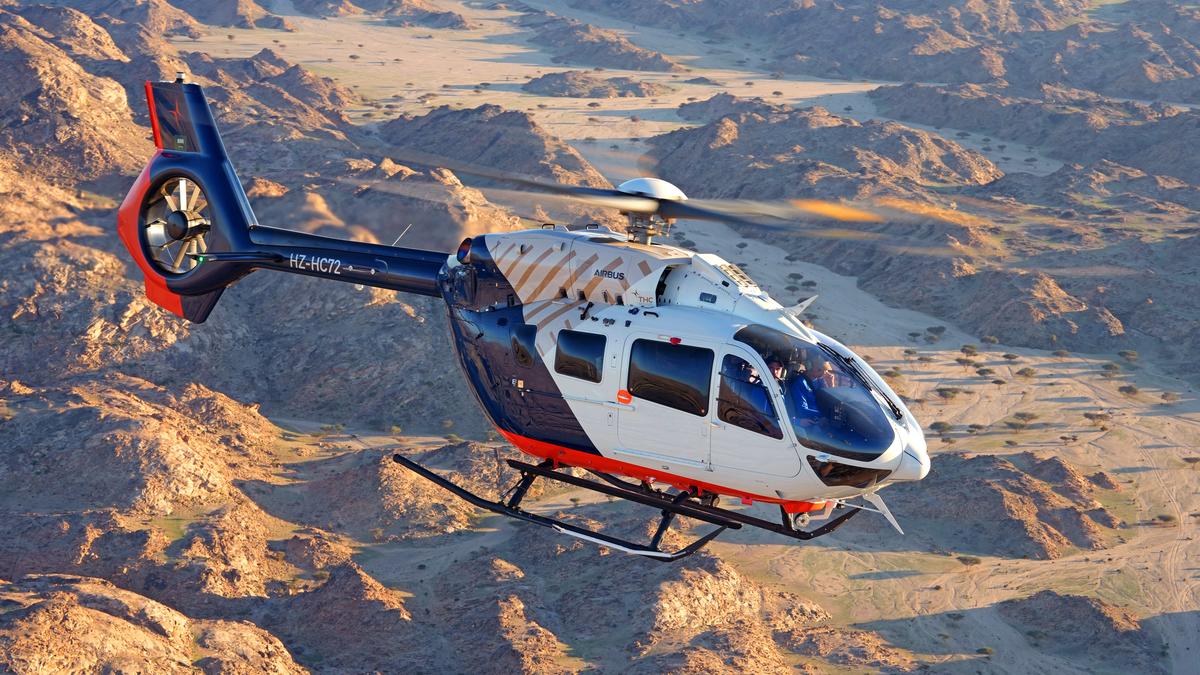

Saudi Arabia’s The Helicopter Company has placed a firm order for eight additional Airbus H145 helicopters, expanding its fleet for emergency medical services and other mission-critical operations across the Kingdom and international markets.
Table of Contents
ToggleSaudi H145 Order Announced at Farnborough Airshow 2026
Airbus Helicopters and The Helicopter Company announced the order on July 20, 2026, during the Farnborough International Airshow in the United Kingdom.
The eight helicopters are scheduled for delivery between 2027 and 2028. The order falls under a broader framework agreement signed by Airbus and THC at Verticon in 2024, covering up to 120 helicopters of different types over an expected three-to-five-year period.
THC is owned by Saudi Arabia’s Public Investment Fund and operates as one of the Kingdom’s principal commercial helicopter service providers.
The company said the additional aircraft would support its fleet optimization strategy, strengthen operational readiness, and create additional capacity for emergency medical services and other critical aviation missions.
Deliveries Scheduled Between 2027 and 2028
The two-year delivery schedule is intended to support a phased introduction of the new aircraft.
By spreading deliveries across 2027 and 2028, THC will be able to align pilot training, maintenance preparation, operational planning, infrastructure, and aircraft deployment with the arrival of each helicopter.
The company described the order as part of a disciplined and forward-looking fleet strategy intended to ensure continuity while supporting future expansion.
Captain Arnaud Martinez, chief executive officer of The Helicopter Company, said the additional aircraft would reinforce the company’s long-term relationship with Airbus and improve its ability to meet changing customer requirements.
“The eight additional H145s will help to enhance our operational capabilities and position THC to further extend our footprint beyond the Kingdom,” Martinez said.
He added that THC intends to strengthen its position as a leading helicopter operator in Saudi Arabia while building a broader international presence.
H145 Fleet to Support Emergency Medical Services
The new helicopters will support THC’s expanding emergency medical services operations.
Air medical transport is becoming increasingly important in Saudi Arabia because of the country’s size, dispersed population centers, major road networks, remote communities, and large-scale infrastructure projects.
Helicopters can provide faster access to accident sites and patients in locations where ground transport may be slow or impractical.
The H145 can be configured with medical equipment, patient litters, clinical workspaces, and space for emergency personnel. Its cabin layout and rear-loading access make it suitable for medical evacuation and time-sensitive transport missions.
THC has already introduced the H145 into emergency medical service operations in Saudi Arabia, giving the company existing experience with the platform.
Aircraft Also Used for Mission-Critical Operations
Beyond medical services, the H145 is designed for a wide range of public-service and commercial missions.
Potential roles include:
- Emergency response
- Search and rescue
- Passenger transport
- Utility operations
- Event support
- Law-enforcement support
- Offshore transport
- Disaster response
- Aerial coordination
THC has previously deployed the H145 in support of the Dakar Rally, where helicopters operate in demanding desert conditions and support medical, logistical, transport, and coordination requirements.
That experience provides an operational example of the H145’s suitability for high-tempo missions in Saudi Arabia’s challenging environment.
Airbus Highlights Hot-and-High Performance
Airbus said the H145 has already demonstrated its performance in Saudi Arabia’s hot-and-high conditions.
High temperatures and elevated terrain reduce air density, which can affect rotor lift, engine output, payload capacity, and overall helicopter performance.
Aircraft operating in such environments require sufficient power margins, efficient rotor systems, and carefully managed weight.
Matthieu Louvot, chief executive officer of Airbus Helicopters, said the additional order reflected THC’s confidence in the H145 as a multi-mission platform.
He said the aircraft had already proven itself under Saudi operational conditions and would support THC as it expands services across the Kingdom and beyond.
H145 Offers Multi-Mission Flexibility
The H145 is a light twin-engine helicopter designed for civil, public-service, and military operations.
Its modular cabin enables operators to reconfigure the aircraft for different missions, improving fleet flexibility and reducing the need to maintain separate helicopter types for every task.
For an operator such as THC, this can simplify training, maintenance, spare-parts management, and fleet scheduling.
A common platform can also improve aircraft availability by allowing helicopters to be reassigned according to operational demand.
The H145’s relatively compact footprint is useful for operations from hospitals, urban landing areas, temporary sites, and confined locations.
Airbus also emphasizes the helicopter’s low acoustic footprint, which is particularly relevant for medical and urban missions near hospitals, residential areas, and populated infrastructure.
Global H145 Fleet Exceeds 1,800 Aircraft
Airbus said more than 1,800 helicopters from the H145 family are currently in service worldwide.
The fleet has accumulated more than 8.6 million flight hours across a wide range of missions.
A large global fleet can benefit operators through established training systems, spare-parts availability, maintenance experience, and a broad technical support network.
It also provides manufacturers with extensive operational data that can be used to improve maintenance planning, reliability, and future aircraft upgrades.
Order Supports Saudi Vision 2030 Aviation Goals
The acquisition supports Saudi Arabia’s broader aviation-development objectives under Vision 2030.
The Kingdom is investing in airports, airlines, aviation services, maintenance infrastructure, training, tourism, emergency response, and advanced air mobility as part of its economic diversification strategy.
THC has played a central role in developing Saudi Arabia’s commercial helicopter market by introducing new services and expanding access to modern rotorcraft.
The additional H145s will help increase available capacity while supporting Saudi Arabia’s ambition to build a more advanced and diversified aviation ecosystem.
The order may also contribute to wider improvements in emergency response, public-service aviation, tourism support, event logistics, and regional connectivity.
Framework Agreement Provides Long-Term Fleet Flexibility
The 2024 framework agreement covering up to 120 Airbus helicopters gives THC a structure for long-term fleet growth.
A framework agreement does not mean that every aircraft has already been purchased. Instead, it allows the customer to place individual firm orders according to operational demand, financing, infrastructure readiness, and strategic priorities.
This approach gives THC the flexibility to expand gradually while maintaining consistency in fleet planning.
For Airbus, the agreement provides a potential long-term order pipeline in one of the Middle East’s fastest-growing aviation markets.
The latest eight-aircraft commitment represents another step in that wider relationship.
Strategic Significance of the Saudi H145 Order
The order strengthens THC’s position in Saudi Arabia’s helicopter market and expands its capacity to deliver public-service and commercial aviation operations.
It also reinforces Airbus Helicopters’ role in the Kingdom at a time when Saudi Arabia is increasing investment in aviation, tourism, emergency services, and major infrastructure programs.
The H145’s suitability for medical transport and mission-critical operations makes it a practical platform for a country with large distances, demanding temperatures, and a growing requirement for rapid-response aviation.
The order also demonstrates how Saudi Arabia is using long-term framework agreements to develop aviation capacity in a structured manner rather than relying only on isolated aircraft purchases.
What to Watch Next
Important developments will include the final configuration of the new helicopters, pilot and maintenance training, operational basing, delivery milestones, and the allocation of aircraft between emergency medical and other missions.
Further orders under the 120-helicopter framework agreement will also be important.
The types selected in future could indicate how THC intends to balance medical transport, passenger services, utility work, offshore operations, and other commercial aviation requirements.
The latest order confirms that the H145 will remain an important platform in Saudi Arabia’s expanding helicopter sector through the second half of the decade.












