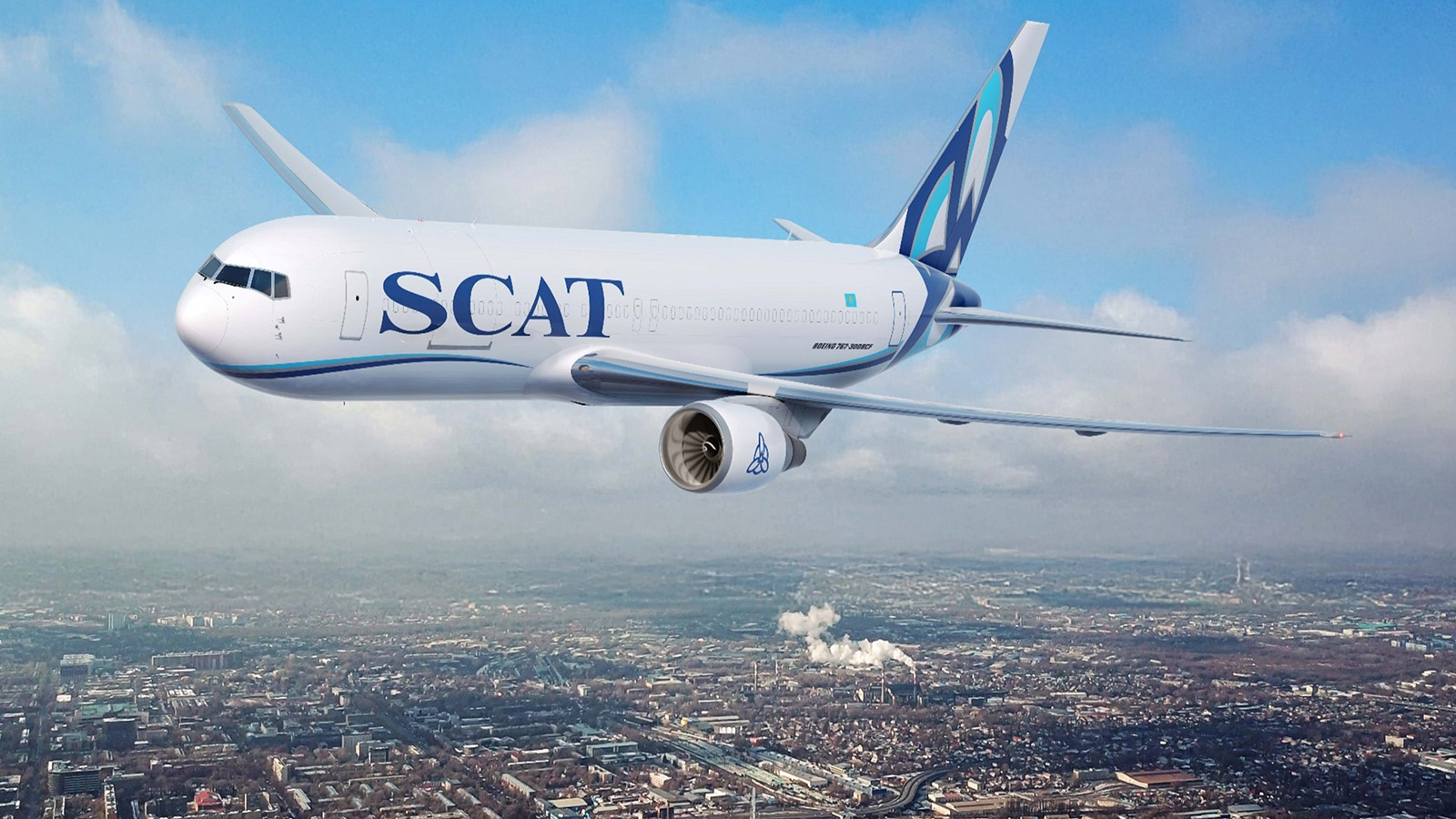

SCAT Airlines will enter the air freight market with a Boeing 767-300 Converted Freighter, becoming the first carrier in Kazakhstan to operate the type as the country seeks to strengthen its position as a Eurasian cargo hub.
Table of Contents
ToggleBoeing to Convert SCAT 767-300ER Into Freighter
Boeing and SCAT Airlines have signed an agreement to convert a Boeing 767-300ER passenger aircraft into a 767-300 Boeing Converted Freighter.
The agreement was announced on July 20, 2026, at the Farnborough International Airshow in the United Kingdom.
The converted aircraft will allow SCAT Airlines to launch general cargo and express freight services, marking the carrier’s entry into dedicated freighter operations.
Once operational, the aircraft will become the first 767-300BCF operated by a Kazakh airline.
The conversion will provide SCAT with a medium widebody freighter capable of serving regional and intercontinental cargo routes linking Central Asia with China, Türkiye, the Middle East, and Europe.
Cargo Expansion Supports Kazakhstan’s Aviation Strategy
Kazakhstan has identified air cargo as an important area of future aviation growth.
Its geographic position between major Asian and European markets gives the country potential to serve as a transit and logistics hub for cargo moving across Eurasia.
Kazakhstan lies near major overland trade corridors and has expanding commercial links with China, Russia, Türkiye, the Gulf region, and Europe. A stronger air freight network could complement rail and road logistics while supporting time-sensitive and high-value cargo movements.
The SCAT Airlines freighter program aligns with the government’s wider objective of developing Kazakhstan into a leading regional aviation and logistics center.
Vladimir Denisov, president of SCAT Airlines, described the launch of cargo services as a strategic step for both the airline and the national aviation sector.
“With southern Kazakhstan’s hub potential, established partners in China, Türkiye and Europe, and Boeing performing the 767-300BCF conversion, this long-term program directly supports the task set by the President of Kazakhstan to establish the country as a leading Eurasian aviation hub,” Denisov said.
767-300BCF Offers 57-Tonne Payload Capacity
The Boeing 767-300BCF is a converted medium widebody freighter designed to carry general cargo, express parcels, e-commerce shipments, and other commercial freight.
The aircraft can carry up to 57 tonnes, or approximately 125,663 pounds, depending on operating conditions and route requirements.
It has a stated range of up to 3,345 nautical miles, equivalent to approximately 6,190 kilometers.
This range would allow SCAT to serve cargo markets across Central Asia, China, the Middle East, parts of Europe, and other nearby regions from Kazakhstan.
The aircraft provides a total cargo volume of approximately 15,692 cubic feet, or 444.3 cubic meters.
Its main deck can accommodate 24 pallet positions and offers about 11,884 cubic feet, or 336.5 cubic meters, of cargo volume.
The lower deck provides approximately 3,378 cubic feet, or 95.7 cubic meters, while the bulk cargo compartment adds another 430 cubic feet, or 12.2 cubic meters.
Converted Freighter Provides Lower-Cost Market Entry
Passenger-to-freighter conversion allows airlines to enter cargo operations without purchasing a newly built freighter.
During conversion, the aircraft receives a reinforced main-deck floor, a large cargo door, cargo-handling systems, structural modifications, revised fire-protection systems, and changes to the cabin and environmental-control architecture.
The conversion extends the economic life of an existing passenger aircraft while giving the operator access to a dedicated cargo platform.
For SCAT Airlines, the 767-300BCF offers a lower-risk route into the freighter market than acquiring a larger or more expensive new-production cargo aircraft.
The aircraft’s size also places it between narrowbody freighters and larger widebody cargo jets, making it suitable for routes where traffic volumes are significant but do not justify the capacity of larger aircraft.
E-Commerce and Express Freight Drive Regional Demand
Boeing and SCAT identified e-commerce and general freight as important demand drivers for the new operation.
Cross-border online retail has increased demand for fast and reliable transport between Asian manufacturing centers, consumer markets in Europe and the Middle East, and growing economies across Central Asia.
Express cargo operators require aircraft capable of transporting large volumes on time-sensitive schedules, often between major logistics hubs during overnight windows.
The 767 freighter family has long been used by global express carriers because of its payload, range, fuel efficiency, and compatibility with established freight networks.
SCAT could use the aircraft to transport e-commerce parcels, consumer goods, industrial components, automotive parts, pharmaceuticals, perishables, and other high-value shipments.
Southern Kazakhstan Could Support Cargo Hub Development
SCAT Airlines highlighted southern Kazakhstan’s potential as a base for future cargo operations.
The region is positioned close to major trade routes connecting China with Central Asia, the Caspian region, Türkiye, and Europe.
A successful cargo operation will depend on more than the aircraft itself. SCAT will also require suitable airport infrastructure, warehouse capacity, customs processing, ground-handling equipment, road and rail connections, and reliable access to cargo customers.
Efficient transshipment will be particularly important if the airline intends to develop hub operations rather than operate only point-to-point freight routes.
The availability of customs and logistics services could determine whether Kazakhstan captures a larger share of time-sensitive Eurasian freight flows.
SCAT Expands Beyond Passenger Operations
SCAT Airlines is one of Kazakhstan’s leading carriers and currently operates passenger services across domestic and international markets.
The launch of dedicated cargo operations will diversify the airline’s business model and reduce its dependence on passenger revenue alone.
Passenger aircraft can carry cargo in their lower holds, but a dedicated freighter provides substantially more volume and allows the transport of loads that cannot be accommodated efficiently on scheduled passenger flights.
A freighter fleet can also operate at times and to destinations selected according to logistics demand rather than passenger schedules.
The 767-300BCF program could therefore open opportunities for charter cargo operations, contracted express services, scheduled freight routes, and cooperation with international logistics companies.
Boeing Global Services to Support Conversion
Boeing will perform and support the 767-300BCF conversion through its services business.
Lindsey Douglas, vice president of Cabin, Modifications, Maintenance & Digital Services at Boeing Global Services, said the aircraft would provide a proven platform for SCAT’s expansion into air cargo.
“The 767-300BCF is a proven performer in the cargo industry, and we are confident it will continue to deliver value for many years to come,” Douglas said.
Boeing’s role will include the engineering and modification work required to convert the passenger aircraft into a certified freighter configuration.
Further details regarding the conversion location, completion date, engine configuration, and entry-into-service schedule were not disclosed.
Strategic Significance for Central Asian Air Cargo
The agreement reflects growing interest in Central Asia as a potential air freight corridor.
Kazakhstan’s large territory, expanding trade relationships, and location between major markets create favorable conditions for cargo growth. However, regional airlines have historically operated relatively limited dedicated widebody freighter capacity.
The introduction of a 767-300BCF could give SCAT the ability to establish regular cargo links with major logistics centers and attract freight that currently moves through airports outside Kazakhstan.
The aircraft may also support the country’s broader goal of combining aviation, rail, road, and logistics infrastructure into an integrated Eurasian transport network.
The commercial outcome will depend on cargo volumes, aircraft utilization, fuel costs, route rights, airport infrastructure, and partnerships with freight forwarders and express operators.
What to Watch Next
The next major milestones will include the start of conversion work, completion of certification, delivery of the aircraft, and the announcement of initial cargo routes.
SCAT will also need to disclose which airport will serve as the principal cargo base and whether it plans to acquire additional freighters.
The first routes will provide an early indication of whether the airline intends to focus on China-Europe traffic, Middle East connections, regional Central Asian services, or a broader mixed network.
The program represents an important step in the development of Kazakhstan’s dedicated air cargo capacity and could establish SCAT Airlines as a significant regional freight operator.