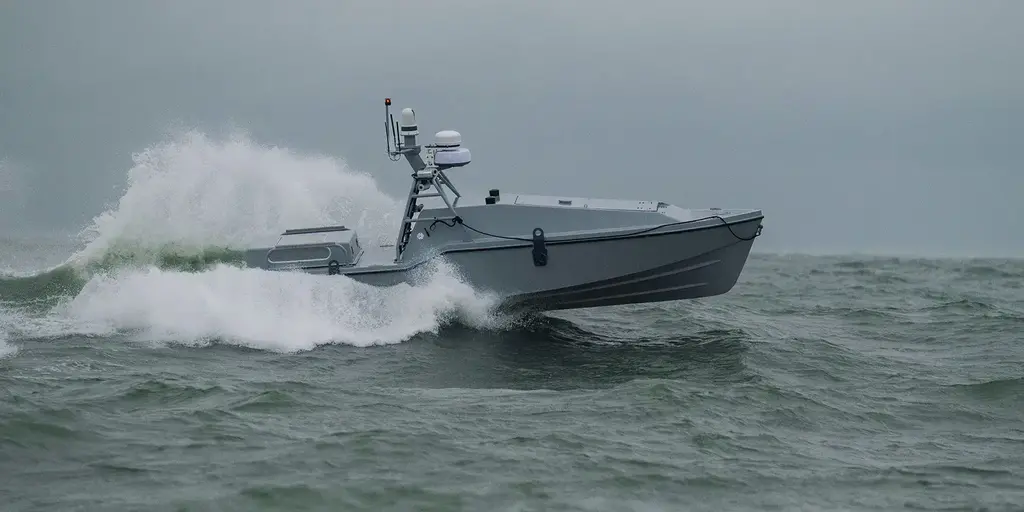

The US-Iran war has brought major shifts in naval warfare, as the US has utilized Sea Drones or Unmanned Surface Vehicles (USVs), for the first time in an active conflict. On July 12, 2026, US Central Command (CENTCOM) forces used three Saronic Corsair one-way attack Unmanned Surface Vessels (USVs) to strike the port of Bandar Abbas, a naval base that serves as a maintenance facility for submarines and ships. The next day, CENTCOM in post on X, claimed that these strikes “degrade Iran’s ability to continue attacking commercial shipping.” This marks a significant shift in naval warfare, which has traditionally been defined by aircraft carriers, destroyers, submarines, and surface warships. The use of USVs demonstrates that sea drones are no longer experimental technology. They have become an operational capability and are transforming the concept of maritime warfare from a platform-centric model toward a network-centric combat environment.
Unmanned Surface Vehicles (USVs) or Sea drones are remotely operated or autonomous maritime platforms for intelligence, surveillance, and reconnaissance (ISR), mine countermeasures (MCM), electronic warfare (EW), anti-submarine warfare (ASW), logistical support, and precision strikes without an onboard crew. AI-driven autonomy, satellite communications, and network-centric warfare systems make USVs suitable for defensive and offensive operations. Their operational significance was demonstrated in the Russia-Ukraine conflict, where Ukrainian Magura V5 and Sea Baby explosive-laden USVs conducted strikes against the Russian Black Sea Fleet. Moreover, Washington’s use of Saronic Corsair USVs against Iran further indicates that USVs are not experimental systems; rather, they have emerged as force multipliers, enhancing maritime domain awareness and enabling relatively low-cost offensive operations.
The use of USVs in recent conflicts has demonstrated that the development of unmanned sea capabilities is redefining the conduct of naval warfare. Rather than only relying on traditional conventional capabilities to achieve sea control and power projection, modern navies are integrating semi- and fully autonomous systems into their force structures. Experts argue that USVs allow navies to optimize the use of human crews by integrating unmanned systems into a single operational picture. Moreover, Joseph Kristanto said that “The sea drones are certainly not a side technology anymore but actively integrated into primary operational toolkits.”
One of the key lessons from the recent maritime engagements is that the lethality of sea drones does not comes solely from their explosive payload but also from the effective integration of command, control, communications, computers, intelligence, surveillance, and reconnaissance (C4ISR) systems. USVs highly rely on beyond-line-of-sight (BLOS) satellite communications, satellite-based navigation, and fused multi-domain data streams. Kyiv’s success in the Black Sea has been the result of high-bandwidth commercial and military satellite networks, backed by NATO reconnaissance assets that provide actionable targeting data to autonomous platforms. Likewise, the Saronic Corsair is an independently controlled, 24-foot vessel capable of travelling more than 1,000 miles at 35 knots above speed and carrying payload of up to 1,000 pounds. Its capabilities depend on the open-architecture software and satellite communications that enable it to navigate and engage targets at considerable distance. However, without the effective space-based C4ISR system, even the most sophisticated autonomous vessel can be left “blind”. This demonstrates that sea control in the modern maritime environment increasingly depends on maintaining resilient access to and control of space-based capabilities.
The second lesson is that the operationalization of USVs has changed the nature of surface fleet defense, especially close-in weapon systems (CIWS) and point-defense networks. In practice, naval air defence systems are design to intercept high speed and low-altitude or “sea-skimming” anti-ship cruise missiles. With the operationalization of USVs, defense systems may have to be prepared to intercept and engage various surface and undersea targets with low radar cross-sections (RCSs) approaching from various angles and at low altitudes. This development transforms terminal defense from a crisis contingency requirement into a persistent operational necessity.
The development and integration of USVs introduces tactical combatant challenges. First, it is economically not feasible for modern navies to expand the multi-billion-dollar missile defense program against the wave of low-cost, high-performance USVs. Fleets need to shift the balance of their arsenals toward directed-energy weapons (lasers), electronic warfare jamming, and high-rate kinetic soft-kill options. Secondly, for traditional missile threats, early warning Radars have time to pass on engagement authority through the centralized system of air defense command.
On the other hand, low-observable USVs can spend less time in the water in a littoral area, compressing the engagement window to 90 seconds. Operationally, it is unviable to run a centralized approval chain in a 90-second engagement window. In order to counter the swarm attacks, Navies have to push engagement decision authorities down to the tactical level through updated pre-defined Rules of Engagement (ROE), automated operational tasking (OPTASK), and standing defence orders. Moreover, AI-assisted target classification enabled automated intercept strikes. The growing development of uncrewed sea capabilities is pushing modern navies from centralized human decision-making toward pre-authorized and AI-integrated engagement
The economic aspect of USV integration is re-engineering naval procurement. The cost of a warship such as a guided-missile destroyer is at least $2 billion, and it can take years to construct. On the other hand, low-cost USVs provide high volume and low-cost attritable mass.
A USV strike force can use relatively cheap and mass-produced surface drones to blow up high-value naval infrastructure and assets without risking sailors’ lives, as shown in Bandar Abbas.
The operationalization of one-way attack USVs in the U.S.-Iran war is a reflection of maritime autonomy. The projection of a new uncrewed warfare is expanding into three vectors:
- USVs will use mesh networking and distributed AI to perform autonomous swarm attacks in the future, rather than relying on pre-programmed routes. If two drones are intercepted from a swarm, the remaining drones will automatically “rethink attack vectors” to overwhelm point defense systems.
- Sea Drones are becoming operational sea motherships. Early variants in the Black Sea have already undergone modifications to be capable of launching aerial reconnaissance drones and firing advanced anti-air missiles with infrared guidance. Modular surface drones will increasingly act as multi-domain, forward-deployed command posts.
- Submarine-launched UUVs will further increase the sensor and strike range of host submarines. These undersea drones will be used to carry out counter-mine missions, long-duration undersea surveillance, protect critical infrastructure in the sea and act as acoustic decoys to conceal crewed submarines.
The operationalization of USVs in modern conflicts shows that autonomous maritime platforms are now an integral part of modern navies. In contemporary times, sea control is not solely about tonnage or missile tubes anymore; it is about data fusion, network resiliency, and algorithmic autonomy. Navies that are able to effectively integrate the use of UAS and UUVs into their operational doctrine will control the littoral and blue water domain