
South Asia’s security landscape is under growing strain. Offensive military doctrines and disruptive technologies, the May 2025 India-Pakistan conflict, rising terrorism along Pakistan’s western border, and the war since February 2026 all add to the pressure. The respondent gives a policy-oriented view on these developments, on Pakistan’s relations with the US, China and Afghanistan, on CPEC, on climate change, and on the prospects for regional cooperation through SAARC.
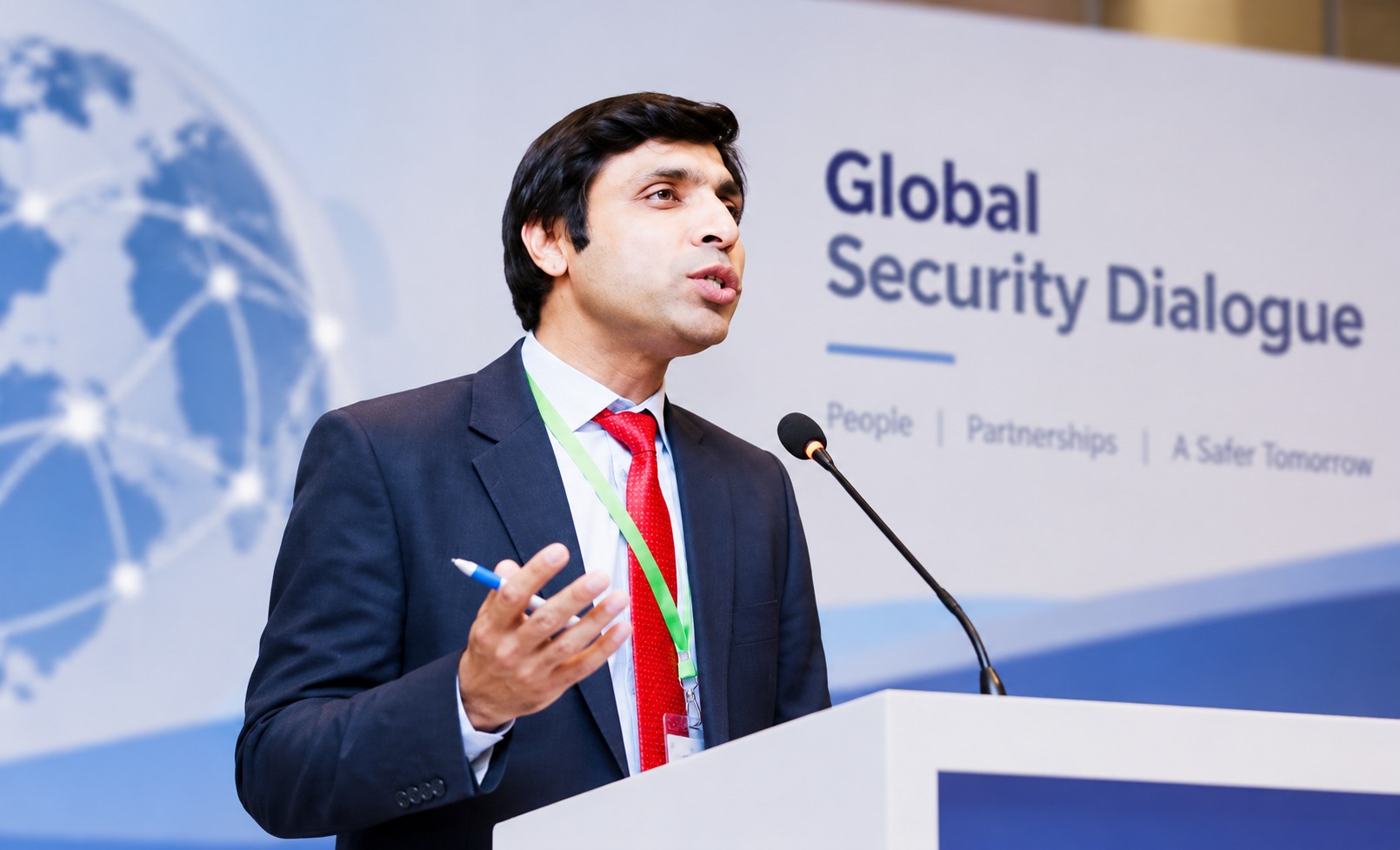
In this context, Liaquat Ali conducted an in-depth interview with Dr. Muhammad Saeed Uzzaman, former Head of the Department of International Relations at the National University of Modern Languages (NUML), Rawalpindi Campus. Dr. M.Saeed Uzzaman, currently serving as Assistant Professor in the Department of Strategic Studies at the National Defence University (NDU), Islamabad, has research interests that include emerging technologies, military doctrines, strategic studies, India–Pakistan relations, and great power politics.
How would you assess the current security landscape in South Asia, and what do you see as the most significant threat to regional stability today?
If you look at the security architecture of South Asia, we come to an understanding that on one hand we have offensive doctrines, and on the other hand there is technological advancement. Modern, disruptive technologies are being used by India and Pakistan against each other, and the May 2025 conflict is one of the significant pieces of evidence in this regard. I think offensive doctrines and technological advancement are the two important phenomena occurring in recent times.
Since the Taliban takeover in Afghanistan, how has the security environment along Pakistan’s western border evolved, and what are the long-term implications for regional stability?
Since the US withdrawal from Afghanistan, terrorist incidents have increased. We have seen terrorism rise in KP and Balochistan. The reason is that the Afghan Taliban and the Tehreek-e-Taliban Pakistan (TTP) have ideological similarities and share the same ideology. This phenomenon is creating a serious security situation for Pakistan.
Time and again, Pakistan has communicated to the Afghan authorities that they should take action against the TTP and the supporters of the BLA. When no action was taken, Pakistan conducted strikes across the border. I think this posture from Kabul, of not taking action against the non-state actors in Afghanistan, has severe consequences for regional stability. In times to come, for the next few years, I am witnessing the same instability in the region.
Do you see any improvement with regard to Pakistan’s hard-state approach toward Afghanistan? Is it going to bear results?
Both kinetic and non-kinetic operations are important to achieving any goal. Yes, there are military operations, but at the same time, diplomatic engagement and involving other actors, such as China, the United States and the Gulf countries, to put pressure on Kabul to take action against non-state actors and terrorist outfits can be an efficient and effective strategy.
For a long-term solution, we need a common understanding. The mediators and friendly states can come into play, because all the stakeholders I mentioned have an interest in the region, so it is important that stability is maintained. Bilateral engagement and multilateral engagement, using the tool of diplomacy, can be a good option alongside whatever is happening.
How is the intensifying US-China rivalry reshaping alliances and strategic calculations in South Asia, particularly for Pakistan?
I will not call it rivalry, because up till now it is competition. There can be disagreements, but this competition has an impact not only on other parts of the world but also on South Asia.
A few years back, the US and India enjoyed cordial relations, and this created a security situation for Pakistan. That is why Pakistan shifted more towards China, its all-weather, ironclad strategic friend. In recent years, however, Pakistan and the US have also been enjoying cordial relations, particularly after the May 2025 conflict.
A few years back there were consequences for the region, and severe impacts for India and Pakistan, particularly Pakistan. But now I think Pakistan is managing efficiently between the two great powers by adopting a hedging strategy, and is efficiently exploiting the opportunities.
How significant is CPEC in shaping Pakistan’s strategic partnerships, and what security challenges does it present?
CPEC is one of the important projects of the BRI. When it started, it progressed at a very fast pace. In recent years we have witnessed some sort of slowdown. Once again, though, the governments of Pakistan and China are working closely to put CPEC 2.0 on a fast track. For its success, Special Economic Zones need to be developed at a much faster pace, and this is what is required to make CPEC successful so that the BRI becomes successful. The governments are working on it, and in times to come we may see significant developments.
Terrorism is one of the significant challenges. Whether in Balochistan or KP, as I mentioned earlier, the TTP and BLA are posing threats to CPEC. Nevertheless, the Pakistan Armed Forces, the civilian and military leadership, and the nation are doing great, in the sense that they are doing whatever they can to eradicate the menace of terrorism. This is what I think.
The BLA is significantly impacting the operationalization of Gwadar Port. How much impact will this have on the Pakistan-China partnership?
China and Pakistan enjoy a strategic partnership, as I mentioned earlier: an ironclad, all-weather friendship. Yes, the challenge of terrorism is there, but I don’t think it will severely impact the China-Pakistan partnership.
Both countries understand, and the leadership in Beijing and Islamabad know, that their partnership and friendship are important not only for themselves but for peace and stability in the region. They are countering terrorism: China is assisting Pakistan, and at the same time the Pakistan Armed Forces are conducting operations against these terrorist outfits. Things are going in the right direction, and in times to come we may see stability and, at the same time, progress on CPEC.
Terrorism, water scarcity and climate change are increasingly discussed alongside traditional military concerns. How urgent do you consider these compared to conventional security threats in the region?
Both traditional and non-traditional security threats are there for Pakistan. On the eastern border, India; on the western border, Afghanistan. And the US and Israel have launched an attack on Iran, and there has been a war since 28 February 2026. So, from all across, Pakistan is facing security challenges.
As I mentioned earlier, Pakistan is trying to manage and steer through all this chaos, and up till now it has done well. I hope the Pakistani government and the Pakistani state will do more to ensure its security, in the traditional domain as well as the non-traditional.
Climate change needs cooperation internationally as well as at the regional level, but we are unable to see this in South Asia. How do you see this?
South Asia is for sure one of the worst-hit regions, but it is not only about South Asian countries. Who benefits from globalization? The developed countries. They have earned more. If you look at carbon emissions, South Asia’s are almost nothing, whereas emissions are much higher in the Western world and China.
So the world and the international community need to support South Asian countries. I will quote one statement: a UK government official statement says that Pakistan needs $348 billion between 2023 and 2030 to address the threat of climate change. Look at the severity. South Asian countries do not have that much in resources.
At the same time, I agree that South Asian countries need to cooperate with each other, and SAARC is an excellent forum where they can cooperate and counter climate change.
Looking ahead, what policy steps should regional actors take to build a more stable and cooperative security architecture in South Asia?
SAARC is the answer. SAARC was developed for economic development, peace and prosperity. It should be made effective, and this is what is required
Considering Pakistan-India relations, is it possible to revive SAARC?
Yes, the enduring rivalry between India and Pakistan is one of the major factors, and particularly India’s stubbornness. It is one of the main factors putting SAARC at a halt. It is the responsibility of India, which calls itself a bigger state. At the same time, other stakeholders, including Pakistan, should take all measures to make SAARC functional.