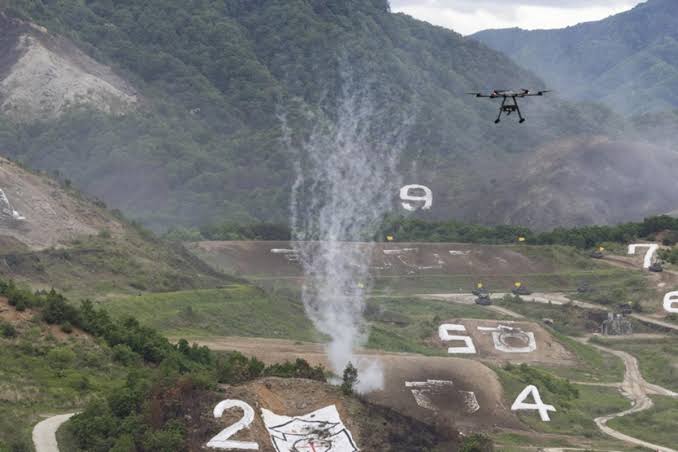

South Korea has invested heavily in sophisticated air and missile defense systems in order to respond to North Korea’s growing military capabilities. However, relatively inexpensive UAVs revealed vulnerabilities that could not necessarily be addressed by advanced conventional weapons. These challenges are no longer confined to intercepting reconnaissance drones that sporadically infiltrate South Korean airspace. This includes the problem of safeguarding military, governmental, and civilian infrastructure against diverse unmanned threats.
Two developments make this issue particularly urgent. North Korea’s intervention in the Russo-Ukrainian war could accelerate the acquisition of expertise concerning modern drone warfare, while the growing possibility of regional dual contingencies—involving China and North Korea—are complicating the availability of American military support. In that sense, South Korea should develop a sustainable national counter-UAS system that integrates existing defense systems, embraces emerging technologies, and remains operational during protracted regional contingencies.
December 2022: A Wake-Up Call
On December 26, 2022, five North Korean UAVs violated South Korean airspace, with one reaching the metropolitan area. Despite scrambling aircraft and helicopters, the South Korean military was unable to shoot down any of them. A KA-1 aircraft also crashed during the process.
The incident exposed problems that go beyond shortcomings in interception. At first, the South Korean military authorities denied that North Korean UAVs entered a no-fly zone in and around the presidential office. However, in January 2023, they acknowledged that one drone had briefly violated the P-73 no-fly zone—an area with a radius of 3.7 kilometers to protect the president’s office—revealing deficiencies in situational awareness and crisis reporting.
South Korea was not without relevant defenses. The South Korean military had TPS-880K radars, K30 Biho self-propelled air-defense systems, 20mm Vulcan anti-aircraft guns, K-SAM Chunma surface-to-air missiles, and attack helicopters including the AH-1 Cobra. Nevertheless, these systems were developed primarily for conventional air defense missions, rather than small-sized UAV interceptions.
Although military surveillance sensors detected some intruding drones, maintaining uninterrupted tracking and sharing target information turned out to be far from easy. Likewise, existing weapons systems encountered operational constraints over populated areas because of potential civilian casualties. Meanwhile, the deployment of dedicated electronic countermeasures remained insufficient.
These failures illustrated that possessing capable air defense equipment alone does not warrant effective C-UAS performance.
An Expanding Threat to National Infrastructure
Previous incidents have also exposed the weaknesses of South Korea’s low-altitude air defense system. In 2014, two suspected reconnaissance drones were discovered after crashing inside South Korean territory. In 2017, another drone was retrieved that carried photos of THAAD installations located in Seongju. This illustrated that strategically important areas, yet geographically far away from the Demilitarized Zone (DMZ), are also vulnerable.
A more recent air threat has impacted civilian infrastructure. In 2024, North Korean trash-carrying balloons caused 12 disruptions, resulting in the closure of runways for 265 minutes in total until July 30 of that year. Although they were balloons and not UAVs, the incident demonstrated how inexpensive aerial balloons could degrade essential national functions without inflicting physical damage.
In response, South Korea has expanded C-UAS protection beyond military facilities. In July 2026, C-UAS systems began operation in major ports, including Busan. Two months later, 16 agencies and approximately 250 people participated in the 2026 National Comprehensive Anti-Terrorism Drill that took place at Incheon International Airport and addressed threats including first-person-view (FPV) drones and swarm drones.
These trends underscore the need to coordinate military defense with civilian aviation, transportation, and infrastructure security.
North Korea’s Russian War Experience: A New Variable
North Korea’s dispatch of its troops to the European battlefield has potentially brought a substantial change in the regional threat environment. In March 2025, South Korea’s National Intelligence Service (NIS) reported indications that North Korean personnel were receiving drone-related training from the Russians.
Exposure to a battlefront that is saturated with drones could provide practical knowledge to North Korea on constant reconnaissance, FPV attacks, electronic warfare, and counter-drone tactics. These experiences could consequently affect North Korea’s military doctrine, training, and procurement priorities.
Nevertheless, operational capabilities should not be confused with experience gleaned through battlefield exposure. Official evidence that vindicates the claim that North Korea has successfully developed a mature, large-scale drone strike capacity on par with Russia’s is insufficient at this juncture. Transforming frontline experience into credible military performance necessitates institutional adaptation, trained operators, industrial capacity, and logistical support.
Even so, South Korea should anticipate a more comprehensive threat spectrum. Enhanced reconnaissance and attack drones could ultimately complement North Korea’s existing artillery and missile forces, complicating South Korea’s defense requirements.
South Korea’s Responses: Progress and Remaining Gaps
South Korea has accelerated its C-UAS modernization. Cheongwang Block I, a laser anti-air weapon that was initially deployed in December 2024, offers a directed-energy-based hard-kill capability against small-sized unmanned aircraft. In June 2026, the Defense Acquisition Program Administration (DAPA) announced the success of the indigenous development of an improved laser oscillator, ultimately increasing the system’s localization rate from 76 to 90 percent.
Other projects include hard-kill interceptor drone development, electronic countermeasures, and research on high-power microwave (HPM) weapons. The Ministry of National Defense (MND) also unfolded its plan in June to acquire more than 20,000 drones and conduct drone operational training for roughly 500,000 military personnel.
However, technological advancement does not necessarily resolve operational shortcomings. While laser weapons depend on reliable detection and tracking capabilities, existing radio-link jamming might not be effective against autonomous or fiber-optic-controlled drones. Meanwhile, kinetic interception would become problematic over densely populated areas.
The central task, therefore, is to link new countermeasures with existing surveillance and command systems while ensuring that equipment, software, and manpower can adapt to rapidly evolving threats.
The Problem of Simultaneous Contingencies
If a crisis in the Taiwan Strait and a Korean contingency occur at the same time, South Korea’s defense posture could become further complicated. America’s intelligence, reconnaissance, air-defense, and reinforcement capabilities could confront competing demands originating from two geographically distant theaters.
Although North Korea could attempt limited provocations while the United States is focused on Taiwan, this course of action is by no means predetermined. Even in the absence of major hostilities, South Korea might have to maintain heightened preparedness with greater reliance on domestic resources for a longer duration.
Such scenarios make sustainability especially crucial. South Korea should ensure that essential C-UAS functions can continue despite delayed US reinforcement or competition over crucial components. Domestic repair capacity, trained personnel, replacement equipment, and adequate stockpiles would become defining elements for operational resilience.
Needless to say, the goal is not to achieve complete independence from the United States, but to strengthen South Korea’s capability to preserve continuity of defense under uncertain regional circumstances.
Building a Sustainable National C-UAS Defense Structure
To keep up with the growing threat precipitated by North Korea’s massive drone production coupled with up-to-date drone tactic, South Korea should pursue the following four priorities in an urgent manner.
Firstly, MND and the Joint Chiefs of Staff should reinforce cooperation with civilian aviation authorities, police, and critical-infrastructure operators. Joint reporting standards, interoperable detection systems, and a common operational picture would improve countermeasures against threats crossing institutional boundaries. In that context, the real-time exercises conducted in Incheon in September 2026 provide the foundation for regular nationwide training.
Secondly, DAPA should prioritize modular systems that can accept swift technological upgrades. Procurement should underscore not only technological finesse but also interoperability, lifecycle costs, and replenishment capability. This especially matters since affordable drones could impose disproportionately high price tags on the defender.
Thirdly, South Korea should clarify legal responsibilities for counter-drone operations in civilian airspace. Electronic jamming near civilian airports poses different dangers from military engagements near the inter-Korean border. The authorities should establish procedures governing identification, engagement authorization, electromagnetic interference, and coordination with air traffic controllers before emergencies erupt.
Fourthly, South Korea should align domestic C-UAS requirements with increasing defense export objectives. Expertise accumulated in the fields of radar, directed-energy weapons, electronic weapons, and unmanned systems offers opportunities to develop an integrated exportable counter-drone package. Yet foreign sales should strengthen domestic production capabilities, instead of competing with essential military requirements—in other words, compromising the domestic deterrence as a trade off. Standardized components, manufacturing capacity that could enlarge the production scale, and stable supply chains could buttress both objectives.
These efforts should be incorporated into US-ROK joint military exercises, including scenarios involving constant drone threats and competing regional military commitments.
Beyond Interception
The lesson from South Korea’s experience is that the effectiveness of C-UAS cannot be calculated merely by the sophistication of individual weapons or the number of intercepted drones. The decisive question is whether the military and civilian authorities could maintain coordinated defense under prolonged pressure.
North Korea’s changing military experience and the probability of concurrent regional contingencies are increasingly making such preparedness a sine qua non. South Korea could contribute to the Korean Peninsula’s long-term stability by integrating its defense capabilities, reinforcing industrial sustainability, and striking a balance between domestic security and defense exports.

Dr. Ju Hyung Kim serves as President of the Security Management Institute, a defense-focused think tank affiliated with South Korea’s National Assembly. He has contributed to numerous defense initiatives and has advised key institutions, including the Republic of Korea Joint Chiefs of Staff.