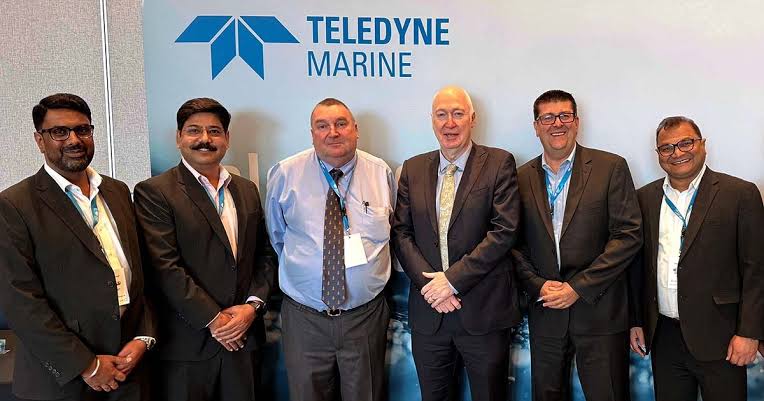

Spry Technocon Private Limited has announced a strategic partnership with Teledyne Marine, Klein Marine Systems, and VideoRay to pursue future opportunities related to unmanned mine countermeasure systems for the Indian Navy.
The collaboration brings together capabilities in autonomous underwater vehicles, sonar, underwater imaging, remotely operated vehicles, mission planning, and maritime systems integration.
The companies intend to develop and propose a modular unmanned Mine Countermeasure, or MCM, suite for potential Indian Navy requirements, including future Mine Countermeasure Vessels, autonomous mine-hunting systems, underwater domain awareness, and other unmanned maritime programs.
No Indian Navy contract, platform selection, procurement value, or delivery timeline was disclosed in the announcement.
Table of Contents
TogglePartnership brings together specialized underwater technologies
Each company is expected to contribute a distinct part of the proposed mine countermeasure architecture.
Teledyne Marine would provide autonomous underwater vehicles and associated capabilities for mine detection, classification, and identification. These systems could be used to survey designated maritime areas and collect sonar and navigation data without requiring a crewed vessel to enter a suspected minefield.
Klein Marine Systems would contribute high-resolution side-scan sonar and seabed-mapping technologies. Side-scan sonar is commonly used to produce detailed acoustic images of the seafloor and identify objects that may represent mines, debris, wreckage, or other underwater hazards.
VideoRay would provide remotely operated vehicles and expeditionary mine countermeasure capabilities. Such systems could be deployed to investigate suspicious underwater contacts, conduct visual inspections, and support follow-on mission tasks.
Spry Technocon would lead system integration, testing, indigenous manufacturing, operator support, and through-life sustainment in India.
The proposed suite is also expected to include mission-planning systems, data-processing tools, and operator-support functions designed to connect the different platforms into a coordinated mine warfare capability.
Proposed solution designed for distributed mine-hunting operations
The partnership reflects a broader international shift toward the use of unmanned and autonomous systems in naval mine warfare.
Conventional mine countermeasure vessels have traditionally operated close to areas where mines may be present. This exposes both crews and specialized ships to potentially serious risks.
Unmanned systems can allow navies to separate the detection and inspection process from the crewed platform.
An autonomous underwater vehicle can be launched to survey an area using sonar and navigation sensors. The data can then be processed to identify objects that may require further examination.
A remotely operated vehicle may subsequently be sent to inspect a suspicious contact at closer range. Depending on the mission requirements and final system configuration, the object could then be marked, avoided, or addressed by a separate neutralization system.
This approach can help reduce the exposure of sailors and high-value naval assets while allowing mine countermeasure missions to be distributed across multiple platforms.
How the proposed system could operate
A typical mission would begin with an autonomous underwater vehicle conducting a programmed survey of a harbor approach, shipping lane, naval base entrance, or other strategically important maritime area.
The vehicle would use sonar to collect data on the seabed and nearby underwater objects.
Mission-processing software would then help operators distinguish possible mines from rocks, wreckage, discarded equipment, or natural seabed features.
Once a possible threat is identified, an ROV could be deployed to obtain additional imagery or conduct a closer inspection.
The partnership has not yet identified the specific Teledyne autonomous vehicle, Klein sonar model, VideoRay ROV configuration, mine-neutralization equipment, or command-and-control system that could be included in a future proposal.
Indian Navy has a continuing mine warfare requirement
Mine countermeasure capabilities remain important for the Indian Navy because naval mines can restrict fleet movement, threaten access to ports, interrupt maritime trade, and delay military operations.
Mines can be placed in harbor entrances, coastal waters, shipping routes, and naval approaches. Their presence can force a navy to conduct lengthy detection and clearance operations before warships or commercial vessels can safely move through an affected area.
India’s extensive coastline, major commercial ports, naval bases, island territories, and dependence on maritime trade make mine warfare a significant operational concern.
An effective unmanned MCM capability could support the protection of naval infrastructure, commercial shipping routes, amphibious operations, and fleet deployments during periods of tension or conflict.
It could also contribute to wider underwater domain awareness by improving seabed mapping, underwater object detection, and the monitoring of strategically important maritime zones.
Local integration supports Make in India policy
The companies said the partnership is aligned with the Indian government’s Aatmanirbhar Bharat and Make in India initiatives.
Spry Technocon’s role would center on integrating the different subsystems in India while supporting local production, testing, maintenance, training, and long-term sustainment.
The partnership also aims to contribute to technology transfer and Indian industrial participation.
Localized support can be particularly important for autonomous underwater systems because they require specialized maintenance, software updates, sensor calibration, operator training, mission-data management, and technical infrastructure.
The actual level of indigenous content, however, would depend on any future procurement structure, export-control approvals, intellectual-property arrangements, technology-transfer agreements, and the Indian Navy’s operational requirements.
Companies offer complementary capabilities
Teledyne Marine supplies underwater instrumentation, acoustic systems, imaging technologies, autonomous platforms, and marine sensors for defense, commercial, offshore, and scientific applications.
Klein Marine Systems, a General Oceans company, specializes in side-scan sonar and underwater imaging systems. Its technologies are used for mine detection, seabed mapping, search missions, and underwater object identification.
VideoRay develops portable and mission-configurable ROVs for defense, security, commercial, and scientific operations. Its systems are designed to support underwater inspection, reconnaissance, identification, and expeditionary missions.
Spry Technocon is an Indian deep-technology company focused on maritime technologies, underwater systems, autonomous platforms, defense engineering, and local integration.
Together, the companies are seeking to present the Indian Navy with a system-of-systems offering rather than a standalone underwater vehicle or sensor.
Partnership positions companies for future Indian Navy opportunities
The announcement establishes an industrial team that could compete for future Indian Navy programs involving unmanned mine countermeasures, MCMVs, autonomous mine hunting, underwater surveillance, and next-generation maritime systems.
It does not indicate that the Indian Navy has formally selected the partnership’s proposed solution.
Any future acquisition would likely require technical evaluations, operational trials, integration demonstrations, commercial negotiations, and compliance with Indian defense procurement requirements.
The competitiveness of the proposed solution will depend on whether the partners can demonstrate reliable interoperability between the autonomous vehicles, sonar systems, ROVs, mission software, and support infrastructure.
Localization, technology transfer, life-cycle costs, operator training, and long-term maintenance arrangements are also likely to influence any future procurement decision.
Why the announcement matters
The partnership highlights the growing role of autonomous and remotely operated systems in modern naval mine warfare.
Navies are increasingly combining AUVs, unmanned surface vessels, ROVs, advanced sonar, and digital mission-management systems to conduct mine detection and clearance operations with less risk to personnel.
For the Indian Navy, a modular and locally supported unmanned MCM suite could offer greater flexibility across ports, coastal waters, naval approaches, and strategically important sea lanes.
The announcement also demonstrates how international defense technology companies are seeking Indian partners capable of meeting local manufacturing, integration, and sustainment requirements.
What to watch next
The next major development would be the release of a formal Indian Navy request for information, request for proposal, technology demonstration, or trial program covering unmanned mine countermeasure systems.
Further clarity will also be needed on the specific AUVs, side-scan sonar systems, ROVs, neutralization tools, mission-management software, local-content share, and technology-transfer arrangements.
Until an official procurement decision is announced, the partnership should be viewed as a coordinated industry effort to pursue future Indian Navy mine warfare and underwater systems opportunities.