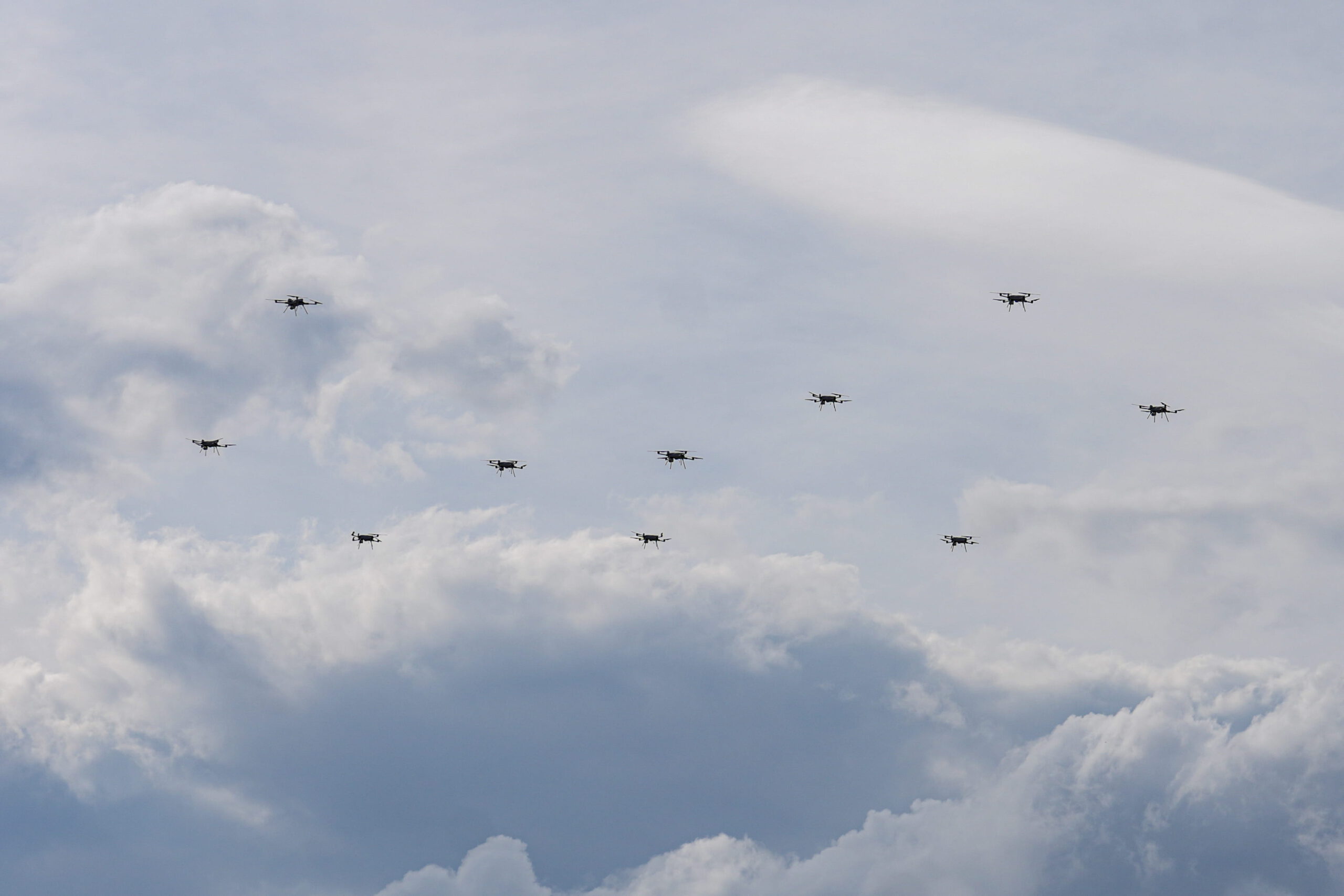

Turkish defence technology company STM has successfully demonstrated its autonomous swarm warfare capabilities during the Ateş Serbest 2026 military exercise, deploying 20 KARGU loitering munitions in a coordinated live-fire attack controlled by a single operator.
The demonstration, conducted at the General Nahit Şenoğul Firing and Exercise Area in Polatlı, Ankara, highlighted the growing sophistication of Türkiye’s indigenous unmanned aerial systems and their potential applications in modern battlefield operations.
According to STM, the KARGU swarm successfully engaged designated targets using autonomous coordination, real-time communication and distributed decision-making algorithms.
The company also demonstrated its BOYGA ammunition-dropping UAV, which achieved a direct hit using an 81 mm munition.
Table of Contents
ToggleSTM KARGU Swarm Conducts Coordinated Live-Fire Attack
During the Distinguished Observer Day of Ateş Serbest 2026, STM deployed 20 KARGU rotary-wing loitering munitions as part of a simulated battlefield scenario involving enemy infantry units.
Operating under the supervision of a single operator, the unmanned aircraft took off autonomously and navigated toward their designated target area.
STM said the drones employed an indigenous distributed control architecture, allowing individual platforms to communicate in real time, exchange targeting information and coordinate their movements without relying on a centralized control unit.
Upon reaching the engagement area, the 20-drone formation divided into two groups of 10 aircraft. Both groups subsequently executed synchronized attacks, successfully destroying designated targets using anti-personnel warheads.
The demonstration illustrated STM’s approach to swarm warfare, in which multiple unmanned platforms operate collaboratively to conduct complex missions while reducing the workload placed on individual operators.
BOYGA UAV Demonstrates Precision Strike Capability
Alongside the KARGU swarm operation, STM showcased the strike capabilities of its indigenously developed BOYGA ammunition-dropping unmanned aerial vehicle.
During the exercise, BOYGA successfully released a specially adapted 81 mm munition and achieved a direct hit on its designated target.
The system, which entered service with Turkish security forces in 2022, incorporates advanced ballistic estimation algorithms intended to improve the accuracy of aerial munition delivery.
BOYGA offers an operational range of 10 kilometers, an endurance of approximately 30 minutes while carrying ammunition, and an operating altitude of up to 3,000 meters.
Weighing approximately 17 kilograms, the platform is designed for portability and deployment in asymmetric warfare and counterterrorism operations.
Its ammunition integration was developed in cooperation with Turkish defence manufacturer MKE.
STM’s KARGU FPV kamikaze UAVs also participated in the exercise.
Turkish Defence Leadership Witnesses Autonomous Swarm Demonstration
The live-fire demonstration was observed by senior Turkish political and military officials, including Minister of National Defence Yaşar Güler, Chief of the Turkish General Staff General Selçuk Bayraktaroğlu, Turkish Land Forces Commander General Metin Tokel and Turkish Air Force Commander General Rafet Dalkıran.
The demonstration followed STM’s earlier swarm warfare trial during the EFES-2026 multinational military exercise in İzmir in May.
STM described that event as the world’s first autonomous live-ammunition swarm attack conducted within an international military exercise scenario involving 20 KARGU loitering munitions.
The latest demonstration at Ateş Serbest 2026 represented another operational evaluation of the company’s swarm intelligence technologies under military exercise conditions.
STM Highlights Growing Role of Autonomous Systems in Modern Warfare
Commenting on the demonstration, STM General Manager Özgür Güleryüz emphasized the company’s continued investment in autonomous systems and swarm intelligence.
“The performance of our advanced technologies under realistic operational conditions is a great source of pride for STM,” Güleryüz said.
He noted that STM’s autonomous technologies are being developed to address evolving operational requirements and the increasingly complex nature of modern warfare.
Güleryüz also highlighted the international adoption of KARGU, confirming that the loitering munition has been exported to 15 countries across four continents.
STM said its development efforts would continue under the leadership of Türkiye’s Secretariat of Defence Industries (SSB), focusing on advanced autonomous technologies and next-generation military capabilities.
Distributed Swarm Architecture and Electronic Warfare Resilience
A central feature of STM’s swarm technology is its distributed control architecture, designed to allow participating UAVs to perform mission-related functions without depending on a single centralized control unit.
According to the company, individual aircraft can exchange targeting information, prioritize objectives, adjust their formations and continue operating even if other platforms within the swarm are lost.
The architecture also supports dynamic mission updates, autonomous task allocation, collision avoidance and the division or reunion of multiple UAV groups.
STM has incorporated electronic warfare resilience technologies into its autonomous systems, including controlled reception pattern antenna (CRPA) capabilities for anti-jam navigation and integration with its KERKES navigation technology for operations in environments where Global Navigation Satellite System (GNSS) signals are unavailable.
These capabilities are particularly relevant to contemporary conflicts, where electronic warfare, disrupted satellite navigation and increasingly sophisticated counter-drone systems present significant operational challenges.
KARGU’s Expanding International Presence
Originally introduced into Turkish Armed Forces service in 2018, KARGU is a portable rotary-wing loitering munition designed for reconnaissance and precision engagement missions.
The platform has an operational range of approximately 10 kilometers and an endurance exceeding 30 minutes.
Equipped with electro-optical and infrared sensors, KARGU is designed to conduct missions during both daytime and nighttime operations.
Its modular configuration allows operators to select anti-personnel or armor-piercing warheads according to mission requirements.
STM has also expanded the platform’s capabilities through the integration of radio-frequency sensing technologies and the JINN electronic warfare pod, intended to enable additional electronic attack and suppression missions.
With exports to 15 countries, KARGU has become an important component of STM’s international unmanned systems portfolio.
The successful demonstration of the 20-platform swarm at Ateş Serbest 2026 underscores Türkiye’s continuing investment in domestically developed autonomous systems, particularly technologies intended to enable coordinated unmanned operations in increasingly contested battlefield environments.