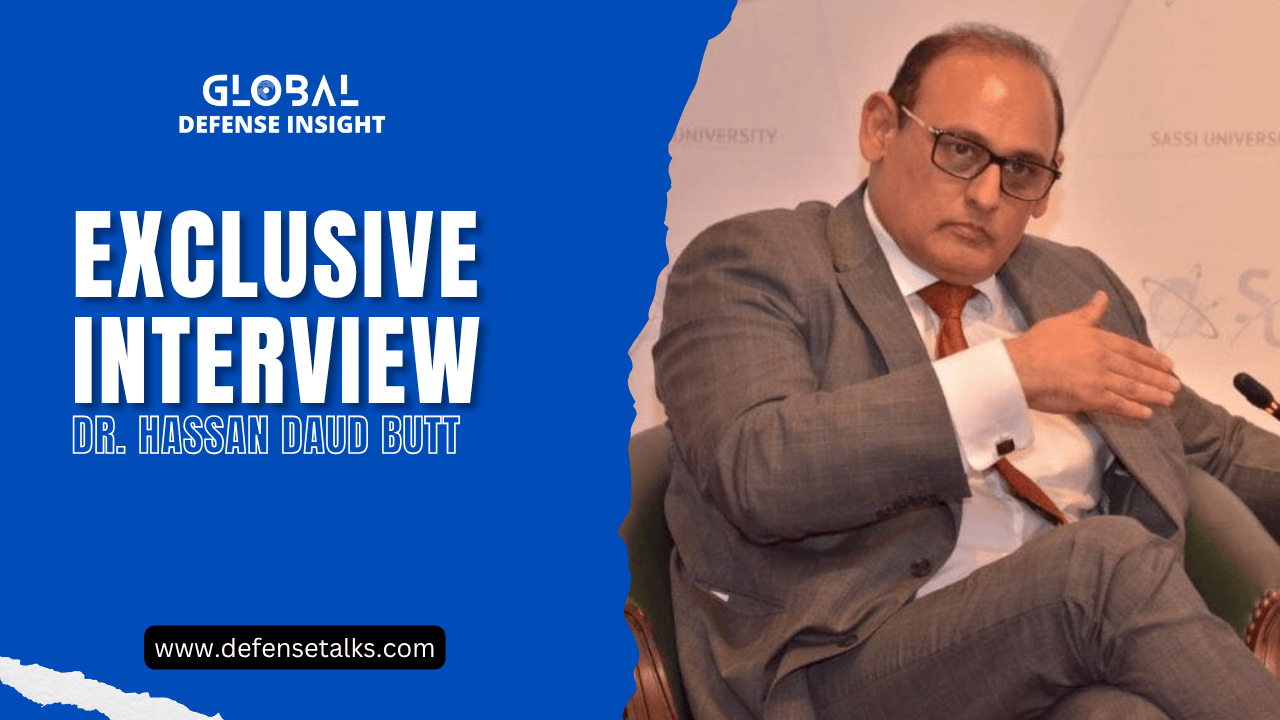

In an exclusive interview with Global Defense Insight, Dr. Hassan Daud Butt shared his expert insights on the evolving trajectory of the China-Pakistan Economic Corridor (CPEC), investment facilitation, and Pakistan’s strategic positioning within the Belt and Road Initiative (BRI). Drawing on his extensive experience in economic policy, international development, and regional integration, he outlined key opportunities, structural challenges, and the reforms required to strengthen Pakistan’s role in global value chains.
Dr. Butt currently serves as Senior Associate Professor at Bahria University, Islamabad, and Senior Advisor to China Energy Engineering Corporation (CEEC) Pakistan. With a distinguished career spanning roles as Project Director of CPEC, CEO of the Board of Investment, and leadership positions in SEZ development, he has also contributed as a consultant to leading international organizations including USAID, IFC, and the UK FCDO, bringing both academic depth and practical expertise to the discussion.
1. How do you assess the current trajectory of CPEC, and what adjustments are needed?
The trajectory of the China-Pakistan Economic Corridor (CPEC) can only be viewed in phases rather than short-term expectations. Over the past decade (2013–2025), Phase I was aimed at addressing Pakistan’s structural bottlenecks, delivering tangible and measurable outcomes. CPEC generated over 200,000 employment opportunities, increased power generation capacity by almost 6000MW, and developed nearly 886km of power transmission lines, thereby alleviating the constant energy crisis being faced by Pakistan. In parallel, around 500–800 km of road infrastructure was constructed, enhancing rural-urban integration and strengthening regional connectivity.
We must also realize that CPEC represents more than just infrastructure development; it signifies a strategic shift in Pakistan’s development approach from a primarily geo-strategic orientation to a geo-economic framework by integrating the country with regional and global markets. A key dimension of this shift is the development of the blue economy, centered in Gwadar Port. Improved connectivity, notably through the Makran Coastal Highway and establishment of Gwadar International Airport, funded by a Chinese grant of approximately $230 million, has enhanced Pakistan’s potential as a key maritime and logistics hub. The ongoing crises in the Strait of Hormuz is further strengthening this aspect.
CPEC has also strengthened bilateral trade between Pakistan and China. Pakistan’s exports to China increased by over 35%, rising from approximately $2.65 billion in 2013 to $3.59 billion in 2021. Sector-specific gains include a 50% rise in sesame exports, nearly 40% growth in seafood exports, and rice exports surpassing the 1-million-ton mark.
However, geopolitical volatility, especially in the Middle East, has disrupted traditional trade and energy routes, with over 20% of oil imports affected. This makes alternative corridors like CPEC increasingly important.
Despite progress, Phase II faces challenges such as investor confidence, security concerns, institutional capacity, and policy consistency. Gwadar Port remains underutilized compared to regional competitors like Jebel Ali and Port of Salalah. Similarly, SEZ progress has been slow due to bureaucratic delays, unclear tax policies, and high energy costs.
Moving forward, Pakistan must shift towards value-added exports, agro-processing, technology expansion, and emerging sectors, ensuring that infrastructure translates into sustainable economic growth.
2. What are the bottlenecks in SEZ operationalization?
Delays in SEZ operationalization stem from both administrative inefficiencies and structural issues. Apart from Rashakai SEZ, most zones have not become fully operational. External factors such as COVID-19 and security concerns also slowed progress by restricting investor movement.
Key challenges include:
- Fragmented governance
- Slow approvals
- Inconsistent utilities
- Weak investor facilitation
More importantly, many SEZs lack a distinct value proposition. They do not offer plug-and-play infrastructure, predictable regulations, or strong export facilitation mechanisms.
Pakistan must adopt a facilitating state model, focusing on targeted sectors aligned with comparative advantage, supported by coordinated infrastructure and policy frameworks. Without this, SEZs risk becoming underutilized industrial estates rather than drivers of transformation.
3. What are the most persistent challenges foreign investors face in Pakistan?
Major challenges include:
- Policy uncertainty
- Slow approval processes
- Fragmented regulations (post-18th Amendment)
- Weak institutional coordination
Modern investors prioritize stability, predictability, and ease of doing business over temporary incentives.
Global trends like nearshoring and friend-shoring present opportunities for Pakistan, especially through Gwadar connectivity. However, SEZs must evolve into integrated business ecosystems, offering:
- Pre-serviced land
- Reliable utilities
- Fast digital infrastructure
- One-window regulatory systems
- Strong legal protections
Without this transformation, Pakistan risks missing opportunities to integrate into global value chains.
4. How can Pakistan reform its regulatory and institutional frameworks?
Reform challenges stem from lack of coordination and weak policy implementation. The Special Investment Facilitation Council (SIFC), established in June 2023, aims to address this by providing a unified platform for decision-making.
This marks a shift toward implementation-driven governance, focusing on project execution rather than announcements.
Pakistan must adopt a sector-focused strategy, prioritizing areas where it has natural advantages such as:
- IT services
- Manufacturing
- Minerals
- Tourism
- Agriculture
Regulatory reforms should include:
- Clear investment policies
- Simplified legal frameworks
- PPP models
- Environmental safeguards
5. How can Pakistan position itself within the BRI?
Pakistan holds a strategic position in the Belt and Road Initiative (BRI), acting as a key connectivity hub. Since its launch in 2013, BRI has surpassed $1 trillion in investments, spanning over 3,000 projects globally.
CPEC remains the flagship corridor, providing China access to the Arabian Sea and reducing reliance on the Strait of Malacca.
However, competition is increasing, with countries like Vietnam and Indonesia offering stronger industrial ecosystems.
To remain competitive, Pakistan must:
- Move beyond transit economy to production hub
- Focus on sectors like EVs, electronics, agriculture, and logistics
- Utilize Gwadar as a transshipment hub
Industrial growth requires:
- Strong FDI inflows
- Clean-tech ecosystems
- Skilled workforce development
- Academia-industry collaboration
Ultimately, Pakistan must convert its geographical advantage into industrial competitiveness, becoming an active participant in global value chains rather than just a transit corridor.