
Following the end of the crisis between India and Pakistan in May 2025, a so-called “navy-first” logic has been gaining prominence in the Indian military sphere. This change has unfolded in the wake of what was generally seen as a circumstantial defeat in May 2025 conflict. Such a touching view came into the view by the Indian Defense Minister Rajnath Singh’s statement who said that “Next time, the opening will be done by our navy”. It was a politically confident remark but creating no strategic sobriety. It is impossible to avoid feeling that Indian leadership is in the grip of hyper-nationalistic chest-thumping, which is disorienting strategic analysis with theatrical determination.
This is evident by historical facts. Back in 2019 Indo-Pak crisis, when two Indian fighter jets were shot down by Pakistan Air Force, the then PM of India stated, “had the rafale jets been there (with the IAF), the result would have been different.” Similar statements were given regarding S-400 long-range air-defense system. But when crisis erupted again May 2025, it was once again Indian Air Force which was collecting the wreckage of its multiple fighter aircrafts, including prestigious Rafale fighter jets downed by Pakistan Air Force in one of the largest beyond-visual-range combat in history. Similarly, the highly appreciated S-400 battery, which was supposed to deny Indian airspace to Pakistan, was also put out-of-action when its radar was knocked out by Pakistan Air Force. Considering these examples, gauging combat prowess of Indian Armed Forces, including Indian Navy, purely from numerical strength or technical capabilities of its military equipment, is a defective practice to say the least.
Thus, recent political assertion by Indian leadership can be dismissed as bravado, but taken at face value, is strategically near-impossible, militarily suicidal, and politically inexcusable. The mythic notion about supposed ‘naval supremacy’ that is pervading the thinking of the Indian strategic planners is a grossly unsound fiction. Indian planners seem to be lost in what can be called ‘stuck-in-history syndrome,’ which highlights certain ‘successes’ of the past and creates misperceptions about once’s own capabilities as well as the potential of the opponent. The 1971 war between India and Pakistan is often used as the rationale behind New Delhi’s self-imposed confidence in naval front. But this comparison is no longer valid in contemporary era.
In 1971, Pakistan was limited in its naval prowess not by the innate brilliance of the Indian Navy. Yes, the relative numerical and technological differences were an important variable, albeit not the defining one. Instead, this was a combination of political inertia, ineffective internal decision making, and domestic strife that negatively affected the operational capacity of the Pakistan Navy to a great extent. This past is still being retroactively idealized by New Delhi to produce a history of structural supremacy, which no longer exists.
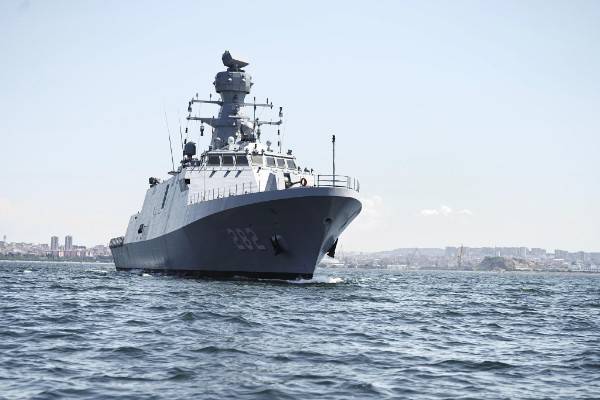
Fast-forward to the episode of May 2025 and the myth is more unpacked. Although rhetoric was aggressive, the so-called prestigious INS Vikrant – the indigenously developed air-craft carrier of India, remained at least 300 nautical miles off the Karachi coast. It was not a chance distance, nor did it emanate from goodwill restraint. It was predetermined by the threat perception. We are living in the age of long-range missiles, and proximity, particularly in naval domain is powerlessness. The naval warfare has been completely transformed by long-range vectors, integrated real time ISR, unmanned systems, and artificial intelligence (AI), for effective conduct of multi-domain operation in a network centric environment. The carrier-centric prestige which was the stamp of dominance previously has turned into a liability in narrow seas like the Arabian Sea. This is even more dangerous when it is to be executed against the state of just 1001 kms of coastline and is able to greatly militarize the area. It is proportional to: smaller the area, the greater is the firepower – which equals the increased vulnerability of the larger-sized warships, particularly a conventionally powered aircraft carrier.
This poses an inherent contradiction, that unless India runs the risk of a more maritime posture when a real crisis occurs, how does a ‘Navy First’ opening come to pass so abruptly in the future? It is not the strategy that answers the question, but rather psychology.
There is confusion in Indian strategic discourse today on deterrent signaling and operational viability. Politicians tend to believe that an escalation through sea is a more secure, less unpredictable rung than one through air and land. This is a precariously false assumption. Naval warfare is not a source of escalation control; it undermines it. The hostilities are no longer bilateral or limited when the maritime assets are turned into the means of their start. Sea routes, ports, energy, and commercial ships are immediately involved.
In contrast to air skirmishes or localized exchange on the ground, the maritime conflict through default internationalizes the crisis. Insurance rates increase more rapidly than ceasefire solutions. Energy markets respond more quickly than diplomats sitting down. Such an escalation would be disastrous in the South Asian situation, where both India and Pakistan are economically weak and regionally involved.
In addition, the Indian planners do not fully understand the naval prowess of Pakistan. Pakistan does not want sea control; it wants sea denial. This differentiation is important. Sea denial is asymmetric, economically effective, and escalatory in nature. Submarines, anti-ship missiles, naval mines, unmanned systems, and saturation tactics are all enough to make a disproportionate burden on a numerically large navy. Consider the fact, since the invasion of Ukraine or what Moscow termed as a ‘special military operation’ has started, it has left nearly 1/3rdof Russian Black Sea Fleet out of commission by Ukrainian military, through the use of a myriad of inexpensive drones, ballistic missiles, and precision cruise missiles. The innovative pioneer in this kind of environment does not take initiative but rather takes on risky elements.
A ‘Navy-First’ initiation would thus give Pakistan the best battleground. It would shorten the period of escalation, minimize the decision-making buffers, and motivate the horizontal and vertical escalation. The party that feels it is exhibiting its own strength would in fact be triggering the strategic instability.
The political aspect plays a crucial role as well; this makes it impossible to defend a ‘naval opening.’ The Arabian Sea is not a detached battlefield. It is an especially important passage way to world trade, particularly global energy exports. Any interference would automatically constitute an invitation to foreign pressures, diplomatic backlash, economic repercussions, or even military intervention. What may be seen at home by Indian leaders as muscular deterrence would be seen abroad as reckless destabilization.
In the contemporary war, escalation dominance is no longer determined by purely military aspects. Equally crucial are diplomatic legitimacy, financial stability, and the ability to dictate the information. The doctrine of ‘navy-first’s compromises each of the three.
The statement of Rajnath Singh cannot be understood as a consistent war-fighting doctrine. It can be more aptly described as post-crisis compensation a bid to reclaim dominance in an area that has been assumed to be a safe haven, easy to manage and symbolically inclinations. There is a worse every-day lesson in history. Wars are oblivious to domains of choice. Political slogans have no power over escalation. Opponents fail to fit domestic narrative requirements.
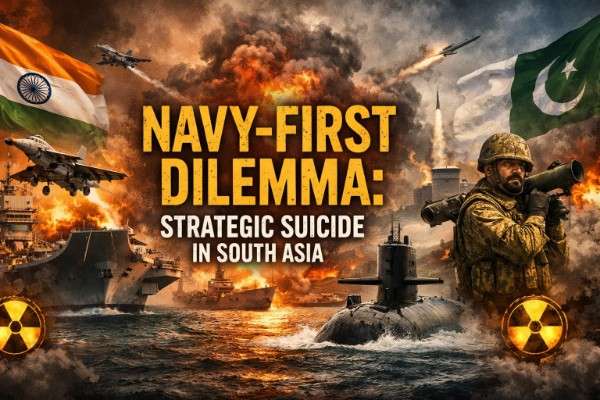
A ‘navy-first opening’ in South Asia will not show strength rather it will forfeit escalation control, invite asymmetric retaliation, internationalize the conflict, and compress decision-making time in a nuclearized environment. It is not strategy: its strategic suicide. If somehow, the conflict erupts and naval escalation follows, it will be the most cognitively irrational decision taken by India in recent times. Regime type, also indicate whether it will commence this way or not: the right-wing regime in India which relies lesser upon battlefield realities and more on the bravado-driven theatrical overplay, will in fact end up in a quagmire if election cycles or domestic upheaval need an external scapegoat. Whether after three years or more than three years after May 2025 crisis, there might be a new conflict, whenever election cycle, domestic upheaval needs ‘strongman’ narrative or external scapegoat. But it is evident in India’s case that the strategic rationality has been easily replaced by sentiment, symbolism and compensatory signaling in such post-crisis settings.


Muhammad Mahad Samija
Muhammad Mahad Samija is a student at the Government College (GC) University Lahore at the Department of Political Science. His Interest areas include great-power rivalry, geo-political and geo-strategic environment in the broader Eurasia and the greater Middle East. He can be contacted at muhammadmahadsamija@gmail.com