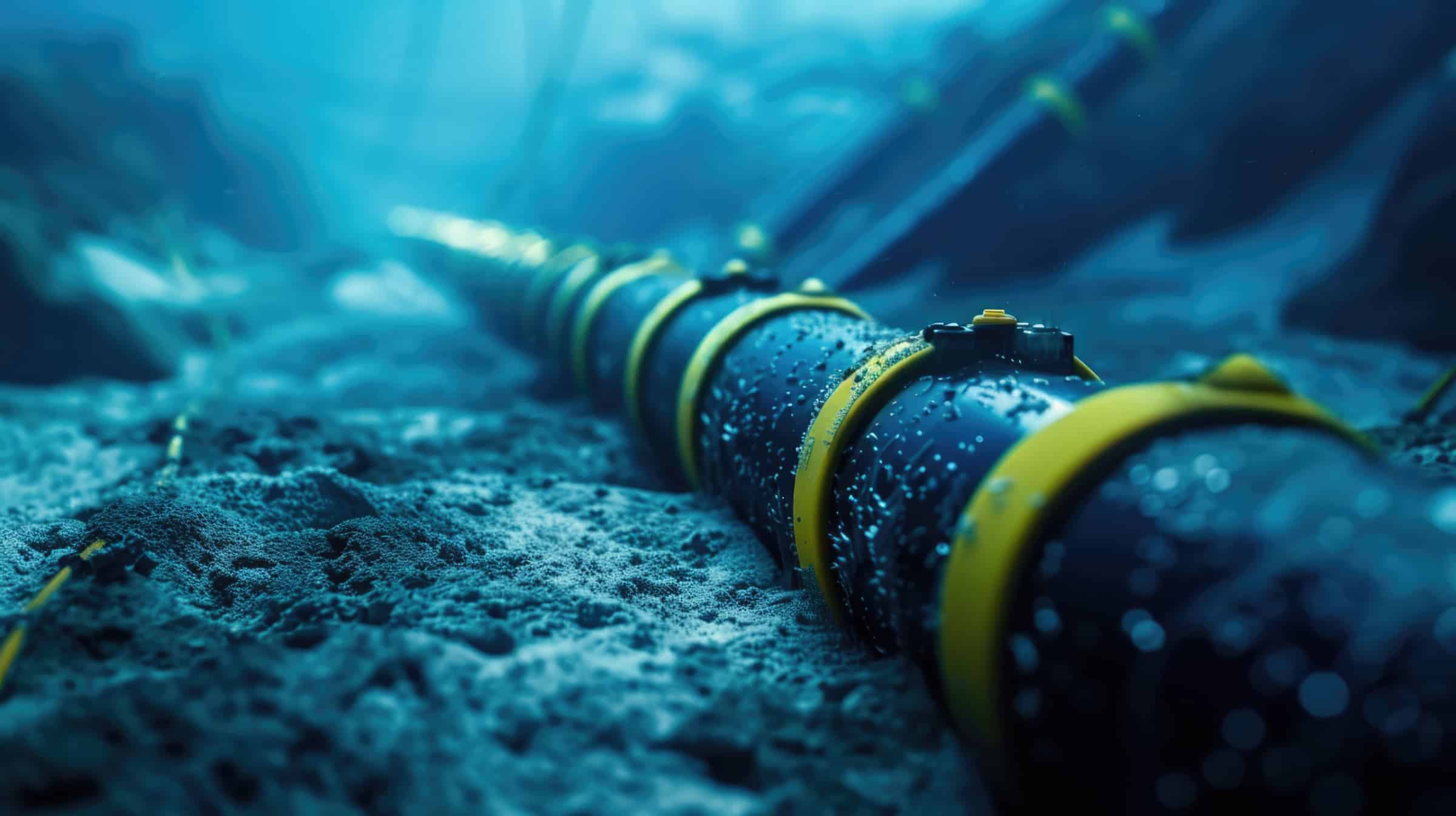

Beneath the world’s oceans lies one of the most consequential infrastructures of the modern era. Submarine fiber optic cables form the physical backbone of the global internet, transmitting an estimated 95 to 99 percent of international data traffic. Financial transactions, cloud computing, diplomatic communications, and routine digital interactions all depend on these undersea systems. Yet the infrastructure that sustains the digital economy remains physically exposed, lightly regulated in some jurisdictions, and increasingly entangled in geopolitical competition.
Recent incidents in strategic maritime regions have drawn attention to the vulnerability of submarine cable networks. Damage to cables in the Red Sea and suspected sabotage incidents in the Baltic Sea have illustrated how localized disruptions can threaten global connectivity. At the same time, advances in monitoring technology, evolving regulatory frameworks, and intensifying strategic rivalry among major powers are reshaping the politics of submarine cable governance. Ensuring the resilience of global digital connectivity now requires coordinated policy responses that extend well beyond engineering solutions.
The New Geopolitical Competition over Submarine Cables:
Submarine cable infrastructure has increasingly become a theatre of strategic competition between the United States and China, with both state actors and corporate entities seeking to shape control over global data routes and digital traffic. Chinese firms, most notably Huawei Marine and other state‑linked carriers such as China Telecom, China Unicom, and China Mobile, have been active in laying and owning submarine cables across Asia, Africa, and beyond, leveraging initiatives like the Digital Silk Road to expand their footprint. According to research on strategic technology competition, China’s integration of cable deployment with broader economic diplomacy has eroded some Western dominance in cable construction and attracted partners in emerging markets, even as it raised concerns among policymakers about dependency, surveillance risk, and strategic leverage over global communications pathways.
In response, the United States has sought to limit Chinese involvement in critical undersea infrastructure while promoting alternative cable routes and trusted suppliers, often in coordination with allied states. U.S. regulators such as the Federal Communications Commission have proposed rules to bar submarine cables containing specified Chinese technologies from connecting to the United States on national security grounds, a reflection of broader efforts to decouple sensitive data infrastructure from Chinese influence. At the same time, American technology companies including Google, Meta, Microsoft, and Amazon deploy private high‑capacity cables that both secure network performance for hyper scale services and reinforce U.S. geopolitical interests by establishing control over key routes. These developments suggest that submarine cables, once viewed as neutral conduits of data, are now regarded as strategic assets instrumental in shaping alignments, dependencies, and digital sovereignty in the era of great‑power rivalry
Grasping the Political Economy of Submarine Cables:
Unlike many other forms of critical infrastructure, submarine cable systems are predominantly financed and operated by private firms. Historically, international telecommunications carriers funded cable construction through cooperative consortia. In recent years, however, global technology companies have become central actors in this sector. Firms such as Google, Meta Platforms, and Microsoft increasingly function as anchor tenants in cable projects because their cloud services and data platforms require enormous international bandwidth.
These firms often underwrite a substantial share of construction costs while telecommunications providers purchase capacity on the completed cables. The arrangement reflects the economic incentives of hyper scale data providers, which benefit directly from reliable and high capacity international connectivity. As a result, private sector investment has significantly expanded global bandwidth and improved redundancy in major network corridors. The figure of this investment is calculated to increase to more than 13 Billion dollars by 2027.
Nevertheless, the geography of cable deployment remains uneven. Remote island states and many developing economies remain dependent on limited connectivity because private investment tends to concentrate in regions with high traffic volumes and predictable commercial returns. Building a submarine cable to a small market with modest data demand is often financially unattractive. Consequently, structural inequalities in global connectivity persist despite rapid growth in digital infrastructure.
Public private partnerships have begun to address this gap. Recent projects linking Pacific Island nations to global networks have combined development finance with private sector participation. These initiatives demonstrate how international development institutions and national governments can mobilize private capital to expand digital infrastructure. However, many analysts argue that existing policy tools remain insufficiently aligned with the scale of the challenge.
New Technologies and their Sub-Sea Dilemma:
Recent technological advances offer promising tools for strengthening cable security. Modern optical transmission systems generate extensive diagnostic information as signals propagate through fiber optic networks. Digital signal processors analyze distortions in the light signal in order to maintain transmission quality. These distortions also contain information about physical disturbances along the cable route.
When analyzed carefully, such data can reveal whether a disturbance was caused by marine life, geological activity, or the passage of a vessel. Technologies such as distributed acoustic sensing enable fiber optic cables to function as continuous sensing arrays capable of detecting acoustic and vibrational signals along their length. In many cases, these monitoring capabilities can be deployed without altering the cable itself. Equipment installed at landing stations can analyze signal variations and identify disturbances along the entire transmission path. Marine scientists have already used such techniques to track whale movements with remarkable precision, including estimates of direction and velocity based on acoustic signatures. The implications extend beyond cable protection. Fiber-optic sensing could support marine science, earthquake detection, and naval monitoring, effectively transforming telecommunications infrastructure into a distributed environmental observatory.
However, these capabilities also raise legal and diplomatic questions. International maritime law, particularly the framework established by the United Nations Convention on the Law of the Sea, protects submarine cables as communications infrastructure. If cables incorporate sensing technologies that extend beyond communications, states may debate whether such systems fall within existing legal definitions.
Technological innovation is therefore advancing faster than the regulatory regimes that govern submarine infrastructure. Policymakers will likely confront complex questions regarding privacy, surveillance, and environmental monitoring as sensing technologies become more widespread.
Legal Deterrence and Infrastructure Protection
Despite their strategic importance, submarine cables remain vulnerable to accidental damage. Fishing equipment and ship anchors account for the majority of cable faults worldwide according to the International Cable Protection Committee. Although deliberate sabotage is less common, recent geopolitical tensions have heightened concerns about intentional interference.
More effective protection will likely require a combination of improved monitoring, coordinated maritime enforcement, and updated legal frameworks. Even modest investigative scrutiny can influence behavior. Investigations into suspicious cable incidents in Northern Europe have reportedly encouraged shipping operators to adopt more cautious anchoring practices. However, detection alone does not guarantee rapid intervention. Governments must also develop operational mechanisms that allow maritime authorities to respond quickly when cable networks appear to be threatened.
The Limits of Satellite and other Space Based Alternatives
The expansion of low Earth orbit satellite constellations has prompted speculation that satellite networks might eventually replace submarine cables. Systems operated by companies such as SpaceX have demonstrated the capacity to provide connectivity in remote or conflict affected environments. During the ongoing war in Ukraine, satellite communications have played an important role in sustaining digital connectivity.
Nevertheless, submarine cables remain vastly more efficient for large scale data transmission. Fiber optic cables can transmit terabits of data per second at far lower cost per transmitted bit than satellite systems. Moreover, cables can carry more terabits of data per second, far exceeding the capacity of most satellite links.
Estimates suggest that satellite connectivity remains orders of magnitude more expensive for high volume traffic. Consequently, cables will continue to form the core infrastructure of global data exchange for the foreseeable future.
Satellite systems therefore function primarily as complementary technologies. They provide resilience during emergencies and extend connectivity to regions where cable deployment is impractical. A robust digital ecosystem depends on the interaction of both systems rather than the substitution of one for the other.
Securing the Foundations of the Digital Economy and Pakistan:
The submarine cable network is frequently described as the backbone of the global internet. Yet governance of this infrastructure remains fragmented across private companies, national regulators, and international institutions. Protecting submarine cables requires recognition that they constitute both commercial assets and strategic infrastructure.
For Pakistan safeguarding these fragile arteries of connectivity is therefore an essential task for policymakers. Pakistan lies at the maritime horn of Indian ocean, Red sea and the strait of Hormuz, serving a node for multiple trans-oceanic data cables that are vital for global data transmission. Many of these cables make landfall in Karachi. The main ones include Asia‑Africa‑Europe‑1 (AAE‑1), SEA‑ME‑WE 4 (South East Asia–Middle East–Western Europe 4), MEWE (India–Middle East–Western Europe), PEACE Cable (Pakistan and East Africa Connecting Europe) etc. Despite several landing systems, Pakistan’s redundancy remains limited compared to more diversified networks in other countries. For example, India’s multiple landing stations and broader cable footprint help buffer against isolated faults, whereas Pakistan’s main cable endpoints are largely concentrated in Karachi.
Similarly, the country has also suffered data outages due to submarine cables, especially the AEE-1 being affected elsewhere that resulted in broadband outages which in turn cost millions to Pakistani consumers in losses as the country hosts a large number of digital service providers and freelancers. It takes weeks to identify and repair the damages to these cables during which bandwidth speeds remained very low.
Three policy priorities are particularly important. Government should modernize legal frameworks in order to reflect the strategic significance of submarine cables and establish meaningful penalties for interference. Regulatory procedures should be transparent and predictable so that national security concerns can be addressed without discouraging infrastructure investment. Finally, international cooperation must expand beyond declaratory statements toward operational coordination on monitoring systems, supply chains, and maritime enforcement.

Hammad Waleed is a Research Associate at Strategic Vision Institute, Islamabad. He graduated with distinction from National Defence University, Pakistan. He writes on issues pertaining National Security, Conflict Analysis, Strategic forecast, and Public Policy. He can be reached at hammadwaleed82@gmail.com.