
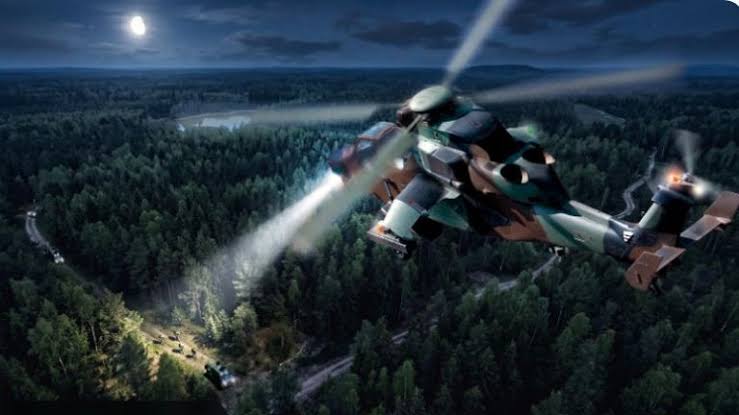

Thales has introduced a new-generation Search and Landing Light system designed to improve visibility, situational awareness, and mission flexibility for helicopter crews operating in demanding environments.
Announced on July 3, 2026, the new high-power Search and Landing Light, or SLL, is intended for military, security, search-and-rescue, medical evacuation, maritime recovery, and civil aviation missions. The system combines native 360-degree swiveling coverage, a compact flush-mounted design, and a software-defined connected architecture, allowing helicopter crews to tailor illumination according to mission requirements.
For helicopter operators, lighting is not simply a support function. In night operations, degraded visual environments, maritime recovery missions, mountain rescue operations, and tactical insertions, illumination can directly affect crew safety, mission timing, and the ability to identify personnel, obstacles, landing zones, or recovery points. Thales’ new SLL is designed to address these operational demands by giving crews unrestricted lighting coverage without requiring the aircraft to reposition.
Table of Contents
ToggleConnected Architecture Supports Crew Coordination
A key feature of the new system is its ability to connect with onboard mission systems, including Forward-Looking Infrared systems, helmet-mounted displays, and multifunction displays. This integration is intended to improve situational awareness and help pilots, co-pilots, and mission specialists coordinate more effectively during complex operations.
The system can be controlled by different crew members depending on the mission profile. In search-and-rescue scenarios, the pilot, co-pilot, or hoist operator can manage one or multiple lights to keep survivors, rescue teams, or landing zones illuminated throughout the mission. This is especially important in operations over mountains, forests, snow-covered terrain, or maritime environments, where visibility conditions can change rapidly.
Search-and-Rescue and Medical Evacuation Applications
For search-and-rescue missions, the SLL allows rapid area scanning and more precise survivor detection during night operations. Its 360-degree coverage means crews can continue illuminating a target area even as the aircraft changes position, reducing the need for repeated manoeuvres and helping accelerate rescue timelines.
During hoisting, medical evacuation, and maritime recovery missions, the system provides stable illumination of the rescue zone. Independent control by the winch or hoist operator allows the light to follow the rescue operation in real time. This can improve visibility for both airborne crews and rescue personnel on the ground or at sea, supporting safer and more efficient recovery operations in degraded visual environments.
Tactical Value for Military Helicopter Missions
Beyond civil and rescue applications, Thales has positioned the new Search and Landing Light as a mission-enabling technology for military aviation. In tactical environments, the SLL can support infiltration, exfiltration, special operations, and other low-light missions where helicopter crews require controlled illumination while minimizing detectability.
The system includes covert operating modes with extremely low infrared detectability, helping reduce the aircraft’s visual and infrared signature. This feature is particularly relevant for operations in contested or sensitive environments, where helicopters must maintain tactical awareness without exposing their position unnecessarily.
Industrial Role and French Production
Thales is responsible for the design of the complete optical assembly for the high-power LED-based lighting subsystem. The company is also handling integration, assembly, and testing of the full system at its facilities in Dourdan, France.
According to Nicolas Bonleux, Vice President for Aerospace Communications at Thales, the system was developed with helicopter crews operating under demanding conditions in mind. He said the new Search and Landing Light gives operators greater flexibility, enhanced mission effectiveness, and the ability to adapt to a wide range of operational scenarios from a single system.
Strategic and Operational Significance
The introduction of Thales’ new SLL reflects a broader trend in rotary-wing mission systems: the shift from standalone equipment toward connected, software-defined, and mission-adaptable subsystems. Helicopter operators increasingly require technologies that can support multiple mission sets without adding excessive weight, complexity, or crew workload.
For defense forces, emergency services, and civil aviation operators, advanced lighting systems can improve night mission effectiveness, reduce risk during hoisting or landing operations, and enhance performance in environments where visual references are limited. By integrating with FLIR, helmet-mounted displays, and multifunction displays, Thales’ new system also aligns with the growing demand for greater sensor fusion and crew-level coordination in modern helicopter operations.
The SLL’s relevance is particularly strong for armed forces and security agencies that rely on helicopters for special operations, border security, maritime patrol, casualty evacuation, disaster response, and counterterrorism support. In these missions, visibility, survivability, and rapid decision-making remain central to mission success.












